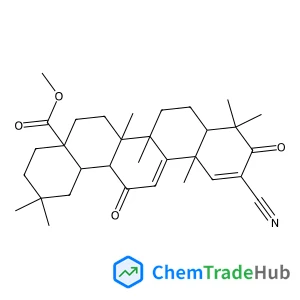
Methyl 2-cyano-3,12-dioxooleana-1,9(11)-dien-28-oate
CAS Number:
218600-53-4
Molecular Formula:
C32H43NO4
Zhijie Chen, Wei Wei, Ho Kyong Shon
Recently, urea electrolysis has become an attractive method for sustainable energy-saving hydrogen production and simultaneous pollutant degradation. To improve urea electrolysis efficiency and simplify electrolysis systems, developing efficient bifunctional electrocatalysts has attracted great interest. Recently, great achievements have been made in the design of high-performance bifunctional catalysts for urea electrolysis. In this review, the current progress in bifunctional catalysts for urea electrolysis is comprehensively analyzed. The fundamentals and catalyst design principles for urea electrolysis are first discussed. Then, the applications of advanced bifunctional catalysts in urea electrolysis are fully demonstrated, such as single atom catalysts (SACs), metal nanoparticles, alloys, metal (hydr)oxides, chalcogenides, pnictides, metal–organic frameworks (MOFs), and composites. The structure–performance correlation of catalysts as well as their design strategies are emphasized. Current catalysts are also evaluated in terms of their catalytic activities, providing insights into the sensible design of high-performance bifunctional electrocatalysts. Several key perspectives are outlined to guide further studies on practical urea electrolysis-driven sustainable hydrogen production and urea-rich wastewater management.
Ziyun Wang, Christopher Hardacre, Wen-Feng Lin
DOI: 10.1039/C6CP06906A
Kaiqi Wu, Wenfei Li, Lu Yu, Wei Tong, Yue Feng, Shenglong Ling, Longhua Zhang, Xiao Zheng, Maojun Yang
DOI: 10.1039/C6CP08107J
Lingyun Zhu, Hua Geng, Yuanping Yi, Zhixiang Wei
DOI: 10.1039/C6CP07417K
Noah M. Johnson, Yuriy Y. Smolin, Daniel Hagaman, Masoud Soroush, Kenneth K. S. Lau, Hai-Feng Ji
DOI: 10.1039/C6CP07853B
Thomas J. McDonough, Lushuai Zhang, Susmit Singha Roy, Nicholas M. Kearns, Michael S. Arnold, Martin T. Zanni
DOI: 10.1039/C6CP06454J
Shimon Vega
DOI: 10.1039/C6CP07881H
I. Arrechea-Marcos, M. J. Mancheño, M. C. Ruiz Delgado, M. M. Ramos, J. A. Quintana, J. M. Villalvilla, M. A. Díaz-García, J. T. López Navarrete, R. Ponce Ortiz, J. L. Segura
DOI: 10.1039/C6CP06819G
Xiaoli Sun
DOI: 10.1039/C6CP07690D
When handling 4-(2-Furylmethyl)thiomorpholine 1,1-dioxide (CAS: 79206-94-3), it ...
When handling 4-Chloro-N-[2-(4-morpholinyl)ethyl]benzamide (CAS: 71320-77-9), it...
Waste containing this compound (CAS: 62921-74-8) should be handled according to ...
Waste containing (S)-Methyl 2-amino-3-cyclohexylpropanoate should be collected i...
This compound can be synthesized using a multi-step process involving the conjug...
There are several alternatives to (2E)-3-(3,4-Dichlorophenyl)acrylic acid in syn...
Ethyl 6-(2-nitrophenyl)imidazo[2,1-b][1,3]thiazole-3-carboxylate (CAS: 925437-84...
Waste containing 2-(1,3-Thiazol-2-yl)ethanamine (CAS: 18453-07-1) should be coll...
Methyl 5-iodo-2-methylbenzoate can be synthesized through the iodination of meth...
5-Chloro[1,2,4]triazolo[1,5-a]pyridine is commonly synthesized via the condensat...

Green Chemistry provides a unique forum for the publication of innovative research on the development of alternative green and sustainable technologies. The scope of Green Chemistry is based on, but not limited to, the definition proposed by Anastas and Warner (Green Chemistry: Theory and Practice, P T Anastas and J C Warner, Oxford University Press, Oxford, 1998). Green chemistry is the utilisation of a set of principles that reduces or eliminates the use or generation of hazardous substances in the design, manufacture and application of chemical products. Green Chemistry is at the frontiers of this continuously-evolving interdisciplinary science and publishes research that attempts to reduce the environmental impact of the chemical enterprise by developing a technology base that is inherently non-toxic to living things and the environment. Submissions on all aspects of research relating to the endeavour are welcome. The journal publishes original and significant cutting-edge research that is likely to be of wide general appeal. To be published, work must present a significant advance in green chemistry. Papers must contain a comparison with existing methods and demonstrate advantages over those methods before publication can be considered. For more information please see this Editorial. Coverage includes the following, but is not limited to: Design (e.g. biomimicry, design for degradation/recycling/reduced toxicity…) Reagents & Feedstocks (e.g. renewables, CO2, solvents, auxiliary agents, waste utilization…) Synthesis (e.g. organic, inorganic, synthetic biology…) Catalysis (e.g. homogeneous, heterogeneous, enzyme, whole cell…) Process (e.g. process design, intensification, separations, recycling, efficiency…) Energy (e.g. renewable energy, fuels, photovoltaics, fuel cells, energy storage, energy carriers…) Applications (e.g. electronics, dyes, consumer products, coatings, pharmaceuticals, preservatives, building materials, chemicals for industry/agriculture/mining…) Impact (e.g. safety, metrics, LCA, sustainability, (eco)toxicology…) Green chemistry is, by definition, a continuously-evolving frontier. Therefore, the inclusion of a particular material or technology does not, of itself, guarantee that a paper is suitable for the journal. To be suitable, the novel advance should have the potential for reduced environmental impact relative to the state of the art. Green Chemistry does not normally deal with research associated with 'end-of-pipe' or remediation issues.