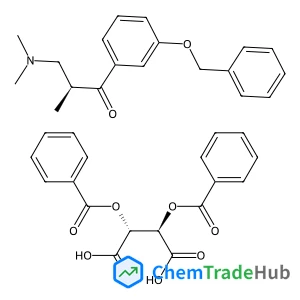
(S)-1-(3-(Benzyloxy)phenyl)-3-(dimethylamino)-2-methylpropan-1-one (2r,3r)-2,3-bis(benzoyloxy)succinate
CAS Number:
1004315-81-4
Molecular Formula:
C37H37NO10
Kai Ren, Lei Huang, Huabing Shu, Guoqiang Zhang, Weihua Mu, Huanping Zhang, Huasong Qin, Gang Zhang
Defect engineering has been considered as an effective way for controlling the heat transport properties of two-dimensional materials. In this work, the effects of point vacancies and grain boundaries on the mechanical and thermal performances of SiC and GeC monolayers are investigated systematically by molecular dynamics calculations. The failure strength in SiC and GeC is decreased by introducing vacancies at room temperature, and the stress–strain relationship can be tuned significantly by different kinds of vacancies. When the grain boundary of 21.78° is applied, the maximal fracture strengths can be as large as 27.56% for SiC and 23.56% for GeC. Also, the thermal properties of the two monolayers show a remarkable dependence on the vacancies and grain boundaries. The high vacancy density in SiC and GeC can induce disordered heat flow and the C/Ge point defect is crucial for thermal conductivity regulation for the Si/GeC monolayer. More importantly, the SiC and GeC monolayers with a grain boundary of 5.09° show excellent interfacial thermal conductance. Our findings are of great importance in understanding SiC and GeC monolayers and seeking their potential applications.
Nana Sun, Bing Yan
DOI: 10.1039/C7CP00631D
Zhengjian Chen, Yanan Huo, Panfeng Long, Hujun Shen, Jong-Min Lee
DOI: 10.1039/C6CP08876G
L. Pavasaryte, A. Katelnikovas, V. Klimavicius, V. Balevicius, A. Krajnc, G. Mali, J. Plavec, A. Kareiva
DOI: 10.1039/C6CP07723D
DOI: 10.1039/C7CP01310H
G. Attilio Ardizzoia, Stefano Brenna
DOI: 10.1039/C6CP07793E
Jefferson Esquina Tsuchida, Fabio Aparecido Ferri
DOI: 10.1039/C6CP07876A
Wei-Qing Huang, Zhong Xie, Wangyu Hu, Ping Peng, Gui-Fang Huang
DOI: 10.1039/C6CP08853H
Congcong Wang, Benjamin R. Ecker, Haotong Wei, Jinsong Huang, Jian-Qiao Meng, Yongli Gao
DOI: 10.1039/C6CP07176G
Ahreum Min, Ahreum Ahn, Cheol Joo Moon, Ji Hoon Lee, Yeon Guk Seong, Seong Keun Kim, Myong Yong Choi
DOI: 10.1039/C6CP06863D
2-Methylbenzene-1,4-diamine dihydrochloride (CAS: 615-45-2) should be stored in ...
(1S,4S)-2,5-Diazabicyclo[2.2.1]heptane dihydrobromide is generally considered sa...
(6-Chloropyridazin-3-YL)methanamine finds applications in the pharmaceutical ind...
2-Fluoro-3-methylphenol is primarily used in the synthesis of pharmaceuticals, p...
When handling 3-Methoxy-4-nitrobenzonitrile, it is important to wear appropriate...
When handling 1,3-Oxazolo[4,5-b]pyridine-2(3H)-thione (CAS: 211949-57-4), it is ...
4-Ethynylbenzamide (CAS: 90347-86-7) falls under various regulatory guidelines i...
3-(2-Ethylphenyl)-2-thioxo-4-imidazolidinone is primarily used as an intermediat...
(2-Fluoro-6-methoxyphenyl)acetic acid, also known as 4-fluoro-3-methoxybenzoic a...
Market trends for 2-[4-(Hydroxymethyl)phenoxy]ethanol (CAS: 102196-18-9) indicat...

Physical Chemistry Chemical Physics (PCCP) is an international journal co-owned by 19 physical chemistry and physics societies from around the world. This journal publishes original, cutting-edge research in physical chemistry, chemical physics and biophysical chemistry. To be suitable for publication in PCCP, articles must include significant innovation and/or insight into physical chemistry; this is the most important criterion that reviewers and Editors will judge against when evaluating submissions. The journal has a broad scope and welcomes contributions spanning experiment, theory, computation and data science. Topical coverage includes spectroscopy, dynamics, kinetics, statistical mechanics, thermodynamics, electrochemistry, catalysis, surface science, quantum mechanics, quantum computing and machine learning. Interdisciplinary research areas such as polymers and soft matter, materials, nanoscience, energy, surfaces/interfaces, and biophysical chemistry are welcomed if they demonstrate significant innovation and/or insight into physical chemistry. Joined experimental/theoretical studies are particularly appreciated when complementary and based on up-to-date approaches.
![trans-2-{[(Tert-butoxy)carbonyl]amino}cyclobutane-1-carboxylic acid structure](https://static.chemtradehub.com/structs/951/951173-25-4-27cd.webp "trans-2-{[(Tert-butoxy)carbonyl]amino}cyclobutane-1-carboxylic acid structure")