












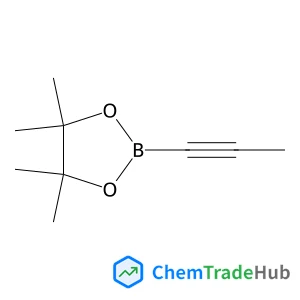
4,4,5,5-Tetramethyl-2-(1-propyn-1-YL)-1,3,2-dioxaborolane
CAS Number:
347389-75-7
Molecular Formula:
C9H15BO2
Qiaoqiao Li, Weibin Chu, Yi-min Ding, Luo Yan, Arup Neogi
Although the efficient separation of electron–hole (e–h) pairs is one of the most sought-after electronic characteristics of materials, due to thermally induced atomic motion and other factors, they do not remain separated during the carrier transport process, potentially leading to rapid carrier recombination. Here, we utilized real-time time-dependent density functional theory in combination with nonadiabatic molecular dynamics (NAMD) to explore the separated dynamic transport path within Ruddlesden–Popper oxysulfide perovskite Y2Ti2O5S2 caused by the dielectric layer and phonon frequency difference. The underlying origin of the efficient overall water splitting in Y2Ti2O5S2 is systematically explored. We report the existence of the bi-directional e–h separate-path transport, in which, the electrons transport in the Ti2O5 layer and the holes diffuse in the rock-salt layer. This is in contrast to the conventional e–h separated distribution with a crowded transport channel, as observed in SrTiO3 and hybrid perovskites. Such a unique feature finally results in a long carrier lifetime of 321 ns, larger than that in the SrTiO3 perovskite (160 ns) with only one carrier transport channel. This work provides insights into the carrier transport in lead-free perovskites and yields a novel design strategy for next-generation functionalized optoelectronic devices.
G. Attilio Ardizzoia, Stefano Brenna
DOI: 10.1039/C6CP07793E
Avijit Mondal, Kaushik Hatua, Ria Sinha Roy, Prasanta K. Nandi
DOI: 10.1039/C6CP07845A
Gregorio Laucirica, Waldemar A. Marmisollé, Omar Azzaroni
DOI: 10.1039/C6CP08793K
Niko Bärsch, René Streubel, Emine Gökce, Stephan Barcikowski, Bilal Gökce
DOI: 10.1039/C6CP07011F
Robert A. Lazenby, Kiran Bano, Jie Zhang, Alan M. Bond, Julie V. Macpherson, Patrick R. Unwin
DOI: 10.1039/C7CP00968B
Yuezhi Mao, Paul R. Horn
DOI: 10.1039/C6CP08039A
Hynek Němec, Karel Žídek, Mohammed J. Al-Marri, Pavel Chábera, Carlito Ponseca, Tönu Pullerits
DOI: 10.1039/C6CP07509F
Junjie Li, Deqiang Yin, Qiang Li, Rong Sun, Sumei Huang, Fanzhi Meng
DOI: 10.1039/C6CP07691B
Jamie C. Wang, Kyle Violette, Omotola O. Ogunsolu
DOI: 10.1039/C6CP07939C
Xiao-Fei Li, Lingling Liu, Qing Yan, Qin-Kun Li, Yunxiang Wang, Mingsen Deng, Qi Qiu
DOI: 10.1039/C6CP08357A
2-Methylbenzene-1,4-diamine dihydrochloride (CAS: 615-45-2) should be stored in ...
(1S,4S)-2,5-Diazabicyclo[2.2.1]heptane dihydrobromide is generally considered sa...
(6-Chloropyridazin-3-YL)methanamine finds applications in the pharmaceutical ind...
2-Fluoro-3-methylphenol is primarily used in the synthesis of pharmaceuticals, p...
When handling 3-Methoxy-4-nitrobenzonitrile, it is important to wear appropriate...
When handling 1,3-Oxazolo[4,5-b]pyridine-2(3H)-thione (CAS: 211949-57-4), it is ...
4-Ethynylbenzamide (CAS: 90347-86-7) falls under various regulatory guidelines i...
3-(2-Ethylphenyl)-2-thioxo-4-imidazolidinone is primarily used as an intermediat...
(2-Fluoro-6-methoxyphenyl)acetic acid, also known as 4-fluoro-3-methoxybenzoic a...
Market trends for 2-[4-(Hydroxymethyl)phenoxy]ethanol (CAS: 102196-18-9) indicat...

Physical Chemistry Chemical Physics (PCCP) is an international journal co-owned by 19 physical chemistry and physics societies from around the world. This journal publishes original, cutting-edge research in physical chemistry, chemical physics and biophysical chemistry. To be suitable for publication in PCCP, articles must include significant innovation and/or insight into physical chemistry; this is the most important criterion that reviewers and Editors will judge against when evaluating submissions. The journal has a broad scope and welcomes contributions spanning experiment, theory, computation and data science. Topical coverage includes spectroscopy, dynamics, kinetics, statistical mechanics, thermodynamics, electrochemistry, catalysis, surface science, quantum mechanics, quantum computing and machine learning. Interdisciplinary research areas such as polymers and soft matter, materials, nanoscience, energy, surfaces/interfaces, and biophysical chemistry are welcomed if they demonstrate significant innovation and/or insight into physical chemistry. Joined experimental/theoretical studies are particularly appreciated when complementary and based on up-to-date approaches.
![3-[(3R,4R)-3-[(6-aminopyrimidin-4-yl)-methyl-amino]-4-methyl-1-piperidyl]-3-oxo-propanenitrile structure](https://static.chemtradehub.com/structs/164/1640971-60-3-83a4.webp "3-[(3R,4R)-3-[(6-aminopyrimidin-4-yl)-methyl-amino]-4-methyl-1-piperidyl]-3-oxo-propanenitrile structure")
![(3R,4aR,7aS,9aR,10S,11R,13aR,13bS,15aS,15bR)-3,11-Dihydroxy-10-(hydroxymethyl)-4,4,7a,10,13a,15b-hexamethyl-1,2,3,4,4a,7,7a,8,9,9a,10,11,12,13,13a,13b,14,15,15a,15b-icosahydro-5H-naphtho[2',1':4,5]cyc
lohepta[1,2-a]naphthalen-5-one structure](https://static.chemtradehub.com/structs/538/53800-21-8-9f18.webp "(3R,4aR,7aS,9aR,10S,11R,13aR,13bS,15aS,15bR)-3,11-Dihydroxy-10-(hydroxymethyl)-4,4,7a,10,13a,15b-hexamethyl-1,2,3,4,4a,7,7a,8,9,9a,10,11,12,13,13a,13b,14,15,15a,15b-icosahydro-5H-naphtho[2',1':4,5]cyc
lohepta[1,2-a]naphthalen-5-one structure")






