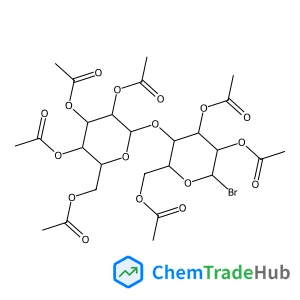
2,3,6-Tri-O-acetyl-4-O-(2,3,4,6-tetra-O-acetyl-beta-D-galactopyranosyl)-alpha-D-glucopyranosyl bromide
CAS Number:
4753-07-5
Molecular Formula:
C26H35BrO17
Meng Wang, Simin Li, Xiongkai Tang, Dongjie Zuo, Yanyuan Jia, Shuo Guo, Zong-Jie Guan, Hui Shen
Structurally precise metal nanoclusters with a facile synthetic process and high catalytic performance have been long pursued. These atomically precise nanocatalysts are regarded as model systems to study structure-performance relationships, surface coordination chemistry, and the reaction mechanism of heterogeneous metal catalysts. Nevertheless, the research on silver-based nanoclusters for driving chemical transformations is sluggish in comparison to gold counterparts. Herein, we report the one-step synthesis of Pt/Ag alloy nanoclusters of [PtAg9(C18H12Br3P)7Cl3](C18H12Br3P), which are highly active in catalysing cycloaddition reactions of CO2 and epoxides. The cluster was obtained in a rather simple way with the reduction of silver and platinum salts in the presence of ligands in one pot. The molecular structure of the titled cluster describes the protection of the Pt-centred Ag9 crown by the shell of phosphine ligands and halides. Its electronic structure, as revealed by density function theoretical calculations, adopts a superatomic geometry with 1S21P6 configuration. Interestingly, the cluster displays high activity in the formation of cyclic carbonates from CO2 under mind conditions.

Journal of Chemical Sciences

Bioorganic & Medicinal Chemistry

Bioorganic & Medicinal Chemistry Letters

Electroanalysis

Critical Reviews in Solid State and Materials Sciences

Topics in Catalysis

Acta Metallurgica Sinica-English Letters

Journal of the Indian Institute of Science

Journal of Asian Natural Products Research

Medicinal Chemistry Research
Grigory V. Zyryanov, Yanlong Kang, Stephen P. Stampp, Dmitry M. Rudkevich
DOI: 10.1039/B207901A
Fei Cheng, Longfang Ren, Tianyu Liang, Xiaoyang Gao, Baoshuai Wang
DOI: 10.1039/D1AN00208B
Toshikazu Kitagawa, Yangsoo Lee, Masaaki Hanamura, Harumi Sakamoto, Hirofumi Konno, Ken’ichi Takeuchi, Koichi Komatsu
DOI: 10.1039/B210126B
Danielle E. Martin, Andrea Richter, Mark J. Tobin, Wilhelm van Bronswjik, Jitraporn Vongsvivut
DOI: 10.1039/C7AN01615H
Hafiz Muhammad Junaid, Amber Rehana Solangi, Madeeha Batool
DOI: 10.1039/D0AN02399J
Feng Shi, Jiayin Li, Jiaxiang Xiao, Xinxi Ma, Yadong Xue, Juan Li, Ming Shen
DOI: 10.1039/D1AN01922H
Ruishuang Yuan, Zuorui Wen, Fuheng You, Ding Jiang, Kun Wang
DOI: 10.1039/D1AN00236H
Akihiko Ishii, Takeshi Takahashi, Akira Tawata, Aki Furukawa, Hideaki Oshida, Juzo Nakayama
DOI: 10.1039/B207810D
2-Methylbenzene-1,4-diamine dihydrochloride (CAS: 615-45-2) should be stored in ...
(1S,4S)-2,5-Diazabicyclo[2.2.1]heptane dihydrobromide is generally considered sa...
(6-Chloropyridazin-3-YL)methanamine finds applications in the pharmaceutical ind...
2-Fluoro-3-methylphenol is primarily used in the synthesis of pharmaceuticals, p...
When handling 3-Methoxy-4-nitrobenzonitrile, it is important to wear appropriate...
When handling 1,3-Oxazolo[4,5-b]pyridine-2(3H)-thione (CAS: 211949-57-4), it is ...
4-Ethynylbenzamide (CAS: 90347-86-7) falls under various regulatory guidelines i...
3-(2-Ethylphenyl)-2-thioxo-4-imidazolidinone is primarily used as an intermediat...
(2-Fluoro-6-methoxyphenyl)acetic acid, also known as 4-fluoro-3-methoxybenzoic a...
Market trends for 2-[4-(Hydroxymethyl)phenoxy]ethanol (CAS: 102196-18-9) indicat...

Physical Chemistry Chemical Physics (PCCP) is an international journal co-owned by 19 physical chemistry and physics societies from around the world. This journal publishes original, cutting-edge research in physical chemistry, chemical physics and biophysical chemistry. To be suitable for publication in PCCP, articles must include significant innovation and/or insight into physical chemistry; this is the most important criterion that reviewers and Editors will judge against when evaluating submissions. The journal has a broad scope and welcomes contributions spanning experiment, theory, computation and data science. Topical coverage includes spectroscopy, dynamics, kinetics, statistical mechanics, thermodynamics, electrochemistry, catalysis, surface science, quantum mechanics, quantum computing and machine learning. Interdisciplinary research areas such as polymers and soft matter, materials, nanoscience, energy, surfaces/interfaces, and biophysical chemistry are welcomed if they demonstrate significant innovation and/or insight into physical chemistry. Joined experimental/theoretical studies are particularly appreciated when complementary and based on up-to-date approaches.
![5-Bromo-3-isopropyl-1H-pyrrolo[2,3-b]pyridine structure](https://static.chemtradehub.com/structs/125/1256819-54-1-8620.webp "5-Bromo-3-isopropyl-1H-pyrrolo[2,3-b]pyridine structure")