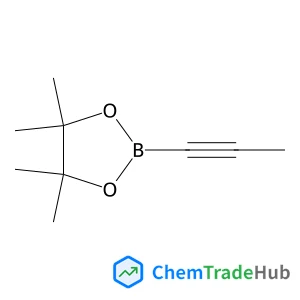
4,4,5,5-Tetramethyl-2-(1-propyn-1-YL)-1,3,2-dioxaborolane
CAS Number:
347389-75-7
Molecular Formula:
C9H15BO2
Ryo Yamane, Hongyi Li, Tetsu Ichitsubo, Kazumasa Sugiyama
This study focuses on the cation intercalation of structurally unique compounds synthesized from the partial dehydration and deprotonation of coordinated water molecules in hydrous materials. Partial dehydration can potentially result in hydrous materials with a porous nature, which maintains the parent structure of the material, and deprotonation causes oxidation in the hydrous materials. Li-intercalation experiments were conducted on the hydrous iron(II) phosphate mineral, vivianite (Fe2+3(PO4)2·8H2O), and its oxidized and partially dehydrated product, santabarbaraite. Vivianite comprises two-dimensional Fe3(PO4)2 sheets and coordinated water molecules. The oxidation progress of the Fe2+ of vivianite increased cathodic capacities up to 156 mA h g−1. The Li-intercalation reaction rate increased significantly owing to dehydration because the partial dehydration of vivianite created structural space for the diffusion of Li+. Furthermore, X-ray diffraction measurements revealed that Li intercalation did not cause the formation of byproducts.
Zhongyu Mou, Yong-Hui Tian, Miklos Kertesz
DOI: 10.1039/C7CP04637E
Y. Unutulmazsoy, R. Merkle, D. Fischer, J. Mannhart, J. Maier
DOI: 10.1039/C7CP00476A
Aurimas Vyšniauskas, Ismael López-Duarte, Nicolas Duchemin, Thanh-Truc Vu, Yilei Wu, Ekaterina M. Budynina, Yulia A. Volkova, Eduardo Peña Cabrera, Diana E. Ramírez-Ornelas, Marina K. Kuimova
DOI: 10.1039/C7CP03571C
Luuk J. G. W. van Wilderen, Daniela Kern-Michler, Henrike M. Müller-Werkmeister, Jens Bredenbeck
DOI: 10.1039/C7CP90063E
Pingyun Li, Qingqing Wang, Guodong Deng, Xiaode Guo, Wei Jiang, Hongying Liu, Fengsheng Li
DOI: 10.1039/C7CP04097K
Deping Qian, Ahmed Hesham Balawi, Yang Wu, Wei Ma, Frédéric Laquai, Zheng Tang, Fengling Zhang, Weiwei Li
DOI: 10.1039/C7CP04780K
J. A. Puszkiel, M. V. Castro Riglos, F. Karimi, A. Santoru, C. Pistidda, T. Klassen, J. M. Bellosta von Colbe, M. Dornheim
DOI: 10.1039/C6CP08278E
2-Methylbenzene-1,4-diamine dihydrochloride (CAS: 615-45-2) should be stored in ...
(1S,4S)-2,5-Diazabicyclo[2.2.1]heptane dihydrobromide is generally considered sa...
(6-Chloropyridazin-3-YL)methanamine finds applications in the pharmaceutical ind...
2-Fluoro-3-methylphenol is primarily used in the synthesis of pharmaceuticals, p...
When handling 3-Methoxy-4-nitrobenzonitrile, it is important to wear appropriate...
When handling 1,3-Oxazolo[4,5-b]pyridine-2(3H)-thione (CAS: 211949-57-4), it is ...
4-Ethynylbenzamide (CAS: 90347-86-7) falls under various regulatory guidelines i...
3-(2-Ethylphenyl)-2-thioxo-4-imidazolidinone is primarily used as an intermediat...
(2-Fluoro-6-methoxyphenyl)acetic acid, also known as 4-fluoro-3-methoxybenzoic a...
Market trends for 2-[4-(Hydroxymethyl)phenoxy]ethanol (CAS: 102196-18-9) indicat...

Physical Chemistry Chemical Physics (PCCP) is an international journal co-owned by 19 physical chemistry and physics societies from around the world. This journal publishes original, cutting-edge research in physical chemistry, chemical physics and biophysical chemistry. To be suitable for publication in PCCP, articles must include significant innovation and/or insight into physical chemistry; this is the most important criterion that reviewers and Editors will judge against when evaluating submissions. The journal has a broad scope and welcomes contributions spanning experiment, theory, computation and data science. Topical coverage includes spectroscopy, dynamics, kinetics, statistical mechanics, thermodynamics, electrochemistry, catalysis, surface science, quantum mechanics, quantum computing and machine learning. Interdisciplinary research areas such as polymers and soft matter, materials, nanoscience, energy, surfaces/interfaces, and biophysical chemistry are welcomed if they demonstrate significant innovation and/or insight into physical chemistry. Joined experimental/theoretical studies are particularly appreciated when complementary and based on up-to-date approaches.
![[1-(5-Methyl-2-pyridinyl)-1H-pyrazol-4-yl]methanol structure](https://static.chemtradehub.com/structs/143/1439822-99-7-6cc9.webp "[1-(5-Methyl-2-pyridinyl)-1H-pyrazol-4-yl]methanol structure")