












Copper binding and protein aggregation: a journey from the brain to the human lens
Literature Information
Publication Date
2023-10-17
DOI
10.1039/D3CB00145H
Impact Factor
0
Authors
Yanahi Posadas, Carolina Sánchez-López
View Original
Abstract
Metal ions have been implicated in several proteinopathies associated to degenerative and neurodegenerative diseases. While the molecular mechanisms for protein aggregation are still under investigation, recent findings from Cryo-EM point out to polymorphisms in aggregates obtained from patients, as compared to those formed in vitro, suggesting that several factors may impact aggregation in vivo. One of these factors could be the direct binding of metal ions to the proteins engaged in aggregate formation. In this opinion article, three case studies are discussed to address the question of how metal ion binding to a peptide or protein may impact its conformation, folding, and aggregation, and how this may be relevant in understanding the polymorphic nature of the aggregates related to disease. Specifically, the impact of Cu2+ ions in the amyloid aggregation of amyloid-β and amylin (or IAPP- islet amyloid polypeptide) are discussed and then contrasted to the case of Cu2+-induced non-amyloid aggregation of human lens γ-crystallin proteins. For the intrinsically disordered peptides amyloid-β and IAPP, the impact of Cu2+ ion binding is highly dependent on the relative location of the metal binding site and the hydrophobic regions involved in β-sheet folding and amyloid formation. Further structural studies of how Cu2+ binding impacts amyloid aggregation pathways and the molecular structure of the final amyloid fibril, both, in vitro and in vivo, will certainly shed light into the molecular origins of the polymorphisms observed in diseased tissue. Finally, contrasting these cases to that of Cu2+-induced non-amyloid aggregation of γ-crystallins, it is evident that, although the impact in aggregation – and the nature of the aggregate – may differ in each system, at the molecular level there is a competition between metal ion coordination and the stability of β-sheet structures. Considering the importance of the β-sheet fold in biology, it is fundamental to understand the energetics and molecular details behind such competition. This opinion article aims to highlight future research directions in the field that can help tackle the important question of how metal ion binding may impact protein folding and aggregation and how this relates to disease.
Recommended Journals
Related Literature
Characterization of electrocatalytic proton reduction and surface adsorption of platinum nanoparticles supported by a polymeric stabilizer on an ITO electrode
Yuta Tsubonouchi, Masashi Kajita, Taichi Hayasaka, Mohamed R. Berber, Masayuki Yagi
2021-12-21
Paper
DOI: 10.1039/D1SE01760H
Enhancing efficiency and stability of perovskite solar cells via in situ incorporation of lead sulfide layer
Yuxia Han, Guanghui Yu, Yu Miao, CaiYan Gao, Xueqin Zhou, YanLin Song, Ke-Jian Jiang
2021-06-23
Paper
DOI: 10.1039/D1SE00751C
Renewable N-doped microporous carbons from walnut shells for CO2 capture and conversion
Xianzhao Shao, Yujia Zhang, Xinyi Miao, Wei Wang, Zhifeng Liu, Quan Liu, Tianlei Zhang, Jianwei Ji, Xiaohui Ji
2021-08-10
Paper
DOI: 10.1039/D1SE01000J
Design and optimization of a maglev electromagnetic–triboelectric hybrid energy converter for supplying power to intelligent sensing equipment
Fankai Kong, Songyan Yin, Chongfei Sun, Chunhui Yang, Hailong Chen, Hengxu Liu
2022-01-11
Paper
DOI: 10.1039/D1SE01582F
Construction of a hierarchically structured, NiCo–Cu-based trifunctional electrocatalyst for efficient overall water splitting and 5-hydroxymethylfurfural oxidation
Ruijuan Zheng, Chenhao Zhao, Jinhua Xiong, Xue Teng, Wuhua Chen, Zhibiao Hu, Zuofeng Chen
2021-06-22
Paper
DOI: 10.1039/D1SE00697E
Bread-inspired foaming strategy to fabricate a wine lees-based porous carbon framework for high specific energy supercapacitors
Hui Peng, Yipu Xu, Yaping Jiang, Xin Wang, Rui Zhao, Faqiang Wang, Lu Li, Guofu Ma
2021-08-20
Paper
DOI: 10.1039/D1SE01059J
Polyoxometalate-induced ‘cage-within-cage’ metal–organic frameworks with high efficiency towards CO2 photoreduction
Ze-Yu Du, Yan-Zhao Yu, Ning-Fang Li, Yun-Shan Xue, Ling-Xi Xu, Hua Mei, Yan Xu
2021-06-21
Paper
DOI: 10.1039/D1SE00804H
Animal fats as a suitable feedstock for co-processing with atmospheric gas oil
Héctor de Paz Carmona, Aleš Vráblík, José Miguel Hidalgo Herrador, Romana Velvarská, Radek Černý
2021-09-02
Paper
DOI: 10.1039/D1SE00917F
New wide-bandgap D–A polymer based on pyrrolo[3,4-b] dithieno[2,3-f:3′,2′-h]quinoxalindione and thiazole functionalized benzo[1,2-b:4,5-b′]dithiophene units for high-performance ternary organic solar cells with over 16% efficiency
M. L. Keshtov, I. O. Konstantinov, S. A. Kuklin, N. K. Davydova, V. G. Alekseev, Z. Xie, Anupam Agrawal, Ganesh D. Sharma
2021-12-01
Paper
DOI: 10.1039/D1SE01748A
You might also like
Compound Q&A
What are the main uses of (3.beta.)-3-Hydroxy-N,N-dimethyl-chol-5-en-24-amide (CAS: 79066-03-8)?
(3.beta.)-3-Hydroxy-N,N-dimethyl-chol-5-en-24-amide (CAS: 79066-03-8) is primari...
79066-03-8(3.beta.)-3-Hydroxy-...
Compound Q&A
What regulatory guidelines apply to 5-(aminomethyl)-2-methoxyphenol (CAS: 89702-89-6)?
5-(Aminomethyl)-2-methoxyphenol (CAS: 89702-89-6) is classified under GHS as a s...
89702-89-65-(aminomethyl)-2-me...
Compound Q&A
What is Thieno[2,3-c]pyridin-7(6H)-one (CAS: 28981-13-7)?
Thieno[2,3-c]pyridin-7(6H)-one (CAS: 28981-13-7) is a heterocyclic organic compo...
28981-13-7Thieno[2,3-c]pyridin...
Compound Q&A
Is 1-[(6-Methoxy-3-pyridinyl)methyl]-4-piperidinamine dihydrochloride (CAS: 1185311-28-7) safe?
1-[(6-Methoxy-3-pyridinyl)methyl]-4-piperidinamine dihydrochloride is generally ...
1185311-28-71-[(6-Methoxy-3-pyri...
Compound Q&A
What regulatory guidelines apply to [(2E)-3-Phenyl-2-propen-1-yl]phosphonic acid (CAS: 146404-58-2)?
[(2E)-3-Phenyl-2-propen-1-yl]phosphonic acid (CAS: 146404-58-2) is regulated und...
146404-58-2[(2E)-3-Phenyl-2-pro...
Compound Q&A
What regulatory guidelines apply to 6-Bromo-7-methoxyquinoline (CAS: 1620515-86-7)?
6-Bromo-7-methoxyquinoline (CAS: 1620515-86-7) falls under the scope of the Glob...
1620515-86-76-Bromo-7-methoxyqui...
Compound Q&A
What industries use (2R)-1-(1-Benzofuran-2-yl)-N-propyl-2-pentanamine (CAS: 260550-89-8)?
This compound is primarily used in the pharmaceutical industry for the developme...
260550-89-8(2R)-1-(1-Benzofuran...
Compound Q&A
What are the main uses of 1-Ethyl-7-[2-methyl-6-(4H-1,2,4-triazol-3-yl)-3-pyridinyl]-3,5-dihydropyrazino[2,3-b]pyrazin-2(1H)-one (CAS: 1228013-15-7)?
1-Ethyl-7-[2-methyl-6-(4H-1,2,4-triazol-3-yl)-3-pyridinyl]-3,5-dihydropyrazino[2...
1228013-15-71-Ethyl-7-[2-methyl-...
Compound Q&A
Are there alternatives to {5-(Acryloylamino)-2-[(dimethylamino)methyl]phenyl}boronic acid (CAS: 1217500-78-1) in synthesis?
Alternative reagents such as 2-[(dimethylamino)methyl]phenylboronic acid or rela...
1217500-78-1{5-(Acryloylamino)-2...
Compound Q&A
What is 3-(Piperidin-4-yloxy)pyridine (CAS: 310881-48-2)?
3-(Piperidin-4-yloxy)pyridine (CAS: 310881-48-2) is an organic compound with the...
310881-48-23-(Piperidin-4-yloxy...
Source Journal
Recommended Compounds
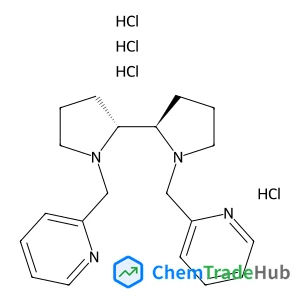
(2R,2'R)-1,1'-Bis(2-pyridinylmethyl)-2,2'-bipyrrolidine tetrahydrochloride
CAS Number:
1228077-88-0
Molecular Formula:
C20H30Cl4N4
amine structure](https://static.chemtradehub.com/structs/629/62924-61-2-0728.webp "[(2-chlorophenyl)methyl](ethyl)amine structure")
Recommended Suppliers






Disclaimer
This page provides academic journal information for reference and research purposes only. We are not affiliated with any journal publishers and do not handle publication submissions. For publication-related inquiries, please contact the respective journal publishers directly.
If you notice any inaccuracies in the information displayed, please contact us at support@chemtradehub.com. We will promptly review and address your concerns.