













Polyoxometalate-induced ‘cage-within-cage’ metal–organic frameworks with high efficiency towards CO2 photoreduction
Literature Information
Publication Date
2021-06-21
DOI
10.1039/D1SE00804H
Impact Factor
6.367
Authors
Ze-Yu Du, Yan-Zhao Yu, Ning-Fang Li, Yun-Shan Xue, Ling-Xi Xu, Hua Mei, Yan Xu
View Original
Abstract
Photocatalytic CO2 reduction (CO2RR) into high-value products is of great significance not only in addressing global warming but also in developing sustainable energy resources. Herein, two novel metal–organic frameworks (MOFs) induced by polyoxometalates (POMs) have been successfully synthesized via a solvothermal method, formulated as {Zn4(MoO4)(HCO2)3(C4H5N2)3}·DMF (Zn/Mo-MOF) and {Zn2Co2(MoO4)(HCO2)3(C4H5N2)3}·DMF (Zn/Co/Mo-MOF) [DMF = HCON(CH3)2]. The single crystal X-ray diffraction (SCXRD) analysis reveals that both MOFs contained MoO42− anions as the building units, which resulted from the decomposition of phosphomolybdic acid (H3PMo12O40). Notably, the cage β in MOFs was constructed by MoO42− anions, and this cage was located outside and interconnected with independent cage α with a sodalite cage-type structure to arrange into a rare cage-within-cage structure. More interestingly, Zn/Co/Mo-MOF exhibited a remarkable CO production rate (38.41 μmol h−1) with a high selectivity of 91.4% for the CO2 photoreduction, which outperforms most of the reported MOF-based photocatalysts. The result of this study demonstrates that the successful introduction of the POM's anions to construct MOFs may open up new opportunities to synthetize highly efficient MOF-based photocatalysts for the CO2 photoreduction.
Related Literature
Tannin polymerization: an overview
Myleidi Vera, Bruno F. Urbano
2021-07-14
Review Article
DOI: 10.1039/D1PY00542A
Synthesis of core-crosslinked star polymers via organocatalyzed living radical polymerization
Yichao Zheng, Jit Sarkar, Hiroshi Niino, Shunsuke Chatani, Shu Yao Hsu, Atsushi Goto
2021-07-05
Paper
DOI: 10.1039/D1PY00663K
Bone mineral: evidence for hydroxy groups by inelastic neutron scattering
Marina G. Taylor, Stewart F. Parker, Kenneth Simkiss, Philip C. H. Mitchell
2001-03-14
Paper
DOI: 10.1039/B005666I
Photophysics on surfaces: Absorption and luminescence properties of Pheophorbide-a on cellulose
M. Gabriela Lagorio, Enrique San Román, André Zeug, Jörg Zimmermann, Beate Röder
2001-03-19
Paper
DOI: 10.1039/B100077M
15N and 2H NMR relaxation and kinetics of stepwise double proton and deuteron transfer in polycrystalline tetraaza[14]annulene
Uwe Langer, Christof Hoelger, Gerd Buntkowsky, Hans-Martin Vieth, Hans-Heinrich Limbach
2001-03-22
Paper
DOI: 10.1039/B007564G
Photooxidation of alkylphenothiazines in SiMCM-48, AlMCM-48 and VMCM-48 mesoporous molecular sieves
2001-01-24
Paper
DOI: 10.1039/B008247N
You might also like
Compound Q&A
What are the main uses of (3.beta.)-3-Hydroxy-N,N-dimethyl-chol-5-en-24-amide (CAS: 79066-03-8)?
(3.beta.)-3-Hydroxy-N,N-dimethyl-chol-5-en-24-amide (CAS: 79066-03-8) is primari...
79066-03-8(3.beta.)-3-Hydroxy-...
Compound Q&A
What regulatory guidelines apply to 5-(aminomethyl)-2-methoxyphenol (CAS: 89702-89-6)?
5-(Aminomethyl)-2-methoxyphenol (CAS: 89702-89-6) is classified under GHS as a s...
89702-89-65-(aminomethyl)-2-me...
Compound Q&A
What is Thieno[2,3-c]pyridin-7(6H)-one (CAS: 28981-13-7)?
Thieno[2,3-c]pyridin-7(6H)-one (CAS: 28981-13-7) is a heterocyclic organic compo...
28981-13-7Thieno[2,3-c]pyridin...
Compound Q&A
Is 1-[(6-Methoxy-3-pyridinyl)methyl]-4-piperidinamine dihydrochloride (CAS: 1185311-28-7) safe?
1-[(6-Methoxy-3-pyridinyl)methyl]-4-piperidinamine dihydrochloride is generally ...
1185311-28-71-[(6-Methoxy-3-pyri...
Compound Q&A
What regulatory guidelines apply to [(2E)-3-Phenyl-2-propen-1-yl]phosphonic acid (CAS: 146404-58-2)?
[(2E)-3-Phenyl-2-propen-1-yl]phosphonic acid (CAS: 146404-58-2) is regulated und...
146404-58-2[(2E)-3-Phenyl-2-pro...
Compound Q&A
What regulatory guidelines apply to 6-Bromo-7-methoxyquinoline (CAS: 1620515-86-7)?
6-Bromo-7-methoxyquinoline (CAS: 1620515-86-7) falls under the scope of the Glob...
1620515-86-76-Bromo-7-methoxyqui...
Compound Q&A
What industries use (2R)-1-(1-Benzofuran-2-yl)-N-propyl-2-pentanamine (CAS: 260550-89-8)?
This compound is primarily used in the pharmaceutical industry for the developme...
260550-89-8(2R)-1-(1-Benzofuran...
Compound Q&A
What are the main uses of 1-Ethyl-7-[2-methyl-6-(4H-1,2,4-triazol-3-yl)-3-pyridinyl]-3,5-dihydropyrazino[2,3-b]pyrazin-2(1H)-one (CAS: 1228013-15-7)?
1-Ethyl-7-[2-methyl-6-(4H-1,2,4-triazol-3-yl)-3-pyridinyl]-3,5-dihydropyrazino[2...
1228013-15-71-Ethyl-7-[2-methyl-...
Compound Q&A
Are there alternatives to {5-(Acryloylamino)-2-[(dimethylamino)methyl]phenyl}boronic acid (CAS: 1217500-78-1) in synthesis?
Alternative reagents such as 2-[(dimethylamino)methyl]phenylboronic acid or rela...
1217500-78-1{5-(Acryloylamino)-2...
Compound Q&A
What is 3-(Piperidin-4-yloxy)pyridine (CAS: 310881-48-2)?
3-(Piperidin-4-yloxy)pyridine (CAS: 310881-48-2) is an organic compound with the...
310881-48-23-(Piperidin-4-yloxy...
Source Journal
Recommended Compounds
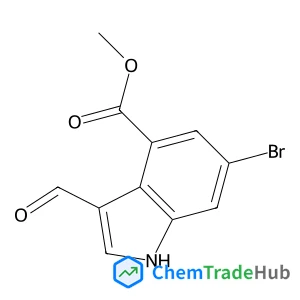
methyl 6-bromo-3-formyl-1H-indole-4-carboxylate
CAS Number:
1353636-63-1
Molecular Formula:
C11H8BrNO3
![N-[(6-Bromo-3-pyridinyl)methyl]ethanamine structure](https://static.chemtradehub.com/structs/120/120740-05-8-ca55.webp "N-[(6-Bromo-3-pyridinyl)methyl]ethanamine structure")
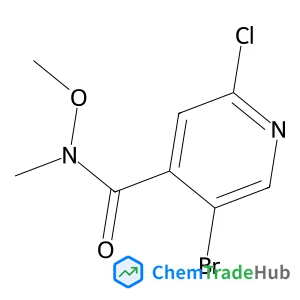
5-Bromo-2-chloro-N-methoxy-N-methylisonicotinamide
CAS Number:
1256790-08-5
Molecular Formula:
C8H8BrClN2O2
Recommended Suppliers




Disclaimer
This page provides academic journal information for reference and research purposes only. We are not affiliated with any journal publishers and do not handle publication submissions. For publication-related inquiries, please contact the respective journal publishers directly.
If you notice any inaccuracies in the information displayed, please contact us at support@chemtradehub.com. We will promptly review and address your concerns.