












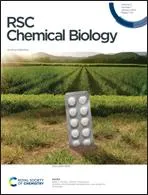

The catechol moiety of obafluorin is essential for antibacterial activity
Literature Information
Publication Date
2023-08-21
DOI
10.1039/D3CB00127J
Impact Factor
0
Authors
Sibyl F. D. Batey, Melissa J. Davie, Edward S. Hems, Jonathon D. Liston, Thomas A. Scott, Silke Alt, Christopher S. Francklyn, Barrie Wilkinson
View Original
Abstract
Obafluorin is a Pseudomonas fluorescens antibacterial natural product that inhibits threonyl-tRNA synthetase (ThrRS). It acts as a broad-spectrum antibiotic against a range of clinically relevant pathogens and comprises a strained β-lactone ring decorated with catechol and 4-nitro-benzyl moieties. The catechol moiety is widespread in nature and its role in the coordination of ferric iron has been well-characterised in siderophores and Trojan horse antibiotics. Here we use a combination of mutasynthesis, bioassays, enzyme assays and metal binding studies to delineate the role of the catechol moiety in the bioactivity of obafluorin. We use P. fluorescens biosynthetic mutants to generate obafluorin analogues with modified catechol moieties. We demonstrate that an intact catechol is required for both antibacterial activity and inhibition of the ThrRS molecular target. Although recent work showed that the obafluorin catechol coordinates Zn2+ in the ThrRS active site, we find that obafluorin is a weak Zn2+ binder in vitro, contrasting with a strong, specific 1 : 1 interaction with Fe3+. We use bioassays with siderophore transporter mutants to probe the role of the obafluorin catechol in Fe3+-mediated uptake. Surprisingly, obafluorin does not behave as a Trojan horse antibiotic but instead exhibits increased antibacterial activity in the presence of Fe3+. We further demonstrate that Fe3+ binding prevents the hydrolytic breakdown of the β-lactone ring, revealing a hitherto unreported function for the catechol moiety in natural product bioactivity.
Related Literature
Novel functional degradable block copolymers for the building of reactive micelles
Sébastien Cajot, Philippe Lecomte, Christine Jérôme, Raphaël Riva
2012-10-23
Paper
DOI: 10.1039/C2PY20528A
Surface modification of magnetite hybrid particles with carbohydrates and gold nanoparticlesvia “click” chemistry
M. Álvarez-Paino, G. Marcelo, A. Muñoz-Bonilla, J. Rodríguez-Hernández, M. Fernández-García
2012-10-25
Paper
DOI: 10.1039/C2PY20824E
Chiral polymeric microspheres grafted with optically active helical polymer chains: a new class of materials for chiral recognition and chirally controlled release
Ci Song, Chaohong Zhang, Fangjie Wang, Wantai Yang, Jianping Deng
2012-09-18
Paper
DOI: 10.1039/C2PY20546G
Synthesis of poly(vinyl acetate)-b-poly(vinyl chloride) block copolymers by Cobalt-Mediated Radical Polymerization (CMRP)
Yasmine Piette, Antoine Debuigne, Vincent Bodart, Nicolas Willet, Anne-Sophie Duwez, Christine Jérôme, Christophe Detrembleur
2012-12-10
Paper
DOI: 10.1039/C2PY20965A
Reducing polyazomethine to poly(N-phenylbenzylamine) with near infrared electrochromic, fluorescence and photovoltaic properties
Jiwei Cai, Ping Zhao, Haijun Niu, Yongfu Lian, Cheng Wang, Xuduo Bai, Wen Wang
2012-11-02
Paper
DOI: 10.1039/C2PY20846F
pH and reduction dual-responsive nanogel cross-linked by quaternization reaction for enhanced cellular internalization and intracellular drug delivery
Zhaohui Tang, Hai Sun, Xuesi Chen
2012-11-07
Paper
DOI: 10.1039/C2PY20871G
Living lamellar crystal initiating polymerization and brittleness mechanism investigations based on crystallization during the ring-opening of cyclic butylene terephthalate oligomers
Zongbao Wang, Bingjie Wang, Quting Gou, Junwu Zhang, Jian Zhou, Peng Chen, Qun Gu
2012-12-03
Paper
DOI: 10.1039/C2PY20847D
Coupled stochastic simulation of the chain length and particle size distribution in miniemulsion radical copolymerization of styrene and N-vinylcaprolactam
Paul H. M. Van Steenberge
2019-08-22
Paper
DOI: 10.1039/C9RE00218A
Refinery integration of lignocellulose for automotive fuel production via the bioCRACK process and two-step co-hydrotreating of liquid phase pyrolysis oil and heavy gas oil
Anna Huber, Samir Reiter, Mario Lukasch, Berndt Hammerschlag, Julia Außerleitner, Daniela Painer, Peter Pucher, Matthäus Siebenhofer, Nikolaus Schwaiger
2020-01-15
Paper
DOI: 10.1039/C9RE00352E
You might also like
Compound Q&A
What is Ethyl 3-cyclohexylpropanoate (CAS: 10094-36-7)?
Ethyl 3-cyclohexylpropanoate is a clear, colorless to light yellow liquid with a...
10094-36-7Ethyl 3-cyclohexylpr...
Compound Q&A
How should waste containing 2-(Hydroxymethyl)-5-(methoxycarbonyl)-6-methyl-4-(2-nitrophenyl)nicotinic acid (CAS: 34783-31-8) be handled?
Waste containing 2-(Hydroxymethyl)-5-(methoxycarbonyl)-6-methyl-4-(2-nitrophenyl...
34783-31-82-(Hydroxymethyl)-5-...
Compound Q&A
How should waste containing 2,4,6-Tris(pentafluoroethyl)-1,3,5-triazine (CAS: 858-46-8) be handled?
Waste containing 2,4,6-Tris(pentafluoroethyl)-1,3,5-triazine (CAS: 858-46-8) sho...
858-46-82,4,6-Tris(pentafluo...
Compound Q&A
What precautions should be taken when handling Chloroac-nle-oh (CAS: 56787-36-1)?
When handling Chloroac-nle-oh (CAS: 56787-36-1), it is essential to wear appropr...
56787-36-1Chloroac-nle-oh
Compound Q&A
What industries use Ethyl 6-phenylimidazo[2,1-b][1,3]thiazole-3-carboxylate (CAS: 752244-05-6)?
Ethyl 6-phenylimidazo[2,1-b][1,3]thiazole-3-carboxylate is primarily used in the...
752244-05-6Ethyl 6-phenylimidaz...
Compound Q&A
Are there alternatives to alpha-(2-Bromophenyl)benzylamine (CAS: 55095-15-3) in synthesis?
Alternatives to alpha-(2-Bromophenyl)benzylamine (CAS: 55095-15-3) in synthesis ...
55095-15-3alpha-(2-Bromophenyl...
Compound Q&A
How should waste containing 2-Chloro-5-methoxypyridine (CAS: 139585-48-1) be handled?
Waste containing 2-Chloro-5-methoxypyridine (CAS: 139585-48-1) should be managed...
139585-48-12-Chloro-5-methoxypy...
Compound Q&A
What industries use 1-(4-Methoxyphenyl)-2,5-dimethyl-1H-pyrrole (CAS: 5044-27-9)?
1-(4-Methoxyphenyl)-2,5-dimethyl-1H-pyrrole (CAS: 5044-27-9) is used in various ...
5044-27-91-(4-Methoxyphenyl)-...
Compound Q&A
Are there alternatives to 3-Bromo-5-(N-Boc)aminomethylisoxazole (CAS: 903131-45-3) in synthesis?
There are alternative reagents and compounds that can be used in the synthesis o...
903131-45-33-Bromo-5-(N-Boc)ami...
Compound Q&A
What is Tungsten(IV) oxide (CAS: 12036-22-5)?
Tungsten(IV) oxide, also known as tungsten dioxide, is a chemical compound with ...
12036-22-5Tungsten(IV) oxide
Source Journal
Recommended Compounds

![2-Bromodibenzo[b,d]furan structure](https://static.chemtradehub.com/structs/86-/86-76-0-1814.webp "2-Bromodibenzo[b,d]furan structure")
![2-{3-[4-(3-Chlorophenyl)-1-piperazinyl]propyl}[1,2,4]triazolo[4,3-a]pyridin-3(2H)-one hydrochloride (1:1) structure](https://static.chemtradehub.com/structs/253/25332-39-2-496e.webp "2-{3-[4-(3-Chlorophenyl)-1-piperazinyl]propyl}[1,2,4]triazolo[4,3-a]pyridin-3(2H)-one hydrochloride (1:1) structure")
2-{3-[4-(3-Chlorophenyl)-1-piperazinyl]propyl}[1,2,4]triazolo[4,3-a]pyridin-3(2H)-one hydrochloride (1:1)
CAS Number:
25332-39-2
Molecular Formula:
C19H23Cl2N5O
Recommended Suppliers



Disclaimer
This page provides academic journal information for reference and research purposes only. We are not affiliated with any journal publishers and do not handle publication submissions. For publication-related inquiries, please contact the respective journal publishers directly.
If you notice any inaccuracies in the information displayed, please contact us at support@chemtradehub.com. We will promptly review and address your concerns.