












A study on theoretical models for investigating time-resolved photoluminescence in halide perovskites
Literature Information
Publication Date
2023-02-10
DOI
10.1039/D2CP05723A
Impact Factor
3.676
Authors
Jing Chen, Jing Lv, Xiaolin Liu, Jia Lin
View Original
Abstract
Time-resolved photoluminescence (TRPL) is an effective experimental technique to study charge carrier dynamic processes in halide perovskites on different time scales. In the past decade, several models have been proposed and employed to study the TRPL curves in halide perovskites, but there is still a lack of systematic summarization and comparative discussion. Here, we reviewed the widely employed exponential models to fit the TRPL curves, and focused on the physical meaning of the extracted carrier lifetimes, as well as the existing debates on the definition of the average lifetime. Emphasis was placed on the importance of the diffusion process in the carrier dynamics, especially for the halide perovskite thin films having transport layers. The solving of the diffusion equation, using both analytical and numerical methods, was then introduced to fit the TRPL curves. Furthermore, the newly proposed global fit and direct measurement of radiative decay rates were discussed.
Related Literature
How the hydrogen sorption properties of palladium are modified through interaction with iridium
Christine Goyhenex, Laurent Piccolo
2017-11-22
Paper
DOI: 10.1039/C7CP07155H
Optical–magnetic bifunctional properties and mechanistic insights on upconversion of NaYF4:Yb,Ho,Tm@NaGdF4 with a tunable nanodumbbell morphology
Zhichao Yu, Haifeng Zhou, Guangjun Zhou, Juan Zhou, Yaqiang Wu, Xingshuang Zhang, Tao Wang, Dapeng Huang, Xinqiang Wang, Jifan Hu
2017-11-07
Paper
DOI: 10.1039/C7CP05011A
A new scaling for the rotational diffusion of molecular probes in polymer solutions
Jing Qing, Anpu Chen, Nanrong Zhao
2017-11-07
Paper
DOI: 10.1039/C7CP07047K
Effects of the c-Si/a-SiO2 interfacial atomic structure on its band alignment: an ab initio study
Fan Zheng, Hieu H. Pham, Lin-Wang Wang
2017-11-13
Paper
DOI: 10.1039/C7CP05879A
Characterising the evaporation kinetics of water and semi-volatile organic compounds from viscous multicomponent organic aerosol particles
Stephen Ingram, Chen Cai, Young-Chul Song, David O. Topping, Simon O’Meara, Jonathan P. Reid
2017-11-13
Paper
DOI: 10.1039/C7CP05172G
Detection of a weak ring current in a nonaromatic porphyrin nanoring using magnetic circular dichroism
Patrycja Kowalska, Martin D. Peeks, Tomasz Roliński, Harry L. Anderson
2017-11-22
Paper
DOI: 10.1039/C7CP07348H
Solvatochromism in perylene diimides; experiment and theory
C. A. Fuller, C. E. Finlayson
2017-11-16
Paper
DOI: 10.1039/C7CP05039A
Nitrate-assisted photocatalytic efficiency of defective Eu-doped Pr(OH)3 nanostructures
S. Aškrabić, V. D. Araújo, M. Passacantando, M. I. B. Bernardi, N. Tomić, B. Dojčinović, D. Manojlović, B. Čalija, M. Miletić, Z. D. Dohčević-Mitrović
2017-11-07
Paper
DOI: 10.1039/C7CP06440C
You might also like
Compound Q&A
What are the main uses of 1H-Indazole-6-carbonitrile (CAS: 141290-59-7)?
1H-Indazole-6-carbonitrile finds applications in pharmaceuticals, where it serve...
141290-59-71H-Indazole-6-carbon...
Compound Q&A
How should waste containing Dioctyl (2E)-2-butenedioate (CAS: 2997-85-5) be handled?
Waste containing Dioctyl (2E)-2-butenedioate (CAS: 2997-85-5) should be collecte...
2997-85-5Dioctyl (2E)-2-buten...
Compound Q&A
What industries use Sodium [(1,2-benzoxazol-3-ylmethyl)sulfonyl]azanide (CAS: 68291-98-5)?
Sodium [(1,2-benzoxazol-3-ylmethyl)sulfonyl]azanide is primarily used in pharmac...
68291-98-5Sodium [(1,2-benzoxa...
Compound Q&A
Are there alternatives to Dimethyl 4-(4,4,5,5-tetramethyl-1,3,2-dioxaborolan-2-yl)-2,6-pyridinedicarboxylate (CAS: 741709-66-0) in synthesis?
Dimethyl 4-(4,4,5,5-tetramethyl-1,3,2-dioxaborolan-2-yl)-2,6-pyridinedicarboxyla...
741709-66-0Dimethyl 4-(4,4,5,5-...
Compound Q&A
How should waste containing 2-Fluoro-6-hydrazinopyridine (CAS: 80714-39-2) be handled?
Waste containing 2-Fluoro-6-hydrazinopyridine (CAS: 80714-39-2) should be manage...
80714-39-22-Fluoro-6-hydrazino...
Compound Q&A
What is 6-Formyl-2-pyridinecarboxylic acid (CAS: 499214-11-8)?
6-Formyl-2-pyridinecarboxylic acid is an organic compound with the molecular for...
499214-11-86-Formyl-2-pyridinec...
Compound Q&A
What is the market or research trend for 3-(3,4-dimethoxyphenyl)-2,5-dimethyl-N-(2-morpholin-4-ylethyl)pyrazolo[1,5-a]pyrimidin-7-amine (CAS: 900874-91-1)?
Research trends for this compound indicate a focus on its potential applications...
900874-91-13-(3,4-dimethoxyphen...
Compound Q&A
How is 9H-Tribenzo[b,d,f]azepine (CAS: 29875-73-8) typically synthesized?
9H-Tribenzo[b,d,f]azepine is typically synthesized via a multi-step process invo...
29875-73-89H-Tribenzo[b,d,f]az...
Compound Q&A
How is 1-Cyclopropyl-7-ethoxy-6-fluoro-8-methoxy-4-oxo-1,4-dihydro-3-quinolinecarboxylic acid (CAS: 1797982-51-4) typically synthesized?
1-Cyclopropyl-7-ethoxy-6-fluoro-8-methoxy-4-oxo-1,4-dihydro-3-quinolinecarboxyli...
1797982-51-41-Cyclopropyl-7-etho...
Compound Q&A
How should waste containing Methyl 3-oxo-1,2,3,4-tetrahydro-6-quinoxalinecarboxylate (CAS: 671820-52-3) be handled?
Waste containing Methyl 3-oxo-1,2,3,4-tetrahydro-6-quinoxalinecarboxylate (CAS: ...
671820-52-3Methyl 3-oxo-1,2,3,4...
Source Journal
Physical Chemistry Chemical Physics

CiteScore:
5.5
Self-citation Rate:
10.3%
Articles per Year:
3036
Physical Chemistry Chemical Physics (PCCP) is an international journal co-owned by 19 physical chemistry and physics societies from around the world. This journal publishes original, cutting-edge research in physical chemistry, chemical physics and biophysical chemistry. To be suitable for publication in PCCP, articles must include significant innovation and/or insight into physical chemistry; this is the most important criterion that reviewers and Editors will judge against when evaluating submissions. The journal has a broad scope and welcomes contributions spanning experiment, theory, computation and data science. Topical coverage includes spectroscopy, dynamics, kinetics, statistical mechanics, thermodynamics, electrochemistry, catalysis, surface science, quantum mechanics, quantum computing and machine learning. Interdisciplinary research areas such as polymers and soft matter, materials, nanoscience, energy, surfaces/interfaces, and biophysical chemistry are welcomed if they demonstrate significant innovation and/or insight into physical chemistry. Joined experimental/theoretical studies are particularly appreciated when complementary and based on up-to-date approaches.
Recommended Compounds
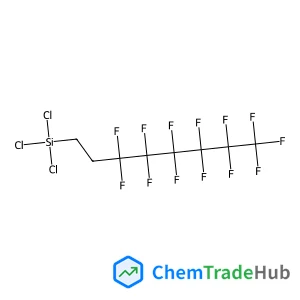
Trichloro(3,3,4,4,5,5,6,6,7,7,8,8,8-tridecafluorooctyl)silane
CAS Number:
78560-45-9
Molecular Formula:
C8H4Cl3F13Si
Recommended Suppliers






Disclaimer
This page provides academic journal information for reference and research purposes only. We are not affiliated with any journal publishers and do not handle publication submissions. For publication-related inquiries, please contact the respective journal publishers directly.
If you notice any inaccuracies in the information displayed, please contact us at support@chemtradehub.com. We will promptly review and address your concerns.