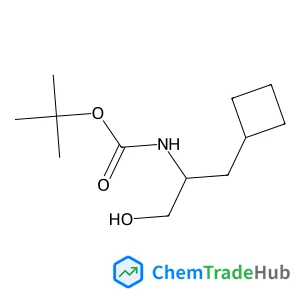
2-Methyl-2-propanyl (1-cyclobutyl-3-hydroxy-2-propanyl)carbamate
CAS Number:
816429-99-9
Molecular Formula:
C12H23NO3
S. Nazir, Yingchun Cheng
Double perovskite oxides (DPO) with antiferromagnetic ground state have received much consideration as they exhibit small stray-field and ultra-fast spin dynamics, which is extremely convenient for high-density and high-frequency data storage devices. It is a well-established fact that strain can easily tune the physical properties of the materials; therefore, the electronic and magnetic properties of recently synthesized ordered ALaCuOsO6 (A = Ba and Sr) DPO under biaxial ([110]) strain are investigated using ab initio calculations. Our results revealed that the unstrained systems exhibit semiconducting states having energy band gaps (Eg) of 0.28 and 0.39 eV for A = Ba and Sr, respectively. Along with this, both structures exhibit AFM ground state due to a strong AFM coupling between partially filled high-energy Cu+ e1g↑ and low-energy empty Os+5 t02g↓ orbitals. The calculated partial spin moments of Cu and Os ions are 0.65/0.66 and 1.58/1.60μB in a Ba-/Sr-doped system having electronic configurations of 3d9 (t32g↑t32g↓e2g↑e1g↓) with S = 0.5 and 5d3 (t32g↑) with S = 1.5, respectively. The robustness of AFM spin ordering is affirmed under the strain effects. The most striking feature of the present study is that Ba- and Sr-doped systems demonstrate an electronic transition from semiconductor to metal at critical tensile strains of +4% and +5% along with improved magnetism as well as Néel temperature, respectively. However, the magnetic ground state remains robust against applied strains in both cases. Hence, the present study shows that strain engineering could be a practical tool to modulate the electronic and magnetic properties of DPO to further enhance their technological applications in spintronics.
Chi Chen, Zarah Medina Baiyee, Xin Chen, Chunming Niu
DOI: 10.1039/C5CP05722A
Cathal Smyth, Daniel G. Oblinsky, Gregory D. Scholes
DOI: 10.1039/C5CP00295H
Sven Stafström
DOI: 10.1039/C5CP06577A
Yonggang Yang, Yufang Liu, Dapeng Yang, Hui Li, Kai Jiang, Jinfeng Sun
DOI: 10.1039/C5CP02530C
Mohammed Ahmed, Ajay K. Singh, Jahur A. Mondal
DOI: 10.1039/C5CP07014G
Daniel Murdock, Rebecca A. Ingle, Igor V. Sazanovich, Ian P. Clark, Yu Harabuchi, Tetsuya Taketsugu, Satoshi Maeda, Andrew J. Orr-Ewing, Michael N. R. Ashfold
DOI: 10.1039/C5CP06597F
Qianli Ma, Eva-Maria Hammer
DOI: 10.1039/C5CP05337D
Gaosheng Nie, Jun Xu, Jianying He, Qingchi Xu, Zhiliang Zhang
DOI: 10.1039/C5CP05435D
Elizabeth S. Foreman, Kara M. Kapnas, YiTien Jou, Jarosław Kalinowski, David Feng, Craig Murray
DOI: 10.1039/C5CP04977F
When handling 2-Methyl-2-propanyl 5-amino-2-thiophenecarboxylate (CAS: 1498311-5...
5-Bromo-1,2-dichloro-3-fluorobenzene (CAS: 1000572-93-9) is a crystalline solid ...
(2R)-2-Amino-2-(4-bromophenyl)ethanol (CAS: 354153-64-3) should be stored in a c...
Methyl 4-(aminomethyl)tetrahydro-2H-pyran-4-carboxylate hydrochloride (CAS: 3627...
1,4-Dimethyl-1H-pyrazole-5-sulfonyl chloride is primarily used as an intermediat...
Dinaphtho[1,2-b:2',1'-d]furan is generally safe when handled with appropriate pe...
The market for 7-Methyl-7,9-dihydro-1H-purine-2,6,8(3H)-trione (CAS: 612-37-3) i...
2-(4-Chlorophenyl)malonaldehyde (CAS: 205676-17-1) is a colorless or light yello...
2-Methylchrysene (CAS: 3351-32-4) is typically synthesized via the reaction of c...
N-(6-aminopyrimidin-4-yl)acetamide (CAS: 89533-23-3) is generally considered saf...

Physical Chemistry Chemical Physics (PCCP) is an international journal co-owned by 19 physical chemistry and physics societies from around the world. This journal publishes original, cutting-edge research in physical chemistry, chemical physics and biophysical chemistry. To be suitable for publication in PCCP, articles must include significant innovation and/or insight into physical chemistry; this is the most important criterion that reviewers and Editors will judge against when evaluating submissions. The journal has a broad scope and welcomes contributions spanning experiment, theory, computation and data science. Topical coverage includes spectroscopy, dynamics, kinetics, statistical mechanics, thermodynamics, electrochemistry, catalysis, surface science, quantum mechanics, quantum computing and machine learning. Interdisciplinary research areas such as polymers and soft matter, materials, nanoscience, energy, surfaces/interfaces, and biophysical chemistry are welcomed if they demonstrate significant innovation and/or insight into physical chemistry. Joined experimental/theoretical studies are particularly appreciated when complementary and based on up-to-date approaches.
![1-{[5-(4,4,5,5-Tetramethyl-1,3,2-dioxaborolan-2-yl)-2-thienyl]methyl}piperidine structure](https://static.chemtradehub.com/structs/121/1218790-44-3-baef.webp "1-{[5-(4,4,5,5-Tetramethyl-1,3,2-dioxaborolan-2-yl)-2-thienyl]methyl}piperidine structure")
![1-Oxa-8-azaspiro[4.5]decan-3-ol structure](https://static.chemtradehub.com/structs/757/757239-76-2-a0ec.webp "1-Oxa-8-azaspiro[4.5]decan-3-ol structure")
methyl]-N,2-dimethyl-2-propanesulfinamide structure](https://static.chemtradehub.com/structs/256/2565792-50-7-8a26.webp "N-[(R)-[3-(Benzyloxy)-2-(dicyclohexylphosphino)phenyl](phenyl)methyl]-N,2-dimethyl-2-propanesulfinamide structure")