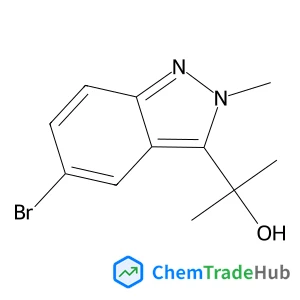
2-(5-Bromo-2-methyl-2H-indazol-3-yl)-2-propanol
CAS Number:
1823787-20-7
Molecular Formula:
C11H13BrN2O
Rajwinder Kaur, Mohamed M. Aboelnga, Dylan J. Nikkel, Stacey D. Wetmore
Nucleases catalyze the cleavage of phosphodiester bonds in nucleic acids using a range of metal cofactors. Although it is well accepted that many nucleases rely on two metal ions, the one-metal mediated pathway is debated. Furthermore, one-metal mediated nucleases maintain activity in the presence of many different metals, but the underlying reasons for this broad metal specificity are unknown. The human apurinic/apyrimidinic endonuclease (APE1), which plays a key role in DNA repair, transcription regulation, and gene expression, is a prototypical example of a one-metal dependent nuclease. Although Mg2+ is the native metal cofactor, APE1 remains catalytically active in the presence of several metals, with the rate decreasing as Mg2+ > Mn2+ > Ni2+ > Zn2+, while Ca2+ completely abolished the activity. The present work uses quantum mechanics–molecular mechanics techniques to map APE1-facilitated phosphodiester bond hydrolysis in the presence of these metals. The structural differences in stationary points along the reaction pathway shed light on the interplay between several factors that allow APE1 to remain catalytically active for various metals, with the trend in the barrier heights correlating with the experimentally reported APE1 catalytic activity. In contrast, Ca2+ significantly changes the metal coordination and active site geometry, and thus completely inhibits catalysis. Our work thereby provides support for the controversial single-metal mediated phosphodiester bond cleavage and clarifies uncertainties regarding the role of the metal and metal identity in this important reaction. This information is key for future medicinal and biotechnological applications including disease diagnosis and treatment, and protein engineering.
Ilya V. Pentin, J. Christian Schön, Martin Jansen
DOI: 10.1039/C004040C
Henar Hernández, J. C. Losada, R. M. Benito
DOI: 10.1039/B902486G
Michelle Everist, Jennifer A. MacNeil, Jonathan R. Moulins, Derek G. Leaist
DOI: 10.1039/B906452D
J. P. Buisson, N. Nomède Martyr, H. Bizot, A. Buelon, O. Chauvet
DOI: 10.1039/B907948C
Paolo Bartolini, Claudio Sangregorio, Andrea Taschin
DOI: 10.1039/B923682A
Y. G. Zhou, J. Xiao-Dong, Z. G. Wang, H. Y. Xiao, F. Gao, X. T. Zu
DOI: 10.1039/B918183K
Tiziana Del Giacco, Benedetta Carlotti, Stefano De Solis, Arianna Barbafina, Fausto Elisei
DOI: 10.1039/B927442A
When handling 2-Methyl-2-propanyl 5-amino-2-thiophenecarboxylate (CAS: 1498311-5...
5-Bromo-1,2-dichloro-3-fluorobenzene (CAS: 1000572-93-9) is a crystalline solid ...
(2R)-2-Amino-2-(4-bromophenyl)ethanol (CAS: 354153-64-3) should be stored in a c...
Methyl 4-(aminomethyl)tetrahydro-2H-pyran-4-carboxylate hydrochloride (CAS: 3627...
1,4-Dimethyl-1H-pyrazole-5-sulfonyl chloride is primarily used as an intermediat...
Dinaphtho[1,2-b:2',1'-d]furan is generally safe when handled with appropriate pe...
The market for 7-Methyl-7,9-dihydro-1H-purine-2,6,8(3H)-trione (CAS: 612-37-3) i...
2-(4-Chlorophenyl)malonaldehyde (CAS: 205676-17-1) is a colorless or light yello...
2-Methylchrysene (CAS: 3351-32-4) is typically synthesized via the reaction of c...
N-(6-aminopyrimidin-4-yl)acetamide (CAS: 89533-23-3) is generally considered saf...

Physical Chemistry Chemical Physics (PCCP) is an international journal co-owned by 19 physical chemistry and physics societies from around the world. This journal publishes original, cutting-edge research in physical chemistry, chemical physics and biophysical chemistry. To be suitable for publication in PCCP, articles must include significant innovation and/or insight into physical chemistry; this is the most important criterion that reviewers and Editors will judge against when evaluating submissions. The journal has a broad scope and welcomes contributions spanning experiment, theory, computation and data science. Topical coverage includes spectroscopy, dynamics, kinetics, statistical mechanics, thermodynamics, electrochemistry, catalysis, surface science, quantum mechanics, quantum computing and machine learning. Interdisciplinary research areas such as polymers and soft matter, materials, nanoscience, energy, surfaces/interfaces, and biophysical chemistry are welcomed if they demonstrate significant innovation and/or insight into physical chemistry. Joined experimental/theoretical studies are particularly appreciated when complementary and based on up-to-date approaches.
![3-[7-Amino-3-(3-pyridinyl)pyrazolo[1,5-a]pyrimidin-6-yl]phenol structure](https://static.chemtradehub.com/structs/861/861249-77-6-025b.webp "3-[7-Amino-3-(3-pyridinyl)pyrazolo[1,5-a]pyrimidin-6-yl]phenol structure")