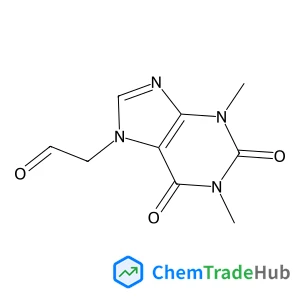
(1,3-Dimethyl-2,6-dioxo-1,2,3,6-tetrahydro-7H-purin-7-yl)acetaldehyde
CAS Number:
5614-53-9
Molecular Formula:
C9H10N4O3
Niklas Illmann, Iulia Patroescu-Klotz, Peter Wiesen
Organic acids are key species in determining the radiative properties of the atmosphere due to their contribution to particle formation. Reported discrepancies between field measurements and modelling suggest significant missing sources. Herein, we present a mechanistic investigation on the gas-phase ozonolysis of ethyl vinyl ketone (EVK, 1-penten-3-one), which we chose as a model compound for α,β-unsaturated ketones. Experiments were performed in a 1080 L quartz-glass reaction chamber (QUAREC) at 990 ± 15 mbar and 298 ± 2 K (r. h. ≪ 0.1%) and analysed via long-path FTIR spectrometry and PTR-ToF-MS. The experiments were performed in the presence of an excess of CO to suppress the chemistry of OH radicals. For a comprehensive picture, in selected experiments, SO2 was also added to the reaction system to scavenge the stabilized Criegee intermediates (sCIs) and to investigate their formation yield. Combining the results of both set-ups allowed us to quantify 2-oxobutanal, for which we report vapour-phase FTIR spectra. In addition, we introduce the first-ever infrared spectra of perpropionic acid, which was also positively identified in the EVK + O3 system. A detailed analysis of the experimental findings allowed us to link the identified reaction products (acetaldehyde, ethyl hydroperoxide, and perpropionic acid) to known bimolecular reactions of RO2 radicals. Thereby, it is shown that the EVK + O3 reaction yields formic acid, HC(O)OH, and propionic acid, C2H5C(O)OH, and their formation is not covered by mechanisms reported in the literature. Three different pathways accounting for their formation from chemically activated CIs are proposed and possible implications for the ozonolysis of α,β-unsaturated ketones in the atmosphere are discussed.
A. Mero, A. Grigoletto, K. Maso, H. Yoshioka, A. Rosato
DOI: 10.1039/C6PY01616B
Fandian Meng, Yunzhi Li, Wenjie Zhang, Shuhua Li, Yiwu Quan, Yixiang Cheng
DOI: 10.1039/C6PY02218A
Jiangang Xiao
DOI: 10.1039/C6PY00763E
Kosuke Hayakawa, Shin-ichi Matsuoka, Masato Suzuki
DOI: 10.1039/C7PY00794A
Jun Zhang, Heng Xu, Chen Zhou
DOI: 10.1039/C6PY00932H
Boyce S. Chang, Stephanie Oyola-Reynoso, Mingchang Lu
DOI: 10.1039/C7PY00416H
Friederike Fleischhaker
DOI: 10.1039/C6PY00867D
When handling 2-Methyl-2-propanyl 5-amino-2-thiophenecarboxylate (CAS: 1498311-5...
5-Bromo-1,2-dichloro-3-fluorobenzene (CAS: 1000572-93-9) is a crystalline solid ...
(2R)-2-Amino-2-(4-bromophenyl)ethanol (CAS: 354153-64-3) should be stored in a c...
Methyl 4-(aminomethyl)tetrahydro-2H-pyran-4-carboxylate hydrochloride (CAS: 3627...
1,4-Dimethyl-1H-pyrazole-5-sulfonyl chloride is primarily used as an intermediat...
Dinaphtho[1,2-b:2',1'-d]furan is generally safe when handled with appropriate pe...
The market for 7-Methyl-7,9-dihydro-1H-purine-2,6,8(3H)-trione (CAS: 612-37-3) i...
2-(4-Chlorophenyl)malonaldehyde (CAS: 205676-17-1) is a colorless or light yello...
2-Methylchrysene (CAS: 3351-32-4) is typically synthesized via the reaction of c...
N-(6-aminopyrimidin-4-yl)acetamide (CAS: 89533-23-3) is generally considered saf...

Physical Chemistry Chemical Physics (PCCP) is an international journal co-owned by 19 physical chemistry and physics societies from around the world. This journal publishes original, cutting-edge research in physical chemistry, chemical physics and biophysical chemistry. To be suitable for publication in PCCP, articles must include significant innovation and/or insight into physical chemistry; this is the most important criterion that reviewers and Editors will judge against when evaluating submissions. The journal has a broad scope and welcomes contributions spanning experiment, theory, computation and data science. Topical coverage includes spectroscopy, dynamics, kinetics, statistical mechanics, thermodynamics, electrochemistry, catalysis, surface science, quantum mechanics, quantum computing and machine learning. Interdisciplinary research areas such as polymers and soft matter, materials, nanoscience, energy, surfaces/interfaces, and biophysical chemistry are welcomed if they demonstrate significant innovation and/or insight into physical chemistry. Joined experimental/theoretical studies are particularly appreciated when complementary and based on up-to-date approaches.
![4-Chloro-N-{[4-(dimethylamino)phenyl]carbamoyl}benzenesulfonamide structure](https://static.chemtradehub.com/structs/558/5581-42-0-7dcb.webp "4-Chloro-N-{[4-(dimethylamino)phenyl]carbamoyl}benzenesulfonamide structure")
![2-[2-(2-Methoxyethoxy)ethoxy]-2-methylpropane structure](https://static.chemtradehub.com/structs/527/52788-79-1-71c1.webp "2-[2-(2-Methoxyethoxy)ethoxy]-2-methylpropane structure")