












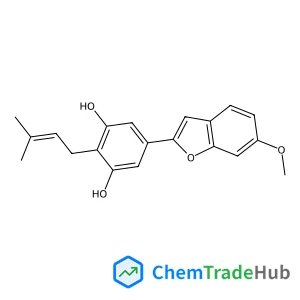
5-(6-Methoxy-1-benzofuran-2-yl)-2-(3-methyl-2-buten-1-yl)-1,3-benzenediol
CAS Number:
1017277-40-5
Molecular Formula:
C20H20O4
Gang Liu, Dong Fang, Yongjie Dan, Huan Luo, Cong Luo, Yanhua Niu, Guangxian Li
Imidazolium ionic liquids (ILs) with various alkyl chain lengths on the cations ([Cnmim]+, n = 2, 4 and 8) and different combined anions ([TFSI]− and [PF6]−) were blended with poly(methyl methacrylate) (PMMA), and the effects of the IL structure on the chain dynamics of PMMA were experimentally investigated by rheology and DSC measurements combined with a simulation method. The results indicate that the interaction between PMMA and ILs becomes stronger as the alkyl chain length on the imidazolium ring increases or the anion changes from [PF6]− to [TFSI]−. As a result, a higher critical entanglement concentration and a larger entanglement molecular weight of PMMA were found in [C8mim][TFSI] due to the stiffer conformation. Molecular dynamics (MD) simulations further demonstrated stronger interactions between PMMA and ILs with longer cationic alkyl chain lengths or [TFSI]− anions, which showed smaller Flory–Huggins interaction parameters and larger radii of gyration, Rg. However, the larger size of alkyl chains or [TFSI]− anions produced a larger free volume in the system as evidenced by positron annihilation lifetime spectroscopy (PALS), which competed with the molecular interaction and dominated the segmental motion. Therefore, a lower Tg and accelerated segmental relaxation were observed. Compared to alkyl chain length, the effect of anions on the interactions between ILs and PMMA is more prominent.
Daniel Oves-Costales, Lijiang Song, Gregory L. Challis
DOI: 10.1039/B823147H
Yingyu Li, Sanyan Cheng, Peichun Dai, Yanxiong Ke
DOI: 10.1039/B818553K
DOI: 10.1039/B820022J
Joe Briscoe, Diego E. Gallardo, Steve Dunn
DOI: 10.1039/B820797F
Winson M. J. Ma, Marta P. Pereira Morais, François D’Hooge, Jean M. H. van den Elsen, Jonathan P. L. Cox, Tony D. James, John S. Fossey
DOI: 10.1039/B814379J
Sumito Tokuji, Yuji Takahashi, Hideyuki Shinmori, Hiroshi Shinokubo, Atsuhiro Osuka
DOI: 10.1039/B819284G
Zuofeng Chen, Keith Man-Chung Wong, Vonika Ka-Man Au, Yanbing Zu, Vivian Wing-Wah Yam
DOI: 10.1039/B820400D
Daeseob Shim, Seung-Ho Jung, Eun-Ha Kim, Dong-Myung Yoon, Kun-Hong Lee, Soo-Hwan Jeong
DOI: 10.1039/B816534C
When handling 2-Methyl-2-propanyl 5-amino-2-thiophenecarboxylate (CAS: 1498311-5...
5-Bromo-1,2-dichloro-3-fluorobenzene (CAS: 1000572-93-9) is a crystalline solid ...
(2R)-2-Amino-2-(4-bromophenyl)ethanol (CAS: 354153-64-3) should be stored in a c...
Methyl 4-(aminomethyl)tetrahydro-2H-pyran-4-carboxylate hydrochloride (CAS: 3627...
1,4-Dimethyl-1H-pyrazole-5-sulfonyl chloride is primarily used as an intermediat...
Dinaphtho[1,2-b:2',1'-d]furan is generally safe when handled with appropriate pe...
The market for 7-Methyl-7,9-dihydro-1H-purine-2,6,8(3H)-trione (CAS: 612-37-3) i...
2-(4-Chlorophenyl)malonaldehyde (CAS: 205676-17-1) is a colorless or light yello...
2-Methylchrysene (CAS: 3351-32-4) is typically synthesized via the reaction of c...
N-(6-aminopyrimidin-4-yl)acetamide (CAS: 89533-23-3) is generally considered saf...

Physical Chemistry Chemical Physics (PCCP) is an international journal co-owned by 19 physical chemistry and physics societies from around the world. This journal publishes original, cutting-edge research in physical chemistry, chemical physics and biophysical chemistry. To be suitable for publication in PCCP, articles must include significant innovation and/or insight into physical chemistry; this is the most important criterion that reviewers and Editors will judge against when evaluating submissions. The journal has a broad scope and welcomes contributions spanning experiment, theory, computation and data science. Topical coverage includes spectroscopy, dynamics, kinetics, statistical mechanics, thermodynamics, electrochemistry, catalysis, surface science, quantum mechanics, quantum computing and machine learning. Interdisciplinary research areas such as polymers and soft matter, materials, nanoscience, energy, surfaces/interfaces, and biophysical chemistry are welcomed if they demonstrate significant innovation and/or insight into physical chemistry. Joined experimental/theoretical studies are particularly appreciated when complementary and based on up-to-date approaches.
![2,5-Dichloro-1H-pyrrolo[3,2-b]pyridine structure](https://static.chemtradehub.com/structs/100/1000342-87-9-f632.webp "2,5-Dichloro-1H-pyrrolo[3,2-b]pyridine structure")
![1-Oxa-8-azaspiro[4.5]decan-3-ol structure](https://static.chemtradehub.com/structs/757/757239-76-2-a0ec.webp "1-Oxa-8-azaspiro[4.5]decan-3-ol structure")




