












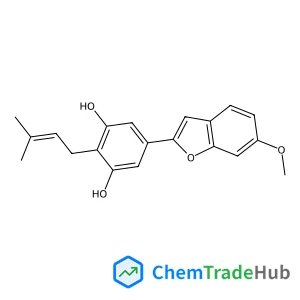
5-(6-Methoxy-1-benzofuran-2-yl)-2-(3-methyl-2-buten-1-yl)-1,3-benzenediol
CAS Number:
1017277-40-5
Molecular Formula:
C20H20O4
Huimin Guo, Zhiwen Lei, Xiaolin Ma, Siyu Liu, Yang Qiu, Jianzhang Zhao
The efficient and selective photocatalytic conversion of chemicals with visible light and naturally abundant resources has long been desired, but this requires finely designed sensitizers that are capable of converting light into chemical energy for the required energy/electron transfer, bond formation and scission, etc. Inspired by flavin (FL) based enzymes that are capable of initiating many redox reactions in biological systems in visible light, FL and naphthalimide chromophores were fused together as a heavy-atom-free triplet photosensitizer (NI-FL). It is expected that the extended conjugation within NI-FL may benefit absorption in the visible light range, promoting the intersystem crossing to triplet excited states for efficient chemoselective conversions. The absorption and emission maximum of NI-FL are redshifted by ∼40 nm and the absorption is more than doubled (1.53 × 10⁴ M−1 cm−1 at 484 nm) with respect to FL (7.5 × 10³ M−1 cm−1 at 439 nm), and a long-lived triplet excited state of intramolecular electron transfer nature was captured (τT = 45.3 μs). The performances of FL and NI-FL in the photooxidation of sulfides in air were also examined. Apart from nearly quantitative selectivity for sulfoxide, NI-FL demonstrates a 0.5–5 fold enhanced performance with respect to FL and the conversion proceeds through radical intermediates formed by electron transfer at excited states with substrates. Mechanistic investigation satisfactorily explained the observed photophysical properties and the dominant role of radical intermediates in the NI-FL catalyzed photooxidation. The findings may help to understand photooxidation sensitized by FL derivatives and benefit the design of novel efficient photosensitizers.
Ritu Kataky, Paula Lopes
DOI: 10.1039/B822685G
Dragoslav Vidovic, Glesni A. Pierce, Simon Aldridge
DOI: 10.1039/B816042B
Dae-Wi Yoon, Dustin E. Gross, Vincent M. Lynch, Chang-Hee Lee, Philip C. Bennett, Jonathan L. Sessler
DOI: 10.1039/B818077F
DOI: 10.1039/B820022J
Daeha Seo, Choong Il Yoo, Bong Hyun Chung, Im Sik Chung, Hyunjoon Song
DOI: 10.1039/B820220F
Jian-Hua Zhu, Shu-Hong Yu, An-Wu Xu, Helmut Cölfen
DOI: 10.1039/B817048G
Winson M. J. Ma, Marta P. Pereira Morais, François D’Hooge, Jean M. H. van den Elsen, Jonathan P. L. Cox, Tony D. James, John S. Fossey
DOI: 10.1039/B814379J
Karolina Kasperkiewicz, Jan-Willem G. Bos, Andrew N. Fitch, Kosmas Prassides, Serena Margadonna
DOI: 10.1039/B815830D
When handling 2-Methyl-2-propanyl 5-amino-2-thiophenecarboxylate (CAS: 1498311-5...
5-Bromo-1,2-dichloro-3-fluorobenzene (CAS: 1000572-93-9) is a crystalline solid ...
(2R)-2-Amino-2-(4-bromophenyl)ethanol (CAS: 354153-64-3) should be stored in a c...
Methyl 4-(aminomethyl)tetrahydro-2H-pyran-4-carboxylate hydrochloride (CAS: 3627...
1,4-Dimethyl-1H-pyrazole-5-sulfonyl chloride is primarily used as an intermediat...
Dinaphtho[1,2-b:2',1'-d]furan is generally safe when handled with appropriate pe...
The market for 7-Methyl-7,9-dihydro-1H-purine-2,6,8(3H)-trione (CAS: 612-37-3) i...
2-(4-Chlorophenyl)malonaldehyde (CAS: 205676-17-1) is a colorless or light yello...
2-Methylchrysene (CAS: 3351-32-4) is typically synthesized via the reaction of c...
N-(6-aminopyrimidin-4-yl)acetamide (CAS: 89533-23-3) is generally considered saf...

Physical Chemistry Chemical Physics (PCCP) is an international journal co-owned by 19 physical chemistry and physics societies from around the world. This journal publishes original, cutting-edge research in physical chemistry, chemical physics and biophysical chemistry. To be suitable for publication in PCCP, articles must include significant innovation and/or insight into physical chemistry; this is the most important criterion that reviewers and Editors will judge against when evaluating submissions. The journal has a broad scope and welcomes contributions spanning experiment, theory, computation and data science. Topical coverage includes spectroscopy, dynamics, kinetics, statistical mechanics, thermodynamics, electrochemistry, catalysis, surface science, quantum mechanics, quantum computing and machine learning. Interdisciplinary research areas such as polymers and soft matter, materials, nanoscience, energy, surfaces/interfaces, and biophysical chemistry are welcomed if they demonstrate significant innovation and/or insight into physical chemistry. Joined experimental/theoretical studies are particularly appreciated when complementary and based on up-to-date approaches.
![2-Bromo-7-chloro-4H-pyrrolo[2,3-b]pyrazine structure](https://static.chemtradehub.com/structs/115/1150617-58-5-0b0a.webp "2-Bromo-7-chloro-4H-pyrrolo[2,3-b]pyrazine structure")

![2-[2-(2-Methoxyethoxy)ethoxy]-2-methylpropane structure](https://static.chemtradehub.com/structs/527/52788-79-1-71c1.webp "2-[2-(2-Methoxyethoxy)ethoxy]-2-methylpropane structure")





