













Effect of simultaneous use of microwave and ultrasound irradiation on the sulfuric acid hydrolysis lignin (SAHL) depolymerization
Literature Information
Publication Date
2021-12-21
DOI
10.1039/D1SE01879E
Impact Factor
6.367
Authors
Masud Rana, Theoneste Nshizirungu, Jeong-Hun Park
View Original
Abstract
In this study, the individual and combined effects of microwave (MW) and ultrasound (US) processes on the depolymerization of sulfuric acid hydrolysis lignin (SAHL) were investigated in a hybrid microwave–ultrasound chemical reactor. Results revealed that the combined use of MW and US processes led to better results in terms of high yields of bio-oil and monomer production (43.01 and 6.69 wt%), as compared to the individual use of MW (32.83 and 4.71 wt%) and US (21.60 and 3.58 wt%) processes. The highest yield of bio-oil (63.50 wt%), which contained 13.04 wt% monomers, was achieved under the optimized reaction conditions of 180 °C, 80 min, 30% US frequency and a 1,4-dioxane to formic acid ratio of 250 : 50 (v/v). Process parameters such as temperature, time and the content of formic acid added to 1,4-dioxane were chosen carefully and optimized using response surface methodology (RSM). The results of the statistical analysis of variance (ANOVA) showed that the depolymerization temperature and time significantly affected (ρ < 0.05) the yield of bio-oil. In the liquid products, the compounds guaiacol (G1), ethanone, 1-(4-hydroxy-3-methoxyphenyl)-(G3), 2-(4-hydroxy-3-methoxyphenyl)acetaldehyde (G10), 4-ethyl phenol (H1), 4-methyl phenol (H4), and dibutyl phthalate (DBPH) were produced as major monomers. Meanwhile, the GPC results showed that the molecular weight of SAHL (Mw = ∼2156) was significantly reduced to lower molecular weight compounds (Mw = 638). The findings obtained from this study suggest that the applied MW–US-assisted lignin depolymerization process could be a promising alternative to the separate use of the MW or US process and can pave the way to continue advancing the lignin conversion practices as a renewable and sustainable resource of aromatic chemicals. Moreover, the proposed method is believed to possess great potential for conversion of a major waste stream from a pulp industry into aromatic chemical production. Future work will be directed toward the simultaneous use of MW–US-assisted depolymerization of lignin in a continuous flow process mimicking the optimized conditions obtained under batch MW–US conditions.
Related Literature
You might also like
Compound Q&A
What are the main uses of (3.beta.)-3-Hydroxy-N,N-dimethyl-chol-5-en-24-amide (CAS: 79066-03-8)?
(3.beta.)-3-Hydroxy-N,N-dimethyl-chol-5-en-24-amide (CAS: 79066-03-8) is primari...
79066-03-8(3.beta.)-3-Hydroxy-...
Compound Q&A
What regulatory guidelines apply to 5-(aminomethyl)-2-methoxyphenol (CAS: 89702-89-6)?
5-(Aminomethyl)-2-methoxyphenol (CAS: 89702-89-6) is classified under GHS as a s...
89702-89-65-(aminomethyl)-2-me...
Compound Q&A
What is Thieno[2,3-c]pyridin-7(6H)-one (CAS: 28981-13-7)?
Thieno[2,3-c]pyridin-7(6H)-one (CAS: 28981-13-7) is a heterocyclic organic compo...
28981-13-7Thieno[2,3-c]pyridin...
Compound Q&A
Is 1-[(6-Methoxy-3-pyridinyl)methyl]-4-piperidinamine dihydrochloride (CAS: 1185311-28-7) safe?
1-[(6-Methoxy-3-pyridinyl)methyl]-4-piperidinamine dihydrochloride is generally ...
1185311-28-71-[(6-Methoxy-3-pyri...
Compound Q&A
What regulatory guidelines apply to [(2E)-3-Phenyl-2-propen-1-yl]phosphonic acid (CAS: 146404-58-2)?
[(2E)-3-Phenyl-2-propen-1-yl]phosphonic acid (CAS: 146404-58-2) is regulated und...
146404-58-2[(2E)-3-Phenyl-2-pro...
Compound Q&A
What regulatory guidelines apply to 6-Bromo-7-methoxyquinoline (CAS: 1620515-86-7)?
6-Bromo-7-methoxyquinoline (CAS: 1620515-86-7) falls under the scope of the Glob...
1620515-86-76-Bromo-7-methoxyqui...
Compound Q&A
What industries use (2R)-1-(1-Benzofuran-2-yl)-N-propyl-2-pentanamine (CAS: 260550-89-8)?
This compound is primarily used in the pharmaceutical industry for the developme...
260550-89-8(2R)-1-(1-Benzofuran...
Compound Q&A
What are the main uses of 1-Ethyl-7-[2-methyl-6-(4H-1,2,4-triazol-3-yl)-3-pyridinyl]-3,5-dihydropyrazino[2,3-b]pyrazin-2(1H)-one (CAS: 1228013-15-7)?
1-Ethyl-7-[2-methyl-6-(4H-1,2,4-triazol-3-yl)-3-pyridinyl]-3,5-dihydropyrazino[2...
1228013-15-71-Ethyl-7-[2-methyl-...
Compound Q&A
Are there alternatives to {5-(Acryloylamino)-2-[(dimethylamino)methyl]phenyl}boronic acid (CAS: 1217500-78-1) in synthesis?
Alternative reagents such as 2-[(dimethylamino)methyl]phenylboronic acid or rela...
1217500-78-1{5-(Acryloylamino)-2...
Compound Q&A
What is 3-(Piperidin-4-yloxy)pyridine (CAS: 310881-48-2)?
3-(Piperidin-4-yloxy)pyridine (CAS: 310881-48-2) is an organic compound with the...
310881-48-23-(Piperidin-4-yloxy...
Source Journal
Recommended Compounds
![7-Bromo-5-chloro-1H-pyrazolo[4,3-b]pyridine structure](https://static.chemtradehub.com/structs/135/1351813-70-1-a716.webp "7-Bromo-5-chloro-1H-pyrazolo[4,3-b]pyridine structure")
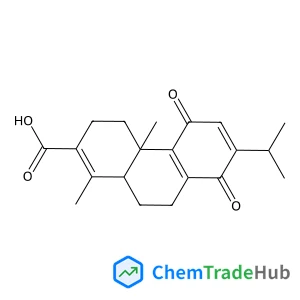
(4aS,10aS)-7-Isopropyl-1,4a-dimethyl-5,8-dioxo-3,4,4a,5,8,9,10,10a-octahydro-2-phenanthrenecarboxylic acid
CAS Number:
142950-86-5
Molecular Formula:
C20H24O4
Recommended Suppliers






Disclaimer
This page provides academic journal information for reference and research purposes only. We are not affiliated with any journal publishers and do not handle publication submissions. For publication-related inquiries, please contact the respective journal publishers directly.
If you notice any inaccuracies in the information displayed, please contact us at support@chemtradehub.com. We will promptly review and address your concerns.