













amine structure](https://static.chemtradehub.com/structs/629/62924-61-2-0728.webp "[(2-chlorophenyl)methyl](ethyl)amine structure")
Ultrahighly nitrogen-doped hollow carbon spheres with hierarchical pores for highly reversible lithium–sulfur batteries
Literature Information
Publication Date
2021-11-25
DOI
10.1039/D1SE01424B
Impact Factor
6.367
Authors
Qingkai Zeng, Xiaolan Li, Jinliang Zhu, Guifang Wang, Xiyong Chen, Shaojian Ma, Pei Kang Shen
View Original
Abstract
Carbon materials are widely used as cathode host materials for lithium–sulfur batteries due to their high specific surface area and high conductivity. Rational structural design can improve the sulfur storage capacity of carbon materials, and appropriate heteroatom doping can enhance the adsorption capacity for lithium polysulfides, thus improving the cycling stability of lithium–sulfur batteries. Herein, we synthesized nitrogen doped porous carbon spheres (NHCSs) with high nitrogen content as cathode host materials for lithium–sulfur batteries, and prepared porous carbon spheres with different nitrogen contents by heat treatment. In comparison, the porous carbon spheres with the highest nitrogen content possess the best polysulfide adsorption capacity and electrochemical activity, leading to a high initial capacity of 806.54 mA h g−1 at 2C and excellent capacity retention rate of 85.71% after 500 cycles. The high electrochemical reversibility and reaction mechanism of carbon spheres with high nitrogen content were confirmed by in situ Raman and in situ XRD. Moreover, NHCS-1/S still exhibits a high areal capacity of 4.11 mA h cm−2 even with a sulfur loading of 4 mg cm−2. This study provides a new strategy and direction for the design of carbon materials as cathode host materials for lithium–sulfur batteries.
Related Literature
The concepts of non-Gibbsian and non-Lewisian properties in chemical thermodynamics
João Carlos R. Reis, Michael J. Blandamer, Michael I. Davis, Gérard Douhéret
2001-03-16
Paper
DOI: 10.1039/B009512P
MgO(100) surface relaxation and vacancy defects: a semi-empirical quantum-chemical study
Paper
DOI: 10.1039/A906046D
Flow-distributed oscillation patterns in the Oregonator model
J. R. Bamforth, J. H. Merkin, S. K. Scott, R. Tóth, V. Gáspár
2001-03-20
Paper
DOI: 10.1039/B010094N
Studies on cobalt-tris(bipyridyl) complexes in acetonitrile–water mixtures
Gerhard Gritzner
2001-03-21
Paper
DOI: 10.1039/B100487P
X- and Q-band EPR of carbonate derived radicals in calcium apatites synthesized at high temperatures and heated tooth enamel
S. Amira, G. Vanhaelewyn, F. Callens
2001-03-16
Paper
DOI: 10.1039/B008249J
Nanosecond time resolved emission spectroscopy of aminocoumarins in AOT reversed micelles
Paper
DOI: 10.1039/A906191F
Phase transition and water molecules in titanylphthalocyanine phase Y crystal
Michael L. Klein
2001-03-14
Paper
DOI: 10.1039/B009490K
An analytical solution for the diffusion of electrolytes through a charge-mosaic membrane
Andriy E. Yaroshchuk
2001-04-11
Paper
DOI: 10.1039/B009186N
Network formation in polyethyleneglycol solutions. An intradiffusion study
Paper
DOI: 10.1039/A905035C
You might also like
Compound Q&A
What are the main uses of (3.beta.)-3-Hydroxy-N,N-dimethyl-chol-5-en-24-amide (CAS: 79066-03-8)?
(3.beta.)-3-Hydroxy-N,N-dimethyl-chol-5-en-24-amide (CAS: 79066-03-8) is primari...
79066-03-8(3.beta.)-3-Hydroxy-...
Compound Q&A
What regulatory guidelines apply to 5-(aminomethyl)-2-methoxyphenol (CAS: 89702-89-6)?
5-(Aminomethyl)-2-methoxyphenol (CAS: 89702-89-6) is classified under GHS as a s...
89702-89-65-(aminomethyl)-2-me...
Compound Q&A
What is Thieno[2,3-c]pyridin-7(6H)-one (CAS: 28981-13-7)?
Thieno[2,3-c]pyridin-7(6H)-one (CAS: 28981-13-7) is a heterocyclic organic compo...
28981-13-7Thieno[2,3-c]pyridin...
Compound Q&A
Is 1-[(6-Methoxy-3-pyridinyl)methyl]-4-piperidinamine dihydrochloride (CAS: 1185311-28-7) safe?
1-[(6-Methoxy-3-pyridinyl)methyl]-4-piperidinamine dihydrochloride is generally ...
1185311-28-71-[(6-Methoxy-3-pyri...
Compound Q&A
What regulatory guidelines apply to [(2E)-3-Phenyl-2-propen-1-yl]phosphonic acid (CAS: 146404-58-2)?
[(2E)-3-Phenyl-2-propen-1-yl]phosphonic acid (CAS: 146404-58-2) is regulated und...
146404-58-2[(2E)-3-Phenyl-2-pro...
Compound Q&A
What regulatory guidelines apply to 6-Bromo-7-methoxyquinoline (CAS: 1620515-86-7)?
6-Bromo-7-methoxyquinoline (CAS: 1620515-86-7) falls under the scope of the Glob...
1620515-86-76-Bromo-7-methoxyqui...
Compound Q&A
What industries use (2R)-1-(1-Benzofuran-2-yl)-N-propyl-2-pentanamine (CAS: 260550-89-8)?
This compound is primarily used in the pharmaceutical industry for the developme...
260550-89-8(2R)-1-(1-Benzofuran...
Compound Q&A
What are the main uses of 1-Ethyl-7-[2-methyl-6-(4H-1,2,4-triazol-3-yl)-3-pyridinyl]-3,5-dihydropyrazino[2,3-b]pyrazin-2(1H)-one (CAS: 1228013-15-7)?
1-Ethyl-7-[2-methyl-6-(4H-1,2,4-triazol-3-yl)-3-pyridinyl]-3,5-dihydropyrazino[2...
1228013-15-71-Ethyl-7-[2-methyl-...
Compound Q&A
Are there alternatives to {5-(Acryloylamino)-2-[(dimethylamino)methyl]phenyl}boronic acid (CAS: 1217500-78-1) in synthesis?
Alternative reagents such as 2-[(dimethylamino)methyl]phenylboronic acid or rela...
1217500-78-1{5-(Acryloylamino)-2...
Compound Q&A
What is 3-(Piperidin-4-yloxy)pyridine (CAS: 310881-48-2)?
3-(Piperidin-4-yloxy)pyridine (CAS: 310881-48-2) is an organic compound with the...
310881-48-23-(Piperidin-4-yloxy...
Source Journal
Recommended Compounds
![7-Bromo-5-chloro-1H-pyrazolo[4,3-b]pyridine structure](https://static.chemtradehub.com/structs/135/1351813-70-1-a716.webp "7-Bromo-5-chloro-1H-pyrazolo[4,3-b]pyridine structure")
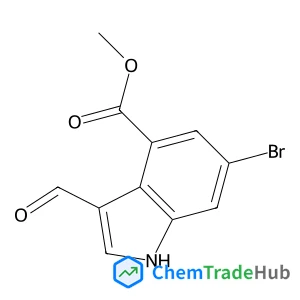
methyl 6-bromo-3-formyl-1H-indole-4-carboxylate
CAS Number:
1353636-63-1
Molecular Formula:
C11H8BrNO3
Recommended Suppliers





Disclaimer
This page provides academic journal information for reference and research purposes only. We are not affiliated with any journal publishers and do not handle publication submissions. For publication-related inquiries, please contact the respective journal publishers directly.
If you notice any inaccuracies in the information displayed, please contact us at support@chemtradehub.com. We will promptly review and address your concerns.