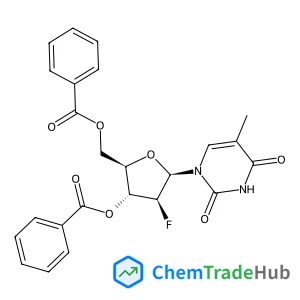
1-(3',5'-Di-O-benzoyl-2'-deoxy-2'-fluoro-b-D-arabinofuranosyl)thymine
CAS Number:
97614-47-6
Molecular Formula:
C24H21FN2O7
Regiane Priscila Ratti, Jefferson Gonçalves Filgueiras, Maurício Falvo, Marisa Aparecida Lima Coral, Francisco Eduardo Gontijo Guimaraes, Eduardo Ribeiro DeAzevedo, Igor Polikarpov
Sugarcane bagasse (SCB) is a promising feedstock for second-generation ethanol production. Bioconversion of lignocellulose into fermentable sugars involves several technological steps, with biomass pretreatment being among the most expensive ones. Here, we set out to investigate how SCB storage under industrial conditions influences SCB's enzymatic saccharification in the absence of pretreatment. Two sets of SCB samples, fresh (fSCB) and around 6 months aged (aSCB), were collected at relevant industrial settings and compared in terms of their chemical composition, physical structure and efficiency of enzymatic hydrolysis. Chemical and physical analyses revealed significant differences between these samples which had a significant impact on the SCB enzymatic conversion. X-Ray diffraction showed that an average crystallite size is about 20% smaller in aSCB as compared to fSCB. Field emission scanning electron microscopy characterization revealed that fSCB is mainly composed of uniform fibers, while aSCB fibers are more disorganized and unstructured. Confocal laser scanning microscopy images of aSCB demonstrated changes in the autofluorescence spectra, indicating alterations in the lignin structure. Nuclear magnetic resonance relaxometry showed differences in the accessibilities between fresh and aged SCB. Both aSCB and fSCB were hydrolyzed using 25 mg of Cellic® CTec3 per gram of biomass (about 4.1 FPU g−1), and after 96 hours of enzymatic hydrolysis of aSCB without any thermomechanical pretreatment, the yield reached 93% while the fSCB hydrolytic yield was almost 40% smaller. These results can have significant impacts on the optimization of lignocellulosic biomass conversion processes.

Herald of the Russian Academy of Sciences

Bioorganic & Medicinal Chemistry Letters

Journal of Asian Natural Products Research

Journal of Chemical Sciences

Polycyclic Aromatic Compounds

Medicinal Chemistry Research

Biocatalysis and Biotransformation

Topics in Catalysis

Chinese Journal of Chemistry

NDT & E International
Walter Richter, Gert Rapp, Alfred Blume
DOI: 10.1039/B009881G
João Carlos R. Reis, Michael J. Blandamer, Michael I. Davis, Gérard Douhéret
DOI: 10.1039/B009512P
Meike Warnken, Karoly Lázár, Michael Wark
DOI: 10.1039/B009045J
DOI: 10.1039/A905655F
Jovana Djordjevic, Vera Dondur, Radovan Dimitrijevic, Aleksandar Kremenovic
DOI: 10.1039/B009384J
Jacek Michalik, David Brown, Jong-Sung Yu, Marek Danilczuk, Jeong Yeon Kim, Larry Kevan
DOI: 10.1039/B008245G
C. G. Eisenhardt
DOI: 10.1039/B009507I
(3.beta.)-3-Hydroxy-N,N-dimethyl-chol-5-en-24-amide (CAS: 79066-03-8) is primari...
5-(Aminomethyl)-2-methoxyphenol (CAS: 89702-89-6) is classified under GHS as a s...
Thieno[2,3-c]pyridin-7(6H)-one (CAS: 28981-13-7) is a heterocyclic organic compo...
1-[(6-Methoxy-3-pyridinyl)methyl]-4-piperidinamine dihydrochloride is generally ...
[(2E)-3-Phenyl-2-propen-1-yl]phosphonic acid (CAS: 146404-58-2) is regulated und...
6-Bromo-7-methoxyquinoline (CAS: 1620515-86-7) falls under the scope of the Glob...
This compound is primarily used in the pharmaceutical industry for the developme...
1-Ethyl-7-[2-methyl-6-(4H-1,2,4-triazol-3-yl)-3-pyridinyl]-3,5-dihydropyrazino[2...
Alternative reagents such as 2-[(dimethylamino)methyl]phenylboronic acid or rela...
3-(Piperidin-4-yloxy)pyridine (CAS: 310881-48-2) is an organic compound with the...