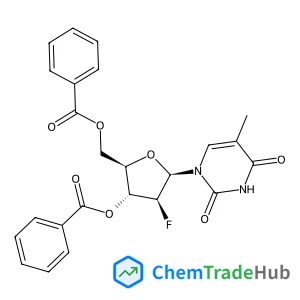
1-(3',5'-Di-O-benzoyl-2'-deoxy-2'-fluoro-b-D-arabinofuranosyl)thymine
CAS Number:
97614-47-6
Molecular Formula:
C24H21FN2O7
Chao Liu, Xin Gao, Caijun Zhangai, Ting Cheng, Yan Wang, Beibei Zhang, Pengyu Dong, Xiaowei Chen, Xinguo Xi, Zhigang Zou
The construction of a layered heterojunction photocatalyst could profoundly promote the charge carrier separation and thus boost the photocatalytic activity. In this work, a two-step exfoliation–reassembly process was first employed to prepare H+-restacked H+TiNbO5− nanosheets (HTN), which were then coupled with BiOCl to fabricate layered BiOCl/H+TiNbO5− (BTN) heterojunctions by a hydrothermal method. The photocatalytic performance of the as-prepared samples was evaluated by degrading rhodamine B (RhB) molecules under visible-light irradiation. Among BTN-X (X = 1, 3, 5 and 7) samples with different loading amounts of BiOCl, the BTN-3 sample showed the highest photodegradation efficiency (k = 0.0728 min−1) and excellent photostability. The improved photocatalytic activity was mainly due to the efficient charge carrier separation and transfer resulting from the layered heterostructure. The increased specific surface area and porous structure of BTN-3 could offer more active sites, which was beneficial for facilitating photocatalytic activity. The photoluminescence (PL) spectra and photo-electrochemical analysis confirmed that the formation of a layered heterojunction could shorten the charge migration distance and enlarge the contact area between BiOCl and HTN, leading to efficient separation and transfer of photoinduced charge carriers. Based on the results of active species trapping experiment and ESR spectra, the active species ˙O2− and h+ played a crucial role in degrading RhB molecules under visible light over BTN composites. A possible photocatalytic mechanism was proposed based on the experimental results. This work may provide an insight into the construction of layered heterostructured photocatalysts with high efficiency.
(3.beta.)-3-Hydroxy-N,N-dimethyl-chol-5-en-24-amide (CAS: 79066-03-8) is primari...
5-(Aminomethyl)-2-methoxyphenol (CAS: 89702-89-6) is classified under GHS as a s...
Thieno[2,3-c]pyridin-7(6H)-one (CAS: 28981-13-7) is a heterocyclic organic compo...
1-[(6-Methoxy-3-pyridinyl)methyl]-4-piperidinamine dihydrochloride is generally ...
[(2E)-3-Phenyl-2-propen-1-yl]phosphonic acid (CAS: 146404-58-2) is regulated und...
6-Bromo-7-methoxyquinoline (CAS: 1620515-86-7) falls under the scope of the Glob...
This compound is primarily used in the pharmaceutical industry for the developme...
1-Ethyl-7-[2-methyl-6-(4H-1,2,4-triazol-3-yl)-3-pyridinyl]-3,5-dihydropyrazino[2...
Alternative reagents such as 2-[(dimethylamino)methyl]phenylboronic acid or rela...
3-(Piperidin-4-yloxy)pyridine (CAS: 310881-48-2) is an organic compound with the...
![(3E)-3-[4-Hydroxy-3,5-bis(2-methyl-2-propanyl)benzylidene]dihydro-2(3H)-furanone structure](https://static.chemtradehub.com/structs/102/102271-49-8-cba7.webp "(3E)-3-[4-Hydroxy-3,5-bis(2-methyl-2-propanyl)benzylidene]dihydro-2(3H)-furanone structure")