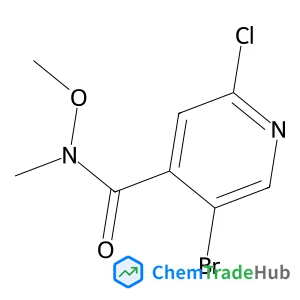
5-Bromo-2-chloro-N-methoxy-N-methylisonicotinamide
CAS Number:
1256790-08-5
Molecular Formula:
C8H8BrClN2O2
A green and facile strategy was designed to fabricate Ni3S2-doped carbon nanosheets (Ni3S2@CN). In this strategy, sodium lignosulfonate was introduced as a sulfur source and carbon source to form the Ni3S2-doped carbon nanosheets. Nickel nitrate hexahydrate was added as a nickel source, and boric acid was used as a template agent for the formation of carbon nanosheets. As the supercapacitor electrode, Ni3S2@CN-0.4-600 exhibited a specific capacitance of 374.5 F g−1 at the current density of 1 A g−1, and achieved cyclic stability (82.9%) after 5000 charge/discharge cycles. The advantage of Ni3S2-doped carbon nanosheets compared to conventional products lies in its simplicity of the synthesis process and easily available biomass-feedstock. On the other hand, waste liquid discharge and process costs were further reduced by the recycling of boric acid templates, which provided a cost-efficient and environmentally friendly way to prepare carbon nanosheets. The facile and green one-step preparation of the Ni3S2-doped carbon nanosheet has been rarely reported previously. Thus, we wish to report the novel design and efficient electrocatalytic performance of the Ni3S2-doped carbon nanosheet in this work.

Electroanalysis

Chinese Journal of Chemistry

Heteroatom Chemistry

Acta Metallurgica Sinica-English Letters

Journal of Chemical Sciences

Bioorganic & Medicinal Chemistry

Journal of the Indian Institute of Science

Colloid Journal

Polycyclic Aromatic Compounds

Critical Reviews in Solid State and Materials Sciences
Davide Barreca, Franca Morazzoni, Gian Andrea Rizzi, Roberto Scotti, Eugenio Tondello
DOI: 10.1039/B009482J
M. Gabriela Lagorio, Enrique San Román, André Zeug, Jörg Zimmermann, Beate Röder
DOI: 10.1039/B100077M
László Biczók, Pierre Valat, Véronique Wintgens
DOI: 10.1039/B100692O
Gauthier Vanhaelewyn, Philippe Lahorte, Frank De Proft, Wim Mondelaers, Paul Geerlings, Freddy Callens
DOI: 10.1039/B008248L
DOI: 10.1039/A905655F
Francesca Benevelli, Waclaw Kolodziejski, Krzysztof Wozniak, Jacek Klinowski
DOI: 10.1039/B100894N
Yufeng Lei, Anqiang Zhang, Yaling Lin
DOI: 10.1039/D1PY00623A
Louise Breloy, Ozgur Yavuz, Ismail Yilmaz, Yusuf Yagci, Davy-Louis Versace
DOI: 10.1039/D1PY00462J
(3.beta.)-3-Hydroxy-N,N-dimethyl-chol-5-en-24-amide (CAS: 79066-03-8) is primari...
5-(Aminomethyl)-2-methoxyphenol (CAS: 89702-89-6) is classified under GHS as a s...
Thieno[2,3-c]pyridin-7(6H)-one (CAS: 28981-13-7) is a heterocyclic organic compo...
1-[(6-Methoxy-3-pyridinyl)methyl]-4-piperidinamine dihydrochloride is generally ...
[(2E)-3-Phenyl-2-propen-1-yl]phosphonic acid (CAS: 146404-58-2) is regulated und...
6-Bromo-7-methoxyquinoline (CAS: 1620515-86-7) falls under the scope of the Glob...
This compound is primarily used in the pharmaceutical industry for the developme...
1-Ethyl-7-[2-methyl-6-(4H-1,2,4-triazol-3-yl)-3-pyridinyl]-3,5-dihydropyrazino[2...
Alternative reagents such as 2-[(dimethylamino)methyl]phenylboronic acid or rela...
3-(Piperidin-4-yloxy)pyridine (CAS: 310881-48-2) is an organic compound with the...