













A new allotrope of carbon-graphdiyne, synthesis and application in photocatalytic hydrogen evolution with surface plasmon resonance enhancement
Literature Information
Publication Date
2021-07-19
DOI
10.1039/D1SE00668A
Impact Factor
6.367
Authors
Zhiliang Jin, Yue Cao
View Original
Abstract
Graphdiyne (GDY, g-CnH2n−2) is a new type of carbon material and is a promising material for efficient photocatalytic hydrogen evolution. In this work, the GDY was successfully synthesized using a unique method based on CuI as a template. The CuI had a catalytic effect, and it can deliver copper ions (Cu+) under pyridine conditions. In addition, eosin-Y (EY) sensitized GDY located with Au nanoparticles (NPs) (EY-GA-40) had the highest H2 evolution activities achieved: 319.1 μmol after five hours under visible light irradiation, and this was 245.4 times higher than the value achieved with unmodified GDY, due to the dual electron injection (DEI) effect. The DEI effect meant that both the EY and the Au NPs could supply electrons for the GDY under illumination. The GDY had a strong ability to absorb the dye molecules, which enabled the excitation state electron of the EY to transfer to the surface of the GDY. The conduction band (CB) of the GDY is lower than the surface plasmon resonance (SPR) state of the Au NPs. Hence, the excited energetic electrons in the SPR state can be injected into the CB of GDY and thus they can participate in the hydrogen evolution reaction (HER) on the surface of GDY. Meanwhile, the LUMO potential of EY is more negative than the CB of the GDY, so the electrons can be easily injected into the CB of the GDY. Hence, the photocatalytic hydrogen evolution activity of the GDY showed a great improvement because of the DEI effect. This work not only provides a novel approach for the application of GDY but also contributes a new strategy for the modification of catalysts.
Recommended Journals
Related Literature
Dynamics of the OH( = 1,2,4) + O3 atmospheric reaction
L. Zhang, A. J. C. Varandas
2001-03-20
Paper
DOI: 10.1039/B010149O
The energetically favorable cis peptide bond for the azaglycine-containing peptide: For-AzGly-NH2 model
Ho-Jin Lee, Jong-Won Song, Young-Sang Choi, Seonggu Ro, Chang-Ju Yoon
2001-04-04
Paper
DOI: 10.1039/B009651M
Nanosecond time resolved emission spectroscopy of aminocoumarins in AOT reversed micelles
Paper
DOI: 10.1039/A906191F
Atomistic simulation and molecular dynamics of model systems for perfluorinated ionomer membranes
Paper
DOI: 10.1039/A905267D
Intermolecular electron transfer in merocyanine aggregates studied by optical and transient EPR methods
Lorenzo Franco, Luigi Pasimeni, Glauco Ponterini, Marco Ruzzi, Ulderico Segre
2001-04-03
Paper
DOI: 10.1039/B009427G
Incorporation of magnesium in mesostructured and mesoporous aluminophosphates
2001-03-14
Paper
DOI: 10.1039/B010029N
The concepts of non-Gibbsian and non-Lewisian properties in chemical thermodynamics
João Carlos R. Reis, Michael J. Blandamer, Michael I. Davis, Gérard Douhéret
2001-03-16
Paper
DOI: 10.1039/B009512P
Network formation in polyethyleneglycol solutions. An intradiffusion study
Paper
DOI: 10.1039/A905035C
You might also like
Compound Q&A
What are the main uses of (3.beta.)-3-Hydroxy-N,N-dimethyl-chol-5-en-24-amide (CAS: 79066-03-8)?
(3.beta.)-3-Hydroxy-N,N-dimethyl-chol-5-en-24-amide (CAS: 79066-03-8) is primari...
79066-03-8(3.beta.)-3-Hydroxy-...
Compound Q&A
What regulatory guidelines apply to 5-(aminomethyl)-2-methoxyphenol (CAS: 89702-89-6)?
5-(Aminomethyl)-2-methoxyphenol (CAS: 89702-89-6) is classified under GHS as a s...
89702-89-65-(aminomethyl)-2-me...
Compound Q&A
What is Thieno[2,3-c]pyridin-7(6H)-one (CAS: 28981-13-7)?
Thieno[2,3-c]pyridin-7(6H)-one (CAS: 28981-13-7) is a heterocyclic organic compo...
28981-13-7Thieno[2,3-c]pyridin...
Compound Q&A
Is 1-[(6-Methoxy-3-pyridinyl)methyl]-4-piperidinamine dihydrochloride (CAS: 1185311-28-7) safe?
1-[(6-Methoxy-3-pyridinyl)methyl]-4-piperidinamine dihydrochloride is generally ...
1185311-28-71-[(6-Methoxy-3-pyri...
Compound Q&A
What regulatory guidelines apply to [(2E)-3-Phenyl-2-propen-1-yl]phosphonic acid (CAS: 146404-58-2)?
[(2E)-3-Phenyl-2-propen-1-yl]phosphonic acid (CAS: 146404-58-2) is regulated und...
146404-58-2[(2E)-3-Phenyl-2-pro...
Compound Q&A
What regulatory guidelines apply to 6-Bromo-7-methoxyquinoline (CAS: 1620515-86-7)?
6-Bromo-7-methoxyquinoline (CAS: 1620515-86-7) falls under the scope of the Glob...
1620515-86-76-Bromo-7-methoxyqui...
Compound Q&A
What industries use (2R)-1-(1-Benzofuran-2-yl)-N-propyl-2-pentanamine (CAS: 260550-89-8)?
This compound is primarily used in the pharmaceutical industry for the developme...
260550-89-8(2R)-1-(1-Benzofuran...
Compound Q&A
What are the main uses of 1-Ethyl-7-[2-methyl-6-(4H-1,2,4-triazol-3-yl)-3-pyridinyl]-3,5-dihydropyrazino[2,3-b]pyrazin-2(1H)-one (CAS: 1228013-15-7)?
1-Ethyl-7-[2-methyl-6-(4H-1,2,4-triazol-3-yl)-3-pyridinyl]-3,5-dihydropyrazino[2...
1228013-15-71-Ethyl-7-[2-methyl-...
Compound Q&A
Are there alternatives to {5-(Acryloylamino)-2-[(dimethylamino)methyl]phenyl}boronic acid (CAS: 1217500-78-1) in synthesis?
Alternative reagents such as 2-[(dimethylamino)methyl]phenylboronic acid or rela...
1217500-78-1{5-(Acryloylamino)-2...
Compound Q&A
What is 3-(Piperidin-4-yloxy)pyridine (CAS: 310881-48-2)?
3-(Piperidin-4-yloxy)pyridine (CAS: 310881-48-2) is an organic compound with the...
310881-48-23-(Piperidin-4-yloxy...
Source Journal
Recommended Compounds
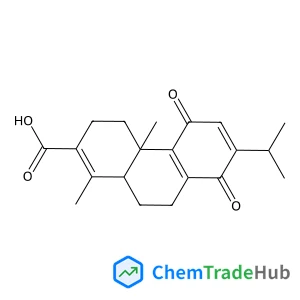
(4aS,10aS)-7-Isopropyl-1,4a-dimethyl-5,8-dioxo-3,4,4a,5,8,9,10,10a-octahydro-2-phenanthrenecarboxylic acid
CAS Number:
142950-86-5
Molecular Formula:
C20H24O4
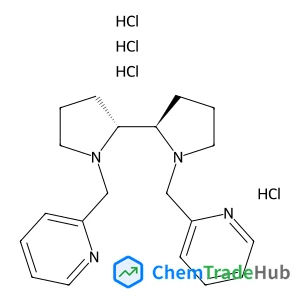
(2R,2'R)-1,1'-Bis(2-pyridinylmethyl)-2,2'-bipyrrolidine tetrahydrochloride
CAS Number:
1228077-88-0
Molecular Formula:
C20H30Cl4N4
Recommended Suppliers





Disclaimer
This page provides academic journal information for reference and research purposes only. We are not affiliated with any journal publishers and do not handle publication submissions. For publication-related inquiries, please contact the respective journal publishers directly.
If you notice any inaccuracies in the information displayed, please contact us at support@chemtradehub.com. We will promptly review and address your concerns.