



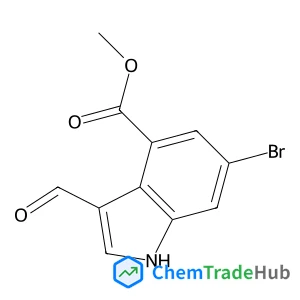
methyl 6-bromo-3-formyl-1H-indole-4-carboxylate
CAS Number:
1353636-63-1
Molecular Formula:
C11H8BrNO3
Irshad Mohammad, Lucie Blondeau, Eddy Foy, Jocelyne Leroy, Eric Leroy, Hicham Khodja, Magali Gauthier
Following the trends of alloys as negative electrodes for Na-ion batteries, the sodiation of a nanostructured InSb intermetallic compound was investigated. The benefit of coupling Sb with In was evaluated through the chemical reduction synthesis of InSb in the form of nanostructured particles assembled in micrometric aggregates. After full structural, morphological and surface characterizations, the electrochemical performance of the nanostructured InSb compound was examined in a carbonated electrolyte with fluoroethylene carbonate (FEC) as the additive. Its performance turns out to be remarkable with a capacity of around 450 mA h g−1 after 50 cycles at C/5. In terms of cyclability, the capacity of InSb is impressively stable at 1C with a capacity retention of 96% up to 100 cycles, in contrast to the strong capacity decay observed for a nanostructured Sb electrode. A good high-rate behavior is also observed with a capacity of 310 mA h g−1 at 5C. The better stability of the InSb compound compared to pure Sb suggests that combining In with Sb improves the ability of the material to alleviate volume expansion and mechanical stress during the repeated sodiation/desodiation processes. X-ray photoelectron spectroscopy and electrochemical impedance spectroscopy studies on cycled electrodes were finally implemented to shed light, respectively, on the surface chemistry and electrochemical stability behavior of the promising InSb compound.

Polycyclic Aromatic Compounds

Journal of the Indian Institute of Science

Bioorganic & Medicinal Chemistry

Heteroatom Chemistry

Colloid Journal

Acta Metallurgica Sinica-English Letters

Biocatalysis and Biotransformation

Journal of Asian Natural Products Research

NDT & E International

Critical Reviews in Solid State and Materials Sciences
Gerhard Gritzner
DOI: 10.1039/B100487P
Daniel R. Tackley, Geoffrey Dent, W. Ewen Smith
DOI: 10.1039/B007763L
Mauricia Schettino, Rosana M. Romano, Alexander Yu. Makarov, Andrey V. Zibarev
DOI: 10.1039/B009433L
Matthew R. Bockman, Rishad J. Dalal, Ramya Kumar, Theresa M. Reineke
DOI: 10.1039/D1PY00250C
DOI: 10.1039/B100238O
Lorenzo Franco, Luigi Pasimeni, Glauco Ponterini, Marco Ruzzi, Ulderico Segre
DOI: 10.1039/B009427G
Prathyusha Chimala, M. Mario Perera, Aissatou Wade, Tucker McKenzie, Joshua Allor, Neil Ayres
DOI: 10.1039/D1PY00560J
Ian C. Hamilton, George J. Kakabadse, Sue Le Vent
DOI: 10.1039/B009408K
(3.beta.)-3-Hydroxy-N,N-dimethyl-chol-5-en-24-amide (CAS: 79066-03-8) is primari...
5-(Aminomethyl)-2-methoxyphenol (CAS: 89702-89-6) is classified under GHS as a s...
Thieno[2,3-c]pyridin-7(6H)-one (CAS: 28981-13-7) is a heterocyclic organic compo...
1-[(6-Methoxy-3-pyridinyl)methyl]-4-piperidinamine dihydrochloride is generally ...
[(2E)-3-Phenyl-2-propen-1-yl]phosphonic acid (CAS: 146404-58-2) is regulated und...
6-Bromo-7-methoxyquinoline (CAS: 1620515-86-7) falls under the scope of the Glob...
This compound is primarily used in the pharmaceutical industry for the developme...
1-Ethyl-7-[2-methyl-6-(4H-1,2,4-triazol-3-yl)-3-pyridinyl]-3,5-dihydropyrazino[2...
Alternative reagents such as 2-[(dimethylamino)methyl]phenylboronic acid or rela...
3-(Piperidin-4-yloxy)pyridine (CAS: 310881-48-2) is an organic compound with the...
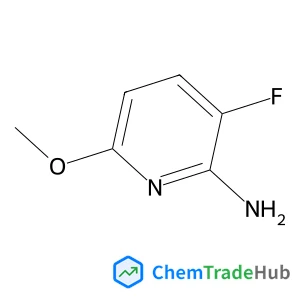
![Ethanone, 1-[4-chloro-2-(methylthio)-5-pyrimidinyl]- structure](https://static.chemtradehub.com/structs/661/66116-82-3-863e.webp "Ethanone, 1-[4-chloro-2-(methylthio)-5-pyrimidinyl]- structure")
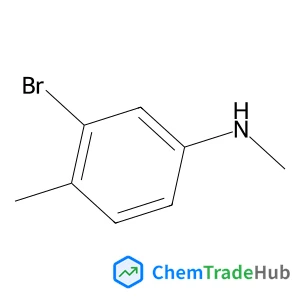
![(3E)-3-[4-Hydroxy-3,5-bis(2-methyl-2-propanyl)benzylidene]dihydro-2(3H)-furanone structure](https://static.chemtradehub.com/structs/102/102271-49-8-cba7.webp "(3E)-3-[4-Hydroxy-3,5-bis(2-methyl-2-propanyl)benzylidene]dihydro-2(3H)-furanone structure")



