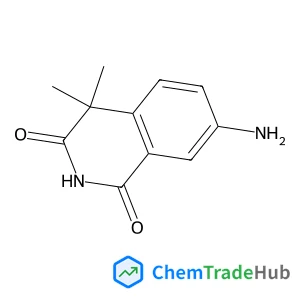
1,3(2H,4H)-Isoquinolinedione, 7-amino-4,4-dimethyl-
CAS Number:
14576-22-8
Molecular Formula:
C11H12N2O2
Xingjie Zhang, Di Qi, Chenchen Jiao, Zhiguo Zhang, Xiaopan Liu, Guisheng Zhang
The direct iminoalkynylation of unactivated olefins with terminal alkynes is achieved for the first time by nickel-catalyzed cascade iminyl-radical cyclization/Sonogashira-type coupling of γ,δ-unsaturated oxime esters under mild conditions. This transformation allows for rapid construction of two challenging C(sp3)–N and C(sp3)–C(sp) bonds in a single step and enables facile access to various N-heterocycles including the challenging fused and spiro ones. Furthermore, the avoidance of using pre-activated alkynylating reagents and the tolerance of γ-H in oxime esters make it a straightforward and practical approach for the synthesis of alkyne-labelled pyrrolines, which widely exist in pharmaceutically relevant architectures. The use of readily available coupling partners, broad substrate scope, good functional group compatibility and versatile product derivatizations bode well for the widespread applications of this method in synthetic chemistry, biochemistry and materials science.

Organic Preparations and Procedures International

Journal of Organometallic Chemistry

Israel Journal of Chemistry

European Journal of Wood and Wood Products

Proceedings of the National Academy of Sciences of the United States of America

Journal of Physics and Chemistry of Solids

Fibre Chemistry

Planta Medica

Pure and Applied Chemistry

Kinetics and Catalysis
DOI: 10.1039/D0CP01095B
Ala’a F. Eftaiha, Abdussalam K. Qaroush, Ahed W. Alsayyed, Feda’a Al-Qaisi, Fatima Alsoubani, Khaleel I. Assaf
DOI: 10.1039/D0CP00629G
V. Esteso, L. G. MacDowell, D. F. Parsons, F. Spallek, H. Míguez, C. Persson, Stefan Yoshi Buhmann, I. Brevik
DOI: 10.1039/C9CP06836H
Peter Licence, Chi-Linh Do-Thanh, Huimin Luo, Sheng Dai
DOI: 10.1039/D0CP01454K
Jia Song, De Ning, Henny J. M. Bouwmeester
DOI: 10.1039/D0CP00247J
Junling Ma, Minjun Yang, Christopher Batchelor-McAuley, Richard G. Compton
DOI: 10.1039/D0CP01904F
Zhefu Li, Gregory A. Voth
DOI: 10.1039/D0CP00378F
Xiang-Ming Wang, Song-Hai Wu, Hai-Tao Ren, Peng-Yue Zhu, Cong Wang, Yong Liu, Shi-Wei Sun, Xiao-Cong Zhang, Yi-Ying Lin, Zi-He Meng, Shao-Yi Jia
DOI: 10.1039/D0CP00569J
Jieren Song, Chaocan Cai, Yujiao Bai, Linlin Miao, Rongguo Wang
DOI: 10.1039/D0CP01727B
4-Nitrophenyl phosphate disodium salt hexahydrate is primarily used as a substra...
2-(Trifluoromethyl)-1,3-oxazole-4-carboxylic Acid (CAS: 1060816-01-4) is widely ...
2-Fluoro-4-biphenylcarboxylic acid should be stored in a cool, dry place at room...
Prednisolone-21-Carboxylic Acid is primarily used in the pharmaceutical industry...
4-(Hydrazinomethyl)-1,2,3-benzenetriol (CAS: 3614-72-0) should be stored in a co...
4-Amino-1-methyl-1H-pyrazole-5-carboxylic acid hydrochloride (CAS: 92534-70-8) i...
Dehydropachymic acid (CAS: 77012-31-8) is regulated by various agencies. It fall...
The market and research trends for 6-[(2,2-Dimethylpropanoyl)amino]nicotinic aci...
1,10-Phenanthroline-2,9-dicarbaldehyde should be stored in a cool, dry place awa...
5-Carbamoyl-11-oxo-10,11-dihydro-5H-dibenzo[b,f]azepin-10-yl acetate can be synt...

Organic Chemistry Frontiers publishes high-quality research from across organic chemistry. Emphases are placed on studies that make significant contributions to the field of organic chemistry by reporting either new or significantly improved protocols or methodologies. Topics include, but are not limited to the following: Organic synthesis Development of synthetic methodologies Catalysis Natural products Functional organic materials Supramolecular and macromolecular chemistry Physical and computational organic chemistry