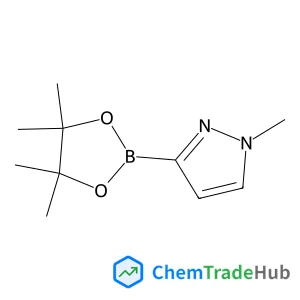
1-Methyl-3-(4,4,5,5-tetramethyl-1,3,2-dioxaborolan-2-yl)-1H-pyrazole
CAS Number:
1020174-04-2
Molecular Formula:
C10H17BN2O2
Xiaoyun Ran, Qian Zhou, Jin Zhang, Shanqiang Wang, Gui Wang, Hui Yang, Xiaochun Liu, Zhouyu Wang
Starting from citric acid (CA) and ethylenediamine derivatives, a solvent-free, catalyst-free and high yielding synthesis approach for bicyclic 2-pyridones is presented. By continuously modifying the core structure, a series of novel and bright fluorophores with outstanding endoplasmic reticulum targeting properties (Pearson's coefficients = 0.89–0.97) and antibacterial activities were obtained. Theoretical calculations and single-crystal structures were further investigated to help reveal the structure–activity relationship. The green preparation method and excellent biological properties make these bicyclic 2-pyridone derivatives very promising for future applications.

Pure and Applied Chemistry

Proceedings of the National Academy of Sciences of the United States of America

Journal of Physics and Chemistry of Solids

Pharmacological Reviews

Fibre Chemistry

Science Progress

European Journal of Wood and Wood Products

Journal of Heterocyclic Chemistry

Kinetics and Catalysis

Journal of Organometallic Chemistry
DOI: 10.1039/C7CP01455D
Andrew A. Peterson, Rune Christensen, Alireza Khorshidi
DOI: 10.1039/C7CP00375G
Xiaoxiao Cao, Yingying Huang, Xue Jiang, Yan Su, Jijun Zhao
DOI: 10.1039/C7CP01147D
Leigh Weston, A. Janotti, X. Y. Cui, C. Stampfl, C. G. Van de Walle
DOI: 10.1039/C7CP01471F
Hong-Yu Fu, Ning Xu, Yi-Min Pan, Xiao-Lin Lu, Min Xia
DOI: 10.1039/C7CP01281K
Krista M. Cosert, Rebecca J. Steidl, Angelines Castro-Forero, Robert M. Worden, Gemma Reguera
DOI: 10.1039/C7CP00885F
Ryo Furuta, Naoyuki Kurake, Kenji Ishikawa, Keigo Takeda, Hiroshi Hashizume, Hiroki Kondo, Takayuki Ohta, Masafumi Ito, Makoto Sekine, Masaru Hori
DOI: 10.1039/C7CP00489C
Johann Lüder, Mun Ho Cheow, Sergei Manzhos
DOI: 10.1039/C7CP01554B
Thomas Rüther, Mitsuhiro Kanakubo, Adam S. Best, Kenneth R. Harris
DOI: 10.1039/C7CP01272A
Jorge Royes, Víctor Polo, Santiago Uriel, Luis Oriol, Milagros Piñol, Rosa M. Tejedor
DOI: 10.1039/C7CP01739A
Waste containing N-Methoxy-N-methyl-1,3-thiazole-5-carboxamide (CAS: 898825-89-3...
N-(4-Biphenylyl)dibenzo[b,d]furan-4-amine should be stored in a tightly sealed c...
The market for 3-Acetamido-5-amino-2,4,6-triiodobenzoic acid (CAS: 1713-07-1) is...
Benzyl 2-O-acetyl-3,4,6-tri-O-benzyl-beta-D-galactopyranoside (CAS: 61820-03-9) ...
2-Ethylpiperazine dihydrochloride (CAS: 438050-52-3) is regulated under the Glob...
1,1'-[1,3-Phenylenebis(methylene)]bis(3-methyl-1H-pyrrole-2,5-dione) (CAS: 11946...
Several alternatives can be used in the synthesis of 5-Fluoro-2-(1-pyrrolidinyl)...
Proper personal protective equipment (PPE) must be worn when handling this compo...
When handling 6-Bromoimidazo[1,2-a]pyridin-8-amine, it is important to wear appr...
Alternatives to (2S,4R)-4-(4-Nitrobenzyl)pyrrolidine-2-carboxylic acid hydrochlo...

Organic Chemistry Frontiers publishes high-quality research from across organic chemistry. Emphases are placed on studies that make significant contributions to the field of organic chemistry by reporting either new or significantly improved protocols or methodologies. Topics include, but are not limited to the following: Organic synthesis Development of synthetic methodologies Catalysis Natural products Functional organic materials Supramolecular and macromolecular chemistry Physical and computational organic chemistry