



The effect of storage cycle on improvement in the photovoltaic parameters of planar triple cation perovskite solar cells
Literature Information
Publication Date
2021-06-23
DOI
10.1039/D1MA00345C
Impact Factor
0
Authors
Vera La Ferrara, Antonella De Maria, Gabriella Rametta, Paola Delli Veneri
View Original
Abstract
One of the important challenges in the field of perovskite solar cells is to investigate the competitive mechanisms of humidity and oxygen which improve the efficiency of cells at moderate humidity and cause the degradation of perovskites at high levels of moisture. We found that when an un-encapsulated standard planar architecture, glass/ITO/SnO2/triple cation perovskite/Spiro-OMeTAD/Au, was realized, exposure to moderate humid air was always needed for proper functioning. We investigated the fabrication and storage procedures of thin (∼320 nm) triple cation perovskite solar cells showing, for the first time, to the best of our knowledge, a remarkable enhancement of all photovoltaic parameters compared to those of pristine cells (with the fill factor exceeding 80%, a short circuit current density of about 24 mA cm−2 and an open circuit voltage of 1121 mV, for champion devices) and, particularly, an impressive increase of power conversion efficiency (PCE) from 13.2% to 20.8% after 72 h of storage in air with moderate humidity. A slight PCE increase to 20.9% was also achieved after subsequent low vacuum storage and after 720 h from the fabrication day. Moreover, devices exhibiting hysteresis-free behavior after storage were characterized for evaluating the mechanism of charge carrier recombination by means of dark and light current density–voltage and illumination-dependent photovoltaic parameters. The storage cycle shown in this work could be a possible route to improve the performance of pristine perovskite solar cells and consequently to proceed with encapsulation procedures.
Recommended Journals

Journal of Catalysis

European Journal of Wood and Wood Products

Pure and Applied Chemistry

Organic Preparations and Procedures International

Helvetica Chimica Acta

Nature

Journal of Heterocyclic Chemistry

Proceedings of the National Academy of Sciences of the United States of America

Pharmacological Reviews

Journal of Organometallic Chemistry
Related Literature
3-D bond-paths of QTAIM and the stress tensor in neutral lithium clusters, Lim (m = 2–5), presented on the Ehrenfest force molecular graph
Alireza Azizi, Roya Momen, Steven R. Kirk, Samantha Jenkins
2019-12-10
Paper
DOI: 10.1039/C9CP05066C
The dual-defective SnS2 monolayers: promising 2D photocatalysts for overall water splitting
2019-11-08
Paper
DOI: 10.1039/C9CP04649F
Mechanism and theory of d-glucopyranose homogeneous acid catalysis in the aqueous solution phase
Karla Dussan
2019-07-15
Paper
DOI: 10.1039/C8CP07224H
Defining aluminum-zoning during synthesis of ZSM-5 zeolites
Teng Li, Frank Krumeich, Ming Chen, Zhiqiang Ma
2019-12-02
Paper
DOI: 10.1039/C9CP05423E
Polypyrrole derivatives for optoelectronic applications: a DFT study on the influence of side groups
Alex Pifer Coleone, Leonardo Gois Lascane
2019-07-23
Paper
DOI: 10.1039/C9CP02638J
Prototypical cyclohexane dimers: spectroscopic evidence for σ stacking at low temperatures
N. Ramanathan, Shubhra Sarkar, K. Sundararajan
2019-12-02
Paper
DOI: 10.1039/C9CP05237B
Rate coefficient of the reaction CH2OO + NO2 probed with a quantum-cascade laser near 11 μm
Pei-Ling Luo, Chen-An Chung
2019-07-26
Paper
DOI: 10.1039/C9CP03333E
Ab initio study of a 2D h-BAs monolayer: a promising anode material for alkali-metal ion batteries
Amitava Banerjee, Younes Benhouria
2019-07-23
Paper
DOI: 10.1039/C9CP03242H
Two-dimensional transition-metal halide CoBr3 with spin-polarized Dirac cone
Wei-xi Zhang, Yong Li, Hui Jin, Yan-chao She
2019-07-18
Paper
DOI: 10.1039/C9CP03337H
Theoretical insights into the effect of the overpotential on CO electroreduction mechanisms on Cu(111): regulation and application of electrode potentials from a CO coverage-dependent electrochemical model
Lihui Ou, Junxiang Chen
2019-11-25
Paper
DOI: 10.1039/C9CP05043D
You might also like
Compound Q&A
What precautions should be taken when handling 4-Methyl-6-(trifluoromethyl)quinoline (CAS: 40716-16-3)?
When handling 4-Methyl-6-(trifluoromethyl)quinoline (CAS: 40716-16-3), safety go...
40716-16-34-Methyl-6-(trifluor...
Compound Q&A
What is 4-(3,5-Difluorophenyl)aniline (CAS: 405058-00-6)?
4-(3,5-Difluorophenyl)aniline is an aromatic organic compound with the CAS numbe...
405058-00-64-(3,5-Difluoropheny...
Compound Q&A
How is 5-{[4-(Trifluoromethyl)phenyl]sulfanyl}-1,2,3-thiadiazole-4-carboxylic acid (CAS: 338982-07-3) typically synthesized?
5-{[4-(Trifluoromethyl)phenyl]sulfanyl}-1,2,3-thiadiazole-4-carboxylic acid can ...
338982-07-35-{[4-(Trifluorometh...
Compound Q&A
What is the market or research trend for 4-Benzylaniline hydrochloride (CAS: 6317-57-3)?
The market for 4-Benzylaniline hydrochloride (CAS: 6317-57-3) is steadily growin...
6317-57-34-Benzylaniline hydr...
Compound Q&A
Is [3-(Diethylsulfamoyl)phenyl]boronic acid (CAS: 871329-58-7) safe?
[3-(Diethylsulfamoyl)phenyl]boronic acid is generally considered safe when handl...
871329-58-7[3-(Diethylsulfamoyl...
Compound Q&A
What are the main uses of 3-Bromo-2,5-dimethoxyaniline (CAS: 115929-62-9)?
3-Bromo-2,5-dimethoxyaniline is mainly used in the pharmaceutical and chemical i...
115929-62-93-Bromo-2,5-dimethox...
Compound Q&A
What regulatory guidelines apply to N-Methyl-1-(5-methyl-1H-indol-3-yl)methanamine (CAS: 915922-67-7)?
N-Methyl-1-(5-methyl-1H-indol-3-yl)methanamine (CAS: 915922-67-7) is subject to ...
915922-67-7N-Methyl-1-(5-methyl...
Compound Q&A
What industries use Carbamic acid, N-[(5S)-5,6-diamino-6-oxohexyl]-, 1,1-dimethylethyl ester (CAS: 24828-96-4)?
This compound is primarily used in the pharmaceutical industry for the synthesis...
24828-96-4Carbamic acid, N-[(5...
Compound Q&A
How should 2-Methyl-2-propanyl [(1S,3R)-3-aminocyclohexyl]carbamate (CAS: 1298101-47-9) be stored?
2-Methyl-2-propanyl [(1S,3R)-3-aminocyclohexyl]carbamate (CAS: 1298101-47-9) sho...
1298101-47-92-Methyl-2-propanyl ...
Compound Q&A
What industries use Ethyl 2-bromo-4,4,4-trifluorobutanoate (CAS: 367-33-9)?
Ethyl 2-bromo-4,4,4-trifluorobutanoate (CAS: 367-33-9) is utilized in the pharma...
367-33-9Ethyl 2-bromo-4,4,4-...
Source Journal
Recommended Compounds
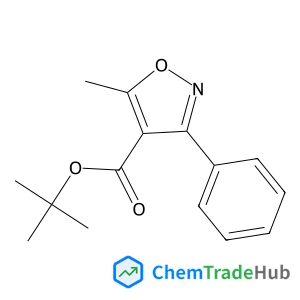
2-Methyl-2-propanyl 5-methyl-3-phenyl-1,2-oxazole-4-carboxylate
CAS Number:
211429-79-7
Molecular Formula:
C15H17NO3
![N-{3-[Benzyl(methyl)amino]propyl}-9-chloro-5,6,7,8-tetrahydro-2-acridinecarboxamide structure](https://static.chemtradehub.com/structs/142/1426944-49-1-1e4c.webp "N-{3-[Benzyl(methyl)amino]propyl}-9-chloro-5,6,7,8-tetrahydro-2-acridinecarboxamide structure")
N-{3-[Benzyl(methyl)amino]propyl}-9-chloro-5,6,7,8-tetrahydro-2-acridinecarboxamide
CAS Number:
1426944-49-1
Molecular Formula:
C25H28ClN3O

Recommended Suppliers







Disclaimer
This page provides academic journal information for reference and research purposes only. We are not affiliated with any journal publishers and do not handle publication submissions. For publication-related inquiries, please contact the respective journal publishers directly.
If you notice any inaccuracies in the information displayed, please contact us at support@chemtradehub.com. We will promptly review and address your concerns.