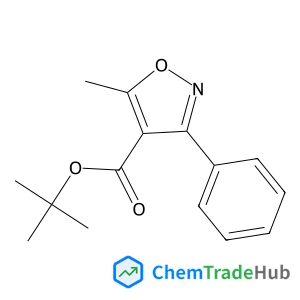
2-Methyl-2-propanyl 5-methyl-3-phenyl-1,2-oxazole-4-carboxylate
CAS Number:
211429-79-7
Molecular Formula:
C15H17NO3
Alex Pifer Coleone, Leonardo Gois Lascane
Conjugated organic polymers have been considered interesting materials for various technological applications, mainly due to their unique optoelectronic properties and the variety of methods employed in their synthesis. In this context, polypyrrole (PPy) derivatives have been widely employed. The great versatility of synthesis of this material allows the production of a number of derivatives with distinct properties, allowing their application in several areas. In this report, aiming to guide the design of compounds with specific features, electronic structure calculations were conducted to evaluate the influence of side groups in the structural, optical and electronic properties of PPy derivatives. The calculations were carried out for oligomeric systems in the framework of density functional theory. Preliminary benchmark studies were conducted by employing two distinct functionals for geometry optimization and evaluation of optoelectronic properties. Comparative studies of the bond length alternation, spatial and energetic distribution of the frontier orbitals, electronic gaps, exciton binding energies, optical absorption spectra and electronic density of states were conducted for each derivative and the influence of the side groups was discussed in terms of their electron donation/withdrawing properties. A set of simple rules (linear equations) was proposed for the prediction of optoelectronic properties of PPy derivatives. In particular, the results have shown that simple Hammett parameters of side groups are sufficient to enable the design of improved materials.
When handling 4-Methyl-6-(trifluoromethyl)quinoline (CAS: 40716-16-3), safety go...
4-(3,5-Difluorophenyl)aniline is an aromatic organic compound with the CAS numbe...
5-{[4-(Trifluoromethyl)phenyl]sulfanyl}-1,2,3-thiadiazole-4-carboxylic acid can ...
The market for 4-Benzylaniline hydrochloride (CAS: 6317-57-3) is steadily growin...
[3-(Diethylsulfamoyl)phenyl]boronic acid is generally considered safe when handl...
3-Bromo-2,5-dimethoxyaniline is mainly used in the pharmaceutical and chemical i...
N-Methyl-1-(5-methyl-1H-indol-3-yl)methanamine (CAS: 915922-67-7) is subject to ...
This compound is primarily used in the pharmaceutical industry for the synthesis...
2-Methyl-2-propanyl [(1S,3R)-3-aminocyclohexyl]carbamate (CAS: 1298101-47-9) sho...
Ethyl 2-bromo-4,4,4-trifluorobutanoate (CAS: 367-33-9) is utilized in the pharma...

Physical Chemistry Chemical Physics (PCCP) is an international journal co-owned by 19 physical chemistry and physics societies from around the world. This journal publishes original, cutting-edge research in physical chemistry, chemical physics and biophysical chemistry. To be suitable for publication in PCCP, articles must include significant innovation and/or insight into physical chemistry; this is the most important criterion that reviewers and Editors will judge against when evaluating submissions. The journal has a broad scope and welcomes contributions spanning experiment, theory, computation and data science. Topical coverage includes spectroscopy, dynamics, kinetics, statistical mechanics, thermodynamics, electrochemistry, catalysis, surface science, quantum mechanics, quantum computing and machine learning. Interdisciplinary research areas such as polymers and soft matter, materials, nanoscience, energy, surfaces/interfaces, and biophysical chemistry are welcomed if they demonstrate significant innovation and/or insight into physical chemistry. Joined experimental/theoretical studies are particularly appreciated when complementary and based on up-to-date approaches.
![Methyl 3-({2'-[(E)-(hydroxyhydrazono)methyl]-4-biphenylyl}methyl)-2-oxo-2,3-dihydro-1H-benzimidazole-4-carboxylate structure](https://static.chemtradehub.com/structs/149/1499167-72-4-034a.webp "Methyl 3-({2'-[(E)-(hydroxyhydrazono)methyl]-4-biphenylyl}methyl)-2-oxo-2,3-dihydro-1H-benzimidazole-4-carboxylate structure")