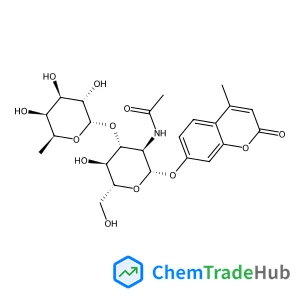
4-Methyl-2-oxo-2H-chromen-7-yl 2-acetamido-2-deoxy-3-O-(6-deoxy-alpha-L-galactopyranosyl)-beta-D-glucopyranoside
CAS Number:
383160-12-1
Molecular Formula:
C24H31NO12
Yi Ren
In this paper, an actively tunable and switchable multi-functional terahertz metamaterial device based on a hybrid vanadium dioxide (VO2)–graphene integrated configuration is proposed. By transiting the phase of VO2, the functions of the proposed device can be reversibly switched between asymmetric transmission (AT) and two different polarization conversions in the terahertz region. When VO2 operates at the isolating state, the AT effect can be achieved with a maximum value of 0.34 for linearly polarized lights due to the excitation of enantiomerically sensitive plasmons in patterned graphene nanostructures. Furthermore, when VO2 is transited from the isolating state to the conducting state, the metamaterial does not only exhibit a linear dichroism response but also perform linear-to-linear and linear-to-circular polarization conversions simultaneously. Specifically, the designed device behaves like a half-wave plate, where a linear polarization conversion ratio exceeds 96.5% at a frequency of 9.17 THz. Meanwhile, it acts as a quarter-wave plate which can convert the linear polarization light into left-handed and right-handed circularly polarized lights with high efficiencies at frequencies of 9.04 and 9.3 THz, respectively. Moreover, the performance of the designed structure can be actively controlled by adjusting the geometrical parameters and Fermi energy of graphene. This work provides a new avenue in developing multi-functional terahertz metamaterial devices.
Dongsook Chang, Christopher N. Lam, Shengchang Tang, Bradley D. Olsen
DOI: 10.1039/C4PY00448E
Hui-Ju Chuang, Chen-Yu Li, Bao-Tsan Ko, Chia-Her Lin
DOI: 10.1039/C4PY00528G
Marcela Castano, Matthew L. Becker
DOI: 10.1039/C4PY00569D
Tao Zhang, Tao Chen, Ihsan Amin, Rainer Jordan
DOI: 10.1039/C4PY00346B
Benjamin B. Noble, Leesa M. Smith, Michelle L. Coote
DOI: 10.1039/C4PY00190G
Xue-Song Ge, Chen He, Wei-Dong He, Sheng-Qi Chen
DOI: 10.1039/C4PY00425F
Beibei Qiu, Xuewen Chen, Lu Xiao, Yongfang Li, Yuehui He, Lihui Jiang
DOI: 10.1039/C4PY00392F
When handling lithium chloride hydrate (1:1:1) (CAS: 16712-20-2), it is importan...
4-(4H-1,2,4-Triazol-4-yl)piperidine is generally considered safe for use in phar...
Waste containing 1,3-Thiazole-2-carboxamide (CAS: 16733-85-0) should be collecte...
5-(Difluoromethyl)-2-fluorobenzonitrile (CAS: 934175-58-3) is subject to regulat...
Methyl 3-acetamido-2-thiophenecarboxylate can be synthesized by the reaction of ...
4-Isoquinolinecarbonitrile is a chemical compound with the CAS number 34846-65-6...
Store Methyl 1H-1,2,3-triazole-4-carboxylate (CAS: 877309-59-6) in a cool, dry p...
6-Bromo[1,3]thiazolo[5,4-b]pyridin-2-amine (CAS: 1160791-13-8) is subject to the...
(2S,3S)-2-Ammonio-3-(3,4-dihydroxyphenyl)-3-hydroxypropanoate (CAS: 23651-95-8) ...
7-Bromo-3-methyl-3,4-dihydroquinazolin-4-one is a solid with a crystalline form....

Physical Chemistry Chemical Physics (PCCP) is an international journal co-owned by 19 physical chemistry and physics societies from around the world. This journal publishes original, cutting-edge research in physical chemistry, chemical physics and biophysical chemistry. To be suitable for publication in PCCP, articles must include significant innovation and/or insight into physical chemistry; this is the most important criterion that reviewers and Editors will judge against when evaluating submissions. The journal has a broad scope and welcomes contributions spanning experiment, theory, computation and data science. Topical coverage includes spectroscopy, dynamics, kinetics, statistical mechanics, thermodynamics, electrochemistry, catalysis, surface science, quantum mechanics, quantum computing and machine learning. Interdisciplinary research areas such as polymers and soft matter, materials, nanoscience, energy, surfaces/interfaces, and biophysical chemistry are welcomed if they demonstrate significant innovation and/or insight into physical chemistry. Joined experimental/theoretical studies are particularly appreciated when complementary and based on up-to-date approaches.
![6,6-Dimethylbicyclo[3.1.1]hept-2-ene-2-carbaldehyde structure](https://static.chemtradehub.com/structs/564/564-94-3-e746.webp "6,6-Dimethylbicyclo[3.1.1]hept-2-ene-2-carbaldehyde structure")
![[(2R)-6,6-Dimethyl-2-morpholinyl]methanol hydrochloride (1:1) structure](https://static.chemtradehub.com/structs/141/1416444-88-6-e06a.webp "[(2R)-6,6-Dimethyl-2-morpholinyl]methanol hydrochloride (1:1) structure")