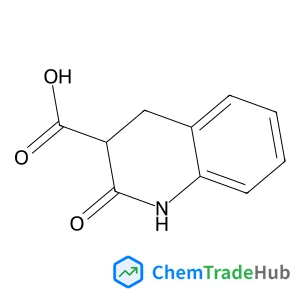
2-Oxo-1,2,3,4-tetrahydro-3-quinolinecarboxylic acid
CAS Number:
246867-17-4
Molecular Formula:
C10H9NO3
Xin Liu, Dingbo Zhang, Yuanzheng Chen, Hui Wang, Hongyan Wang, Yuxiang Ni
Thermoelectric (TE) materials as one of the effective solutions to the energy crisis are gaining more and more interest owing to their capability to generate electricity from waste heat without generating air pollution. In this work, the TE properties of α-XP monolayers such as the stability, electronic structure, electrical and phonon transport were thoroughly studied in combination with the first-principles calculations and Boltzmann transport equations. We found that α-SbP and α-BiP have indirect bandgaps of 0.85 eV and 0.73 eV, respectively, which are suitable for thermoelectric materials. Furthermore, due to the multiple valleys at the energy band edges and the high carrier mobility, α-XP possesses both large Seebeck coefficients and high electrical conductivities. It is also found that the lattice thermal conductivity of α-BiP is smaller than that of α-SbP due to lower phonon frequencies, smaller phonon group velocities, larger Grüneisen parameters and higher phonon relaxation times. High TE performance was achieved with the ZT values reaching 4.59 (for α-BiP at 500 K) and 1.34 (for α-SbP at 700 K). Our results quantify α-XP monolayers as promising candidates for building outstanding thermoelectric devices.
Cathal Smyth, Daniel G. Oblinsky, Gregory D. Scholes
DOI: 10.1039/C5CP00295H
Zheng-Hua Tan, Rui Yang, Kazuya Terabe, Xue-Bing Yin, Xin Guo
DOI: 10.1039/C5CP06484H
Qiaohong Li, Luyang Qiao, Ruiping Chen, Zuju Ma, Rui Si, Yuangen Yao, Kechen Wu
DOI: 10.1039/C5CP07309J
Tomofumi Tada, Kazunari Yoshizawa
DOI: 10.1039/C5CP05423K
Sumita Das
DOI: 10.1039/C5CP04716A
Chi Chen, Zarah Medina Baiyee, Xin Chen, Chunming Niu
DOI: 10.1039/C5CP05722A
Tetsu Yonezawa, Yoshiki Uchida, Hiroki Tsukamoto
DOI: 10.1039/C5CP06107E
Mohammed Ahmed, Ajay K. Singh, Jahur A. Mondal
DOI: 10.1039/C5CP07014G
Harald Ceymann, Moritz Balkenhohl, Alexander Schmiedel, Marco Holzapfel, Christoph Lambert
DOI: 10.1039/C5CP06917C
Ludmila B. Boinovich, Alexandre M. Emelyanenko, Kirill A. Emelyanenko, Konstantin I. Maslakov
DOI: 10.1039/C5CP06988B
When handling 2-Methyl-2-propanyl 5-amino-2-thiophenecarboxylate (CAS: 1498311-5...
5-Bromo-1,2-dichloro-3-fluorobenzene (CAS: 1000572-93-9) is a crystalline solid ...
(2R)-2-Amino-2-(4-bromophenyl)ethanol (CAS: 354153-64-3) should be stored in a c...
Methyl 4-(aminomethyl)tetrahydro-2H-pyran-4-carboxylate hydrochloride (CAS: 3627...
1,4-Dimethyl-1H-pyrazole-5-sulfonyl chloride is primarily used as an intermediat...
Dinaphtho[1,2-b:2',1'-d]furan is generally safe when handled with appropriate pe...
The market for 7-Methyl-7,9-dihydro-1H-purine-2,6,8(3H)-trione (CAS: 612-37-3) i...
2-(4-Chlorophenyl)malonaldehyde (CAS: 205676-17-1) is a colorless or light yello...
2-Methylchrysene (CAS: 3351-32-4) is typically synthesized via the reaction of c...
N-(6-aminopyrimidin-4-yl)acetamide (CAS: 89533-23-3) is generally considered saf...

Physical Chemistry Chemical Physics (PCCP) is an international journal co-owned by 19 physical chemistry and physics societies from around the world. This journal publishes original, cutting-edge research in physical chemistry, chemical physics and biophysical chemistry. To be suitable for publication in PCCP, articles must include significant innovation and/or insight into physical chemistry; this is the most important criterion that reviewers and Editors will judge against when evaluating submissions. The journal has a broad scope and welcomes contributions spanning experiment, theory, computation and data science. Topical coverage includes spectroscopy, dynamics, kinetics, statistical mechanics, thermodynamics, electrochemistry, catalysis, surface science, quantum mechanics, quantum computing and machine learning. Interdisciplinary research areas such as polymers and soft matter, materials, nanoscience, energy, surfaces/interfaces, and biophysical chemistry are welcomed if they demonstrate significant innovation and/or insight into physical chemistry. Joined experimental/theoretical studies are particularly appreciated when complementary and based on up-to-date approaches.
![2,5-Dichloro-1H-pyrrolo[3,2-b]pyridine structure](https://static.chemtradehub.com/structs/100/1000342-87-9-f632.webp "2,5-Dichloro-1H-pyrrolo[3,2-b]pyridine structure")