












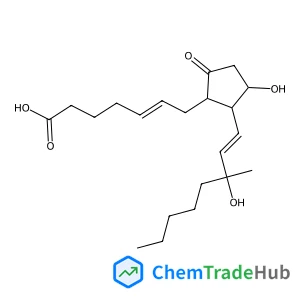
(5Z,11alpha,13E,15R)-11,15-Dihydroxy-15-methyl-9-oxoprosta-5,13-dien-1-oic acid
CAS Number:
55028-70-1
Molecular Formula:
C21H34O5
Yuping Wang, Shuhua Shi, Ruishan Tan, Wei Yan, Delu Gao, Dunyou Wang
We report a time-dependent, full dimensional, wave-packet calculation for the reaction of OH + DBr to examine the effect of the energy efficiency on the reactivity. This study shows that the vibrational excitations of the OH and DBr enhance the reaction. However, the rotational excitations of OH and DBr both hinder the reaction. As a result, the vibrational energies of both the OH and DBr reactants are more efficient at promoting the reactivity than the translational energy, while the rotational energies of OH and DBr are less effective than the translational energy. By analyzing the state population of the vibrational and rotational states along the reaction pathway, we also developed an approach in order to explain the enhancement of the vibrational excitation and the hindrance of the rotational excitation of the reaction. We found that the initial-state selected vibrational excited states of OH and DBr are the dominant components, respectively, for surmounting the barrier. However, the initial-state selected rotational excited states of OH and DBr are no longer the dominant states for surmounting the transition state owing to their population changes in the van der Waals well. This quantitative analysis demonstrates the potential well in the entrance valley plays an important role in the energy efficiency with regards to the reactivity.
Wibe A. de Jong, Eric Bylaska, Niranjan Govind, Curtis L. Janssen, Karol Kowalski, Thomas Müller, Ida M. B. Nielsen, Hubertus J. J. van Dam, Valera Veryazov, Roland Lindh
DOI: 10.1039/C002859B
Simon Mathieu, Georges Trinquier
DOI: 10.1039/B908152F
Salim Nassreddine, Gérard Bergeret, Bernadette Jouguet, Christophe Geantet, Laurent Piccolo
DOI: 10.1039/B925062J
Tiziana Del Giacco, Benedetta Carlotti, Stefano De Solis, Arianna Barbafina, Fausto Elisei
DOI: 10.1039/B927442A
Selvarengan Paranthaman, François-Xavier Coudert, Alain H. Fuchs
DOI: 10.1039/B925074C
Dorota Koziej, Michael Hübner, Nicolae Barsan, Udo Weimar, Marcin Sikora, Jan-Dierk Grunwaldt
DOI: 10.1039/B906829E
When handling 2-Methyl-2-propanyl 5-amino-2-thiophenecarboxylate (CAS: 1498311-5...
5-Bromo-1,2-dichloro-3-fluorobenzene (CAS: 1000572-93-9) is a crystalline solid ...
(2R)-2-Amino-2-(4-bromophenyl)ethanol (CAS: 354153-64-3) should be stored in a c...
Methyl 4-(aminomethyl)tetrahydro-2H-pyran-4-carboxylate hydrochloride (CAS: 3627...
1,4-Dimethyl-1H-pyrazole-5-sulfonyl chloride is primarily used as an intermediat...
Dinaphtho[1,2-b:2',1'-d]furan is generally safe when handled with appropriate pe...
The market for 7-Methyl-7,9-dihydro-1H-purine-2,6,8(3H)-trione (CAS: 612-37-3) i...
2-(4-Chlorophenyl)malonaldehyde (CAS: 205676-17-1) is a colorless or light yello...
2-Methylchrysene (CAS: 3351-32-4) is typically synthesized via the reaction of c...
N-(6-aminopyrimidin-4-yl)acetamide (CAS: 89533-23-3) is generally considered saf...

Physical Chemistry Chemical Physics (PCCP) is an international journal co-owned by 19 physical chemistry and physics societies from around the world. This journal publishes original, cutting-edge research in physical chemistry, chemical physics and biophysical chemistry. To be suitable for publication in PCCP, articles must include significant innovation and/or insight into physical chemistry; this is the most important criterion that reviewers and Editors will judge against when evaluating submissions. The journal has a broad scope and welcomes contributions spanning experiment, theory, computation and data science. Topical coverage includes spectroscopy, dynamics, kinetics, statistical mechanics, thermodynamics, electrochemistry, catalysis, surface science, quantum mechanics, quantum computing and machine learning. Interdisciplinary research areas such as polymers and soft matter, materials, nanoscience, energy, surfaces/interfaces, and biophysical chemistry are welcomed if they demonstrate significant innovation and/or insight into physical chemistry. Joined experimental/theoretical studies are particularly appreciated when complementary and based on up-to-date approaches.
![4-Chloro-N-{[4-(dimethylamino)phenyl]carbamoyl}benzenesulfonamide structure](https://static.chemtradehub.com/structs/558/5581-42-0-7dcb.webp "4-Chloro-N-{[4-(dimethylamino)phenyl]carbamoyl}benzenesulfonamide structure")
![1-Oxa-8-azaspiro[4.5]decan-3-ol structure](https://static.chemtradehub.com/structs/757/757239-76-2-a0ec.webp "1-Oxa-8-azaspiro[4.5]decan-3-ol structure")
methyl]-N,2-dimethyl-2-propanesulfinamide structure](https://static.chemtradehub.com/structs/256/2565792-50-7-8a26.webp "N-[(R)-[3-(Benzyloxy)-2-(dicyclohexylphosphino)phenyl](phenyl)methyl]-N,2-dimethyl-2-propanesulfinamide structure")




