












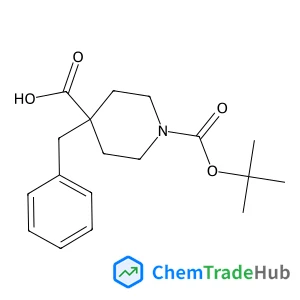
4-Benzyl-1-(tert-butoxycarbonyl)piperidine-4-carboxylic acid
CAS Number:
170838-87-6
Molecular Formula:
C18H25NO4
A. Martín Pendás, E. Francisco
The prevailing magnetic spin coupling paradigm is based on a one-electron picture, and is therefore orbital dependent and unsatisfactory from a physical point of view. We examine it under a truly invariant real space perspective, focusing on the role of electron delocalization. We show that this view, compatible with orbital thinking, overcomes its limitations. By examining simple model systems we show that it is electron delocalization that drives any singlet–triplet gap, and that delocalization and ionic mixing are two sides of the same reality. It is in the end delocalization, fostered or hindered by the specific structure of a system, that lies behind its preferred magnetic coupling mode. In the case of superexchange-mediated coupling through atomic bridges, we also point out the non-essential role of the bridge's electrons in setting up singlet–triplet preferences. We show that the use of real space thinking allows for tuning singlet–triplet gaps using knobs that are not easily grasped from the orbital standpoint, opening new avenues in the design and control of molecular magnets.
Jianchang Xu, Shuangqing Sun, Zhikun Wang, Shiyuan Peng, Songqing Hu, Lijuan Zhang
DOI: 10.1039/C8CP00751A
Sampsa Vierros, Monika Österberg, Maria Sammalkorpi
DOI: 10.1039/C8CP05104F
Guangjin Hou, Jochem Struppe, David A. Case
DOI: 10.1039/C8CP00647D
Nguyen N. Hieu, Le M. Bui, Huynh V. Phuc, Bui D. Hoi, B. Amin, Chuong V. Nguyen
DOI: 10.1039/C8CP05588B
Shuanglong Chen, Zhen Yao, Hang Lv, Enlai Dong, Xibao Yang, Ran Liu, Bingbing Liu
DOI: 10.1039/C8CP04415E
Hai-feng Zheng, Shuang Yu, Tian-ding Hu, Jing Xu, Yi-hong Ding
DOI: 10.1039/C8CP04774J
Boubacar Traore, Claudine Katan, Mikaël Kepenekian, Jacky Even
DOI: 10.1039/C8CP00745D
Elliot Christ, Dominique Collin, Jean-Philippe Lamps
DOI: 10.1039/C8CP00009C
This compound is mainly used as an intermediate in the synthesis of antipsychoti...
Waste containing 1-(D-Ribofuranosyl)-1,4-dihydro-3-pyridinecarboxamide (CAS: 191...
2-Methyl-2-propanyl 3-bromo-3-(hydroxymethyl)-1-azetidinecarboxylate (CAS: 20079...
N-(4-Chloro-2-pyridinyl)acetamide (CAS: 245056-66-0) is a chemical compound with...
5-Chloro-2-hydroxybenzoic acid, also known as 5-chlorosalicylic acid, is an arom...
When handling 1,1-Dichloro-1-fluoroethane (CAS: 1717-00-6), it is important to u...
Fmoc-(2S,3R)-3-phenylpyrrolidine-2-carboxylic acid is a white crystalline solid ...
4-Amino-5-bromo-2-pyridinecarboxylic acid is primarily used as a precursor in th...
Handling this compound should be done with personal protective equipment (PPE) i...
When handling 8-bromo-2,2-dimethyl-3,4-dihydro-2H-1,4-benzoxazin-3-one, use prop...

Physical Chemistry Chemical Physics (PCCP) is an international journal co-owned by 19 physical chemistry and physics societies from around the world. This journal publishes original, cutting-edge research in physical chemistry, chemical physics and biophysical chemistry. To be suitable for publication in PCCP, articles must include significant innovation and/or insight into physical chemistry; this is the most important criterion that reviewers and Editors will judge against when evaluating submissions. The journal has a broad scope and welcomes contributions spanning experiment, theory, computation and data science. Topical coverage includes spectroscopy, dynamics, kinetics, statistical mechanics, thermodynamics, electrochemistry, catalysis, surface science, quantum mechanics, quantum computing and machine learning. Interdisciplinary research areas such as polymers and soft matter, materials, nanoscience, energy, surfaces/interfaces, and biophysical chemistry are welcomed if they demonstrate significant innovation and/or insight into physical chemistry. Joined experimental/theoretical studies are particularly appreciated when complementary and based on up-to-date approaches.
![1-[3-(4-Morpholinylsulfonyl)phenyl]methanamine structure](https://static.chemtradehub.com/structs/933/933989-32-3-51af.webp "1-[3-(4-Morpholinylsulfonyl)phenyl]methanamine structure")
![Methyl 4-({[(2-methyl-2-propanyl)oxy]carbonyl}amino)bicyclo[2.2.2]octane-1-carboxylate structure](https://static.chemtradehub.com/structs/943/943845-74-7-b7e5.webp "Methyl 4-({[(2-methyl-2-propanyl)oxy]carbonyl}amino)bicyclo[2.2.2]octane-1-carboxylate structure")




