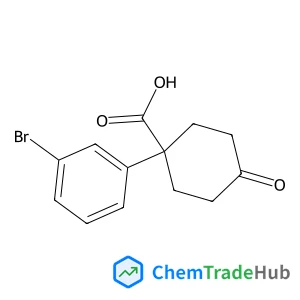
1-(3-Bromophenyl)-4-oxocyclohexanecarboxylic acid
CAS Number:
1385694-53-0
Molecular Formula:
C13H13BrO3
Nadia Dozova, Fabien Lacombat, Murielle Lombard, Djemel Hamdane, Pascal Plaza
Thymidylate is a vital DNA precursor synthesized by thymidylate synthases. ThyX is a flavin-dependent thymidylate synthase found in several human pathogens and absent in humans, which makes it a potential target for antimicrobial drugs. This enzyme methylates the 2′-deoxyuridine 5′-monophosphate (dUMP) to 2′-deoxythymidine 5′-monophosphate (dTMP) using a reduced flavin adenine dinucleotide (FADH−) as prosthetic group and (6R)-N5,N10-methylene-5,6,7,8-tetrahydrofolate (CH2THF) as a methylene donor. Recently, it was shown that ThyX-catalyzed reaction is a complex process wherein FADH− promotes both methylene transfer and reduction of the transferred methylene into a methyl group. Here, we studied the dynamic and photophysics of FADH− bound to ThyX, in several substrate-binding states (no substrate, in the presence of dUMP or folate or both) by femtosecond transient absorption spectroscopy. This methodology provides valuable information about the ground-state configuration of the isoalloxazine moiety of FADH− and the rigidity of its local environment, through spectra shape and excited-state lifetime parameters. In the absence of substrate, the environment of FADH− in ThyX is only mildly more constrained than that of free FADH− in solution. The addition of dUMP however narrows the distribution of ground-state configurations and increases the constraints on the butterfly bending motion in the excited state. Folate binding results in the selection of new ground-state configurations, presumably located at a greater distance from the conical intersection where excited-state decay occurs. When both substrates are present, the ground-state configuration appears on the contrary rather limited to a geometry close to the conical intersection, which explains the relatively fast excited-state decay (100 ps on the average), even if the environment of the isoalloxazine is densely packed. Hence, although the environment of the flavin is dramatically constrained, FADH− retains a dynamic necessary to shuttle carbon from folate to dUMP. Our study demonstrates the high sensitivity of FADH− photophysics to the constraints exerted by its immediate surroundings.
Julia Romanova, Vincent Liégeois, Benoît Champagne
DOI: 10.1039/C4CP02977A
Deya Das, Sang Soo Han, Kwang-Ryeol Lee, Abhishek K. Singh
DOI: 10.1039/C4CP03251A
Ping-Ping Sun, Quan-Song Li, Li-Na Yang, Zhu-Zhu Sun, Ze-Sheng Li
DOI: 10.1039/C4CP02951H
Chengkui Xiahou, J. N. L. Connor
DOI: 10.1039/C3CP54569E
Xiaojiao Kang, Zhiyao Hou, Jun Lin
DOI: 10.1039/C4CP00817K
DOI: 10.1039/C3CP53822B
Sonja Kouva, Jenni Andersin, Karoliina Honkala, Juha Lehtonen, Jaana Kanervo
DOI: 10.1039/C4CP02742F
Peng Wang, Hongtao Wang, Wei Yang
DOI: 10.1039/C4CP01784F
4-Benzyl-2,2-dimethylmorpholine is generally considered safe when handled under ...
(5,6-Dimethoxy-3-pyridinyl)boronic acid is a chemical compound with the molecula...
1,1,3,3-Tetramethyl-1,3-bis(2-methyl-2-propanyl)disiloxane is synthesized throug...
(2R,4S)-1-Boc-4-methylpyrrolidine-2-carboxylic acid is primarily used as a build...
When handling 2,3-Dichloroacrylonitrile, it is crucial to wear appropriate perso...
(S)-1-(o-Tolyl)ethanamine hydrochloride should be stored in a cool, dry place to...
Benzyl [1-(hydroxyamino)-1-imino-2-methyl-2-propanyl]carbamate (CAS: 518047-98-8...
2-Methyloxazole-5-carbaldehyde is used in the pharmaceutical industry for the sy...
The market for 2-Methyl-2-propanyl 4-[(1S)-1-hydroxyethyl]-1-piperidinecarboxyla...
1-Butyl-3-methylpyridinium bromide is generally considered safe for laboratory u...

Physical Chemistry Chemical Physics (PCCP) is an international journal co-owned by 19 physical chemistry and physics societies from around the world. This journal publishes original, cutting-edge research in physical chemistry, chemical physics and biophysical chemistry. To be suitable for publication in PCCP, articles must include significant innovation and/or insight into physical chemistry; this is the most important criterion that reviewers and Editors will judge against when evaluating submissions. The journal has a broad scope and welcomes contributions spanning experiment, theory, computation and data science. Topical coverage includes spectroscopy, dynamics, kinetics, statistical mechanics, thermodynamics, electrochemistry, catalysis, surface science, quantum mechanics, quantum computing and machine learning. Interdisciplinary research areas such as polymers and soft matter, materials, nanoscience, energy, surfaces/interfaces, and biophysical chemistry are welcomed if they demonstrate significant innovation and/or insight into physical chemistry. Joined experimental/theoretical studies are particularly appreciated when complementary and based on up-to-date approaches.