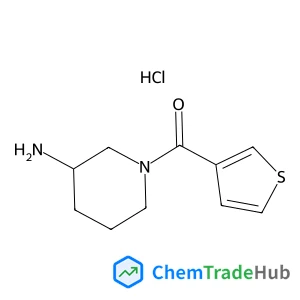
(3-Amino-piperidin-1-yl)-thiophen-3-yl-methanone hydrochloride
CAS Number:
1185316-70-4
Molecular Formula:
C10H15ClN2OS
A. Bafekry, M. Faraji, M. M. Fadlallah, A. Bagheri Khatibani, I. Abdolhosseini Sarsari, M. Ghergherehchi
The 2D form of the BeO sheet has been successfully prepared (Hui Zhang et al., ACS Nano, 2021, 15, 2497). Motivated by these exciting experimental results on the 2D layered BeO structure, we studied the effect of the adsorption of B atoms on BeO (B@BeO) and substitutional B atoms (B-BeO) at the Be site at different B concentrations. We investigated the structural stability and the mechanical, electronic, magnetic, and optical properties of the mentioned structures using first-principles calculations. We found out that hexagonal BeO monolayers with adsorbed and dopant B atoms have different mechanical stabilities at different concentrations. B@BeO and B-BeO monolayers are brittle structures, and B@BeO structures are more rigid than B-BeO monolayers (at the same B concentration). The adsorption and the formation energy per B atom decrease as the B concentration increases. In comparison, the work function increases when increasing the B concentration. The work function of B@BeO is higher than the corresponding value of B-BeO (at the same B concentration). The magnetic moment linearly increases as the B concentration increases. BeO is a semiconductor with an indirect bandgap of 5.3 eV. The B@BeO and B-BeO structures are semiconductors, except for 3B-BeO (14.2% doped concentration), which is a metal. The bandgap is 1.25 eV for most of the adsorbed atom concentrations. For B-BeO, the bandgap decreases to zero at a concentration of 14.2%. The bandgap of the B-BeO monolayer at different B concentrations is smaller than the corresponding values of the B@BeO monolayer, which indicates that B substitutional doping has a greater effect on the electronic structure of the BeO monolayer than B adsorption doping. We investigated the optical properties, including the dielectric function and absorption coefficient. The results indicate good optical absorption in the range of infrared and ultraviolet energies for the B adsorbed and doped BeO monolayer.
Ling Liu, Jianbing Zhao, Patricia J. Culligan, Xi Chen
DOI: 10.1039/B905641F
Simon Mathieu, Georges Trinquier
DOI: 10.1039/B908152F
Sulagna De, Sk. Musharaf Ali, Asraf Ali, V. G. Gaikar
DOI: 10.1039/B902422K
Jean-François Boily
DOI: 10.1039/B909925E
DOI: 10.1039/C003389H
When handling 2-Methyl-2-propanyl 5-amino-2-thiophenecarboxylate (CAS: 1498311-5...
5-Bromo-1,2-dichloro-3-fluorobenzene (CAS: 1000572-93-9) is a crystalline solid ...
(2R)-2-Amino-2-(4-bromophenyl)ethanol (CAS: 354153-64-3) should be stored in a c...
Methyl 4-(aminomethyl)tetrahydro-2H-pyran-4-carboxylate hydrochloride (CAS: 3627...
1,4-Dimethyl-1H-pyrazole-5-sulfonyl chloride is primarily used as an intermediat...
Dinaphtho[1,2-b:2',1'-d]furan is generally safe when handled with appropriate pe...
The market for 7-Methyl-7,9-dihydro-1H-purine-2,6,8(3H)-trione (CAS: 612-37-3) i...
2-(4-Chlorophenyl)malonaldehyde (CAS: 205676-17-1) is a colorless or light yello...
2-Methylchrysene (CAS: 3351-32-4) is typically synthesized via the reaction of c...
N-(6-aminopyrimidin-4-yl)acetamide (CAS: 89533-23-3) is generally considered saf...

Physical Chemistry Chemical Physics (PCCP) is an international journal co-owned by 19 physical chemistry and physics societies from around the world. This journal publishes original, cutting-edge research in physical chemistry, chemical physics and biophysical chemistry. To be suitable for publication in PCCP, articles must include significant innovation and/or insight into physical chemistry; this is the most important criterion that reviewers and Editors will judge against when evaluating submissions. The journal has a broad scope and welcomes contributions spanning experiment, theory, computation and data science. Topical coverage includes spectroscopy, dynamics, kinetics, statistical mechanics, thermodynamics, electrochemistry, catalysis, surface science, quantum mechanics, quantum computing and machine learning. Interdisciplinary research areas such as polymers and soft matter, materials, nanoscience, energy, surfaces/interfaces, and biophysical chemistry are welcomed if they demonstrate significant innovation and/or insight into physical chemistry. Joined experimental/theoretical studies are particularly appreciated when complementary and based on up-to-date approaches.
![2-[2-(2-Methoxyethoxy)ethoxy]-2-methylpropane structure](https://static.chemtradehub.com/structs/527/52788-79-1-71c1.webp "2-[2-(2-Methoxyethoxy)ethoxy]-2-methylpropane structure")