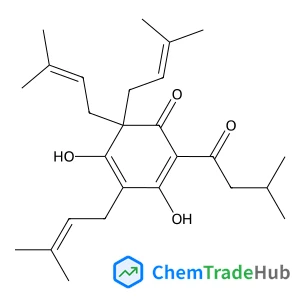
3,5-Dihydroxy-4-(3-methylbutanoyl)-2,6,6-tris(3-methyl-2-buten-1-yl)-2,4-cyclohexadien-1-one
CAS Number:
468-28-0
Molecular Formula:
C26H38O4
Resham Rana, Robert Bavisotto, Kaiming Hou, Wilfred T. Tysoe
Mechano- or tribochemical processes are often induced by the large pressures, of the order of 1 GPa, exerted at contacting asperities at the solid–solid interface. These tribochemical process are not very well understood because of the difficulties of probing surface-chemical reaction pathways occurring at buried interfaces. Here, strategies for following surface reaction pathways in detail are illustrated for the tribochemical decomposition of 7-octenoic and octanoic acid adsorbed on copper. The chemistry was measured in ultrahigh vacuum by sliding either a tungsten carbide ball or a silicon atomic force microscope (AFM) tip over the surface to test a previous proposal that the nature of the terminal group in the carboxylic acid, vinyl versus alkyl, could influence its binding to the counterface, and therefore the reaction rate. The carboxylic acids bind strongly to the copper substrate as carboxylates to expose the hydrocarbon terminus. The tribochemical reaction rate was found to be independent of the nature of the hydrocarbon terminus, although the pull-off and friction forces measured by the AFM were different. The tribochemical reaction is initiated in the same way as the thermal reaction, by the carboxylate group tilting to eliminate carbon dioxide and deposit alkyl species onto the surface. This reaction occurs thermally at ∼640 K, but tribochemically at room temperature, producing significant differences in the rates and selectivities of the subsequent decomposition pathways of the adsorbed products.
Matthew G. Quesne, Alberto Roldan, Nora H. de Leeuw, C. Richard A. Catlow
DOI: 10.1039/C9CP00924H
Zhenglong Su, Jingyi Chen, Yunzhen Zhao, Jiaye Su
DOI: 10.1039/C9CP01714C
Angelo Giussani, Graham A. Worth
DOI: 10.1039/C9CP00705A
José I. Martínez, Julio A. Alonso
DOI: 10.1039/C9CP01114E
Haiming Wu
DOI: 10.1039/C9CP01192G
Emmanouil Kechaoglou, Spyridon Kaziannis, Constantine Kosmidis
DOI: 10.1039/C9CP01470E
Hans-Joachim Werner, Daniel Kats, Samuel Lenz, Guntram Rauhut, Hermann Stoll, Joris van Slageren
DOI: 10.1039/C9CP00785G
Yoshihiro Koyama, Kiyoto Matsuishi, Takahiro Takekiyo, Hiroshi Abe, Yukihiro Yoshimura
DOI: 10.1039/C9CP01730E
A. Sarsa, J. M. Alcaraz-Pelegrina, C. Le Sech
DOI: 10.1039/C9CP01063G
When handling 2-Chloro-1,2-bis(4-methylphenyl)ethanone (CAS: 71193-32-3), it is ...
4-Ethoxy-3-(5-methyl-4-oxo-7-propyl-1,4-dihydroimidazo[5,1-f][1,2,4]triazin-2-yl...
Methyl 3-Oxo-4-Androsten-17-Carboxylate (CAS: 2681-55-2) should be stored in a c...
(R)-3-Amino-4-(3-hexylphenylamino)-4-oxobutylphosphonic acid is primarily used i...
2-Methyl-2-propanyl 3-amino-3-carbamoyl-1-azetidinecarboxylate (CAS: 1254120-14-...
There are alternative reagents that can be used in synthesis instead of (E)-4-(t...
[2-(3-Chlorophenyl)-1,3-thiazol-4-yl]methanol (CAS: 121202-20-8) is a crystallin...
The market and research trends for Methyl (2S)-[(4S)-2,2-dimethyl-1,3-dioxolan-4...
The market for 1-Bromo-2-isocyanatoethane (CAS: 42865-19-0) is driven by its use...
4-Nitro-D-phenylalanine hydrochloride (CAS: 147065-06-3) is primarily used in re...

Physical Chemistry Chemical Physics (PCCP) is an international journal co-owned by 19 physical chemistry and physics societies from around the world. This journal publishes original, cutting-edge research in physical chemistry, chemical physics and biophysical chemistry. To be suitable for publication in PCCP, articles must include significant innovation and/or insight into physical chemistry; this is the most important criterion that reviewers and Editors will judge against when evaluating submissions. The journal has a broad scope and welcomes contributions spanning experiment, theory, computation and data science. Topical coverage includes spectroscopy, dynamics, kinetics, statistical mechanics, thermodynamics, electrochemistry, catalysis, surface science, quantum mechanics, quantum computing and machine learning. Interdisciplinary research areas such as polymers and soft matter, materials, nanoscience, energy, surfaces/interfaces, and biophysical chemistry are welcomed if they demonstrate significant innovation and/or insight into physical chemistry. Joined experimental/theoretical studies are particularly appreciated when complementary and based on up-to-date approaches.