


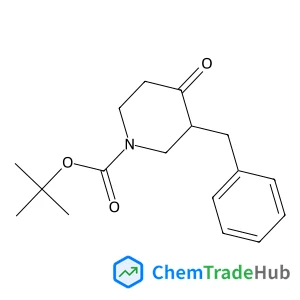
2-Methyl-2-propanyl 3-benzyl-4-oxo-1-piperidinecarboxylate
CAS Number:
193274-82-7
Molecular Formula:
C17H23NO3
Bahram Ghanbari, Fatemeh Kazemi Zangeneh, German Sastre, Maryam Moeinian, Sina Marhabaie, Zahra Taheri Rizi
An example of zeolite selectivity (MFI → MOR) driven by synthesis aging time has been studied. Using N,N,N′,N′-tetramethyl-N,N′-dipropyl-ethylenediammonium diiodide (TMDP) as an organic structure-directing agent (OSDA), the zeolite phases obtained at 2 h (MFI 97%), 8 h (MFI 84%, MOR 16%) and 24 h (MFI 43%, MOR 57%) have been characterized by powder X-ray diffraction. The results suggest that at intermediate aging time, namely 8 h and 24 h, the dominant phase (MFI) is displaced by MOR. Different techniques (FT-IR, Raman, 13C MAS NMR, TGA/DTG and HC microanalysis) have been employed to verify the OSDA integrity and occlusion inside the zeolite micropores as well as to quantify the water and OSDA loading. The 1H MAS NMR of the as-made occluded zeolite was compared with the spectra of TMDP and the recovered OSDA from the sample by extraction with water. The comparison indicated that TMDP was not structurally intact, indicating the chemical transformation of TMDP to imidazolinium homologues through the Hofmann degradation process. Furthermore, careful acidic breakdown of the aluminosilicate shell, covered on the zeolite samples by hydrofluoric acid, revealed that the remaining OSDA had been partially degraded to lower molecular weight ammonium salt, confirmed by 1H NMR and mass spectrometry measurements. A computational study was performed by using a force field based methodology, including accurate loading of water and OSDA in the zeolite (MFI and MOR) unit cells. The results show an important contribution of the presence of water. The samples with larger aging time (8 h and 24 h) incorporate less water and show partial TMDP degradation, whilst at the shortest aging time (2 h), there is a larger water content and TMDP remains intact. The larger accessible volume of MFI justifies that this is the dominant phase at short aging times (large water content) since it can accommodate a larger number of water molecules than MOR. The OSDA partial degradation also plays a role. At longer aging times the partial OSDA decomposition has been considered in the models by including TMDP + Imidaz, which is more stabilized by MOR, whilst at shorter aging times the only OSDA present, TMDP, is better stabilized by MFI.

Organic Process Research & Development

Current Opinion in Solid State & Materials Science

Russian Journal of Bioorganic Chemistry

Nature Medicine

Chemical Communications

Journal of Natural Medicines

Journal of Saudi Chemical Society

Saudi Pharmaceutical Journal

Russian Journal of General Chemistry

Crystallography Reports
Fuhong Xiao, Yangling Hu, Huawen Huang, Fen Xu, Guo-Jun Deng
DOI: 10.1039/D0OB00362J
Seda Karahan, Cihangir Tanyeli
DOI: 10.1039/C9OB02208B
S. Israel Suarez, Caroline C. Warner, Heather Brown-Harding, Andrea M. Thooft, Brett VanVeller, John C. Lukesh, III
DOI: 10.1039/C9OB02486G
Suo-Suo Qi, Zhen-Hui Jiang, Ming-Ming Chu, Yi-Feng Wang, Xue-Yang Chen, Wan-Zhen Ju, Dan-Qian Xu
DOI: 10.1039/D0OB00393J
Nicholas Konstandaras, Michelle H. Dunn, Max S. Guerry, Christopher D. Barnett, Marcus L. Cole, Jason B. Harper
DOI: 10.1039/C9OB02258A
Karlos Eduardo Pianoski, Julia Poletto, Michael Jackson Vieira da Silva, Jeniffer Nascimento Ascencio Camargo, Andrey Petita Jacomini, Davana Silva Gonçalves, Davi Fernando Back, Sidnei Moura, Fernanda Andreia Rosa
DOI: 10.1039/D0OB00319K
6-Bromo-2-methylimidazo[1,2-a]pyrimidine (CAS: 1111638-05-1) falls under various...
While there are no direct alternatives, similar compounds like 1-Pyrrolidineetha...
4-Methyl-2,6-bis(2-methyl-2-propanyl)phenyl methylcarbamate (CAS: 1918-11-2) is ...
2-(3-Bromo-4-fluorophenyl)-1,3-dioxolane (CAS: 77771-04-1) should be stored in a...
4,5,6,7-Tetrahydro-1H-indazole hydrochloride is a white crystalline solid with a...
(2R)-1-Methoxy-3-phenyl-2-propanamine is a chiral organic compound with the CAS ...
Ethyl 1-(1-phenylethyl)-1H-imidazole-5-carboxylate is used in various industries...
4-[(1E,3S)-1-(4-Hydroxyphenyl)-1,4-pentadien-3-yl]phenol (CAS: 17676-24-3) falls...
(S)-3-Amino-5-phenylpentanoic acid hydrochloride is primarily used in the pharma...
7-Methoxy-1-benzothiophene-2-carboxylic acid is typically synthesized by reactin...

Physical Chemistry Chemical Physics (PCCP) is an international journal co-owned by 19 physical chemistry and physics societies from around the world. This journal publishes original, cutting-edge research in physical chemistry, chemical physics and biophysical chemistry. To be suitable for publication in PCCP, articles must include significant innovation and/or insight into physical chemistry; this is the most important criterion that reviewers and Editors will judge against when evaluating submissions. The journal has a broad scope and welcomes contributions spanning experiment, theory, computation and data science. Topical coverage includes spectroscopy, dynamics, kinetics, statistical mechanics, thermodynamics, electrochemistry, catalysis, surface science, quantum mechanics, quantum computing and machine learning. Interdisciplinary research areas such as polymers and soft matter, materials, nanoscience, energy, surfaces/interfaces, and biophysical chemistry are welcomed if they demonstrate significant innovation and/or insight into physical chemistry. Joined experimental/theoretical studies are particularly appreciated when complementary and based on up-to-date approaches.


![(3aS,6aS)-1-Methyloctahydropyrrolo[3,4-b]pyrrole structure](https://static.chemtradehub.com/structs/877/877212-98-1-9157.webp "(3aS,6aS)-1-Methyloctahydropyrrolo[3,4-b]pyrrole structure")



