


Tuning the structural, electronic and dynamical properties of Janus M4X3Y3 (M = Pd, Ni and Co; X,Y = S, Se and Te) monolayers: a DFT study
Literature Information
Publication Date
2021-08-30
DOI
10.1039/D1CP01916C
Impact Factor
3.676
Authors
Ismail Eren, Berna Akgenc
View Original
Abstract
Based on density functional theory, the structural, electronic and vibrational properties of two-dimensional transition metal chalcogenides M2X3 and their Janus type M4X3Y3, where M = Pd, Co and Ni and X = Se, S and Te, are investigated. Motivated by the successful synthesis of a 2D Pd2Se3 monolayer and the proof of the dynamical stability of Ni2Se3 and Co2Se3 monolayers, in terms of the phonon band dispersions, we have systemically studied the fundamental physical properties of Janus transition metal chalcogenides, such as their structural, phonon and thermodynamic stability and their electronic and mechanical properties. Our results show that Janus structures of M4X3Y3 are energetically favorable and dynamically stable. The ab initio molecular dynamic simulations (AIMD) results clearly prove that they kept their thermal stability at room temperature. We have demonstrated their structural, electronic and vibrational properties and Raman spectra. The electronic band dispersions show that monolayer Co2Se3 shows half-metal properties with a moderate band gap (1.01 eV), Pd2Se3 has a 1.42 eV direct band gap, while Ni2Se3 has a 1.38 eV indirect band gap. Pd4Se3S3, Pd4Se3Te3 and Pd4S3Te3 are indirect band gap semiconductors with band gaps of 1.22 eV, 1.05 eV and 0.61 eV, respectively. Ni4Se3S3, Ni4Se3Te3 and Ni4S3Te3 are indirect band gap semiconductors with band gaps of 1.61 eV, 0.77 eV and 0.49 eV, respectively. While pristine Co2Se3 is shown to have half-metallicity (HM), the HM behaviour of the Janus Co4Se3Te3 and Co4S3Te3 monolayers disappear and Co4Se3S3 remains a HM with a moderate band gap of 0.85 eV. In addition, the Raman spectra of these Janus materials are shown to exhibit totally distinctive features as compared to those of the pristine materials. This work reveals the important material properties of Janus type M4X3Y3 monolayers, where M = Pd, Co and Ni and X = Se, S and Te, which could have wide applications in new functional devices.
Recommended Journals

Russian Journal of General Chemistry

Crystallography Reports

Journal of Saudi Chemical Society

Drug Discovery Today

Russian Journal of Coordination Chemistry

Russian Chemical Bulletin

Chemistry Education Research and Practice

Journal of Peptide Science

Current Opinion in Colloid & Interface Science

Russian Journal of Bioorganic Chemistry
Related Literature
Regioselective catalytic asymmetric N-alkylation of isoxazol-5-ones with para-quinone methides
Suo-Suo Qi, Zhen-Hui Jiang, Ming-Ming Chu, Yi-Feng Wang, Xue-Yang Chen, Wan-Zhen Ju, Dan-Qian Xu
2020-03-14
Communication
DOI: 10.1039/D0OB00393J
Synthesis of β-lactams via diastereoselective, intramolecular Kinugasa reactions
Oskar Popik, Barbara Grzeszczyk, Olga Staszewska-Krajewska, Bartłomiej Furman, Marek Chmielewski
2020-03-16
Paper
DOI: 10.1039/D0OB00228C
Recent advances in cobalt-catalysed C–H functionalizations
Alessio Baccalini, Stefania Vergura, Pravas Dolui, Giuseppe Zanoni, Debabrata Maiti
2019-11-07
Review Article
DOI: 10.1039/C9OB01994D
Insights into DNA catalysis from structural and functional studies of the 8-17 DNAzyme
Marjorie Cepeda-Plaza, Alessio Peracchi
2020-01-28
Review Article
DOI: 10.1039/C9OB02453K
A highly efficient method for the construction of cyclopropane-containing dihydroindole derivatives from indolemethylenecyclopropanes with DIAD and DEAD
Mintao Chen, Wenqing Zang, Yin Wei, Min Shi
2019-12-10
Paper
DOI: 10.1039/C9OB02520K
You might also like
Compound Q&A
What regulatory guidelines apply to 6-Bromo-2-methylimidazo[1,2-a]pyrimidine (CAS: 1111638-05-1)?
6-Bromo-2-methylimidazo[1,2-a]pyrimidine (CAS: 1111638-05-1) falls under various...
1111638-05-16-Bromo-2-methylimid...
Compound Q&A
Are there alternatives to 1-Pyrrolidineethanol, β-methyl-α-phenyl-, (αS,βR) (CAS: 123620-80-4) in synthesis?
While there are no direct alternatives, similar compounds like 1-Pyrrolidineetha...
123620-80-41-Pyrrolidineethanol...
Compound Q&A
Is 4-Methyl-2,6-bis(2-methyl-2-propanyl)phenyl methylcarbamate (CAS: 1918-11-2) safe?
4-Methyl-2,6-bis(2-methyl-2-propanyl)phenyl methylcarbamate (CAS: 1918-11-2) is ...
1918-11-24-Methyl-2,6-bis(2-m...
Compound Q&A
How should 2-(3-Bromo-4-fluorophenyl)-1,3-dioxolane (CAS: 77771-04-1) be stored?
2-(3-Bromo-4-fluorophenyl)-1,3-dioxolane (CAS: 77771-04-1) should be stored in a...
77771-04-12-(3-Bromo-4-fluorop...
Compound Q&A
What are the physical and chemical properties of 4,5,6,7-Tetrahydro-1H-indazole hydrochloride (CAS: 18161-11-0)?
4,5,6,7-Tetrahydro-1H-indazole hydrochloride is a white crystalline solid with a...
18161-11-04,5,6,7-Tetrahydro-1...
Compound Q&A
What is (2R)-1-Methoxy-3-phenyl-2-propanamine (CAS: 59919-07-2)?
(2R)-1-Methoxy-3-phenyl-2-propanamine is a chiral organic compound with the CAS ...
59919-07-2(2R)-1-Methoxy-3-phe...
Compound Q&A
What industries use Ethyl 1-(1-phenylethyl)-1H-imidazole-5-carboxylate (CAS: 56649-47-9)?
Ethyl 1-(1-phenylethyl)-1H-imidazole-5-carboxylate is used in various industries...
56649-47-9Ethyl 1-(1-phenyleth...
Compound Q&A
What regulatory guidelines apply to 4-[(1E,3S)-1-(4-Hydroxyphenyl)-1,4-pentadien-3-yl]phenol (CAS: 17676-24-3)?
4-[(1E,3S)-1-(4-Hydroxyphenyl)-1,4-pentadien-3-yl]phenol (CAS: 17676-24-3) falls...
17676-24-34-[(1E,3S)-1-(4-Hydr...
Compound Q&A
What industries use (S)-3-Amino-5-phenylpentanoic acid hydrochloride (CAS: 331846-97-0)?
(S)-3-Amino-5-phenylpentanoic acid hydrochloride is primarily used in the pharma...
331846-97-0(S)-3-Amino-5-phenyl...
Compound Q&A
How is 7-methoxy-1-benzothiophene-2-carboxylic acid (CAS: 88791-07-5) typically synthesized?
7-Methoxy-1-benzothiophene-2-carboxylic acid is typically synthesized by reactin...
88791-07-57-methoxy-1-benzothi...
Source Journal
Physical Chemistry Chemical Physics

CiteScore:
5.5
Self-citation Rate:
10.3%
Articles per Year:
3036
Physical Chemistry Chemical Physics (PCCP) is an international journal co-owned by 19 physical chemistry and physics societies from around the world. This journal publishes original, cutting-edge research in physical chemistry, chemical physics and biophysical chemistry. To be suitable for publication in PCCP, articles must include significant innovation and/or insight into physical chemistry; this is the most important criterion that reviewers and Editors will judge against when evaluating submissions. The journal has a broad scope and welcomes contributions spanning experiment, theory, computation and data science. Topical coverage includes spectroscopy, dynamics, kinetics, statistical mechanics, thermodynamics, electrochemistry, catalysis, surface science, quantum mechanics, quantum computing and machine learning. Interdisciplinary research areas such as polymers and soft matter, materials, nanoscience, energy, surfaces/interfaces, and biophysical chemistry are welcomed if they demonstrate significant innovation and/or insight into physical chemistry. Joined experimental/theoretical studies are particularly appreciated when complementary and based on up-to-date approaches.
Recommended Compounds
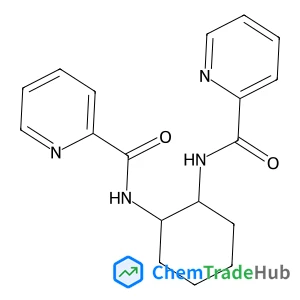
N,N'-(1R,2R)-1,2-Cyclohexanediyldi(2-pyridinecarboxamide)
CAS Number:
218290-24-5
Molecular Formula:
C18H20N4O2
Recommended Suppliers




Disclaimer
This page provides academic journal information for reference and research purposes only. We are not affiliated with any journal publishers and do not handle publication submissions. For publication-related inquiries, please contact the respective journal publishers directly.
If you notice any inaccuracies in the information displayed, please contact us at support@chemtradehub.com. We will promptly review and address your concerns.