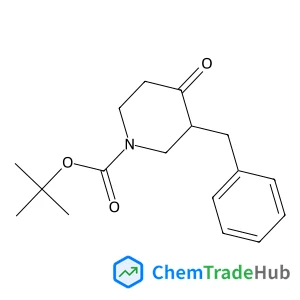
2-Methyl-2-propanyl 3-benzyl-4-oxo-1-piperidinecarboxylate
CAS Number:
193274-82-7
Molecular Formula:
C17H23NO3
Mirko Elbers, Christian Schmidt, Christian Sternemann, Christoph J. Sahle, Sandro Jahn, Christian Albers, Robin Sakrowski, Metin Tolan, Max Wilke
Knowledge of the microscopic structure of fluids and changes thereof with pressure and temperature is important for the understanding of chemistry and geochemical processes. In this work we investigate the influence of sodium chloride on the hydrogen-bond network in aqueous solution up to supercritical conditions. A combination of in situ X-ray Raman scattering and ab initio molecular dynamics simulations is used to probe the oxygen K-edge of the alkali halide aqueous solution in order to obtain unique information about the oxygen's local coordination around the ions, e.g. solvation-shell structure and the influence of ion pairing. The measured spectra exhibit systematic temperature dependent changes, which are entirely reproduced by calculations on the basis of structural snapshots obtained via ab initio molecular dynamics simulations. Analysis of the simulated trajectories allowed us to extract detailed structural information. This combined analysis reveals a net destabilizing effect of the dissolved ions which is reduced with rising temperature. The observed increased formation of contact ion pairs and occurrence of larger polyatomic clusters at higher temperatures can be identified as a driving force behind the increasing structural similarity between the salt solution and pure water at elevated temperatures and pressures with drawback on the role of hydrogen bonding in the hot fluid. We discuss our findings in view of recent results on hot NaOH and HCl aqueous fluids and emphasize the importance of ion pairing in the interpretation of the microscopic structure of water.

Proceedings of the National Academy of Sciences of the United States of America

European Journal of Wood and Wood Products

Journal of Physics and Chemistry of Solids

Science Progress

Israel Journal of Chemistry

Molecular Pharmacology

Fibre Chemistry

Journal of Heterocyclic Chemistry

Pharmacological Reviews

Nature
Khashayar Ghandi, Brenda Addison-Jones, Jean-Claude Brodovitch, Iain McKenzie, Paul W. Percival, Joachim Schüth
DOI: 10.1039/B108656A
Kathrin Winkler, Jörg Lindner, Vinod Subramaniam, Thomas M. Jovin, Peter Vöhringer
DOI: 10.1039/B108843B
J. Rivera-Utrilla, M. Sánchez-Polo, C. A. Zaror
DOI: 10.1039/B108194B
Apichart Linhananta, Kieran F. Lim
DOI: 10.1039/B109074G
Kenichi Izawa, Toshiaki Ogasawara, Hideki Masuda, Hirofumi Okabayashi, Charmian J. O'Connor, Isao Noda
DOI: 10.1039/B107556J
E. Saiz, E. Riande
DOI: 10.1039/B106480K
R. Mukhopadhyay, L. L. Wong, K. K. Lo, T. Pochapsky, H. A. O. Hill
DOI: 10.1039/B108107A
Thorsten M. Bernhardt, Bernhard Kaiser, Klaus Rademann
DOI: 10.1039/B110194C
Leszek Lapinski, Maciej J. Nowak, Dariusz C. Bieńko, Danuta Michalska
DOI: 10.1039/B108702A
Michel Mons, Iliana Dimicoli, Benjamin Tardivel, François Piuzzi, Valérie Brenner, Philippe Millié
DOI: 10.1039/B108146M
6-Bromo-2-methylimidazo[1,2-a]pyrimidine (CAS: 1111638-05-1) falls under various...
While there are no direct alternatives, similar compounds like 1-Pyrrolidineetha...
4-Methyl-2,6-bis(2-methyl-2-propanyl)phenyl methylcarbamate (CAS: 1918-11-2) is ...
2-(3-Bromo-4-fluorophenyl)-1,3-dioxolane (CAS: 77771-04-1) should be stored in a...
4,5,6,7-Tetrahydro-1H-indazole hydrochloride is a white crystalline solid with a...
(2R)-1-Methoxy-3-phenyl-2-propanamine is a chiral organic compound with the CAS ...
Ethyl 1-(1-phenylethyl)-1H-imidazole-5-carboxylate is used in various industries...
4-[(1E,3S)-1-(4-Hydroxyphenyl)-1,4-pentadien-3-yl]phenol (CAS: 17676-24-3) falls...
(S)-3-Amino-5-phenylpentanoic acid hydrochloride is primarily used in the pharma...
7-Methoxy-1-benzothiophene-2-carboxylic acid is typically synthesized by reactin...

Physical Chemistry Chemical Physics (PCCP) is an international journal co-owned by 19 physical chemistry and physics societies from around the world. This journal publishes original, cutting-edge research in physical chemistry, chemical physics and biophysical chemistry. To be suitable for publication in PCCP, articles must include significant innovation and/or insight into physical chemistry; this is the most important criterion that reviewers and Editors will judge against when evaluating submissions. The journal has a broad scope and welcomes contributions spanning experiment, theory, computation and data science. Topical coverage includes spectroscopy, dynamics, kinetics, statistical mechanics, thermodynamics, electrochemistry, catalysis, surface science, quantum mechanics, quantum computing and machine learning. Interdisciplinary research areas such as polymers and soft matter, materials, nanoscience, energy, surfaces/interfaces, and biophysical chemistry are welcomed if they demonstrate significant innovation and/or insight into physical chemistry. Joined experimental/theoretical studies are particularly appreciated when complementary and based on up-to-date approaches.
![Benzeneacetic acid, 2-[(2,6-dichlorophenyl)amino]-, compd. with 1-pyrrolidineethanol (1:1) structure](https://static.chemtradehub.com/structs/119/119623-66-4-5301.webp "Benzeneacetic acid, 2-[(2,6-dichlorophenyl)amino]-, compd. with 1-pyrrolidineethanol (1:1) structure")