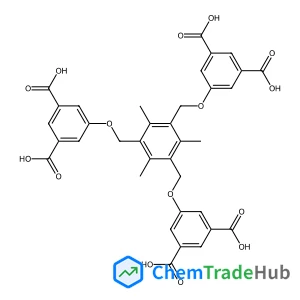
5,5',5''-(((2,4,6-Trimethylbenzene-1,3,5-triyl)tris(methylene))tris(oxy))triisophthalic acid
CAS Number:
1159974-70-5
Molecular Formula:
C36H30O15
Haoliang Huang, Verónica Celorrio, Diego Gianolio, Christopher Hardacre, Dan J. L. Brett, Andrea E. Russell
Understanding the surface structure of bimetallic nanoparticles is crucial for heterogeneous catalysis. Although surface contraction has been established in monometallic systems, less is known for bimetallic systems, especially of nanoparticles. In this work, the bond length contraction on the surface of bimetallic nanoparticles is revealed by XAS in H2 at room temperature on dealloyed Pt–Sn nanoparticles, where most Sn atoms were oxidized and segregated to the surface when measured in air. The average Sn–Pt bond length is found to be ∼0.09 Å shorter than observed in the bulk. To ascertain the effect of the Sn location on the decrease of the average bond length, Pt–Sn samples with lower surface-to-bulk Sn ratios than the dealloyed Pt–Sn were studied. The structural information specifically from the surface was extracted from the averaged XAS results using an improved fitting model combining the data measured in H2 and in air. Two samples prepared so as to ensure the absence of Sn in the bulk were also studied in the same fashion. The bond length of surface Sn–Pt and the corresponding coordination number obtained in this study show a nearly linear correlation, the origin of which is discussed and attributed to the poor overlap between the Sn 5p orbitals and the available orbitals of the Pt surface atoms.
Pushpendra Kumar, Sunil Kumar, Subrata Ghosh, Suman Kalyan Pal
DOI: 10.1039/C6CP01721E
Carlos Cabezas, Martinus A. T. Robben, Anouk M. Rijs, Isabel Peña, J. L. Alonso
DOI: 10.1039/C5CP02654G
Kenneth R. Harris, Mitsuhiro Kanakubo
DOI: 10.1039/C5CP04277A
DOI: 10.1039/C6CP03044K
DOI: 10.1039/C6CP02177H
José Manuel Guevara-Vela, Eduardo Romero-Montalvo, Víctor Arturo Mora Gómez, Rodrigo Chávez-Calvillo, Marco García-Revilla, Evelio Francisco, Ángel Martín Pendás, Tomás Rocha-Rinza
DOI: 10.1039/C6CP00763E
Runrun Wu, Yun Li, Shanshan Pan, Sainan Wang
DOI: 10.1039/C5CP02731D
Wenwen Cui, Alfonso San-Miguel
DOI: 10.1039/C6CP03263J
Rachael E. H. Miles, Jonathan P. Reid
DOI: 10.1039/C6CP03826C
Waste containing N-Methoxy-N-methyl-1,3-thiazole-5-carboxamide (CAS: 898825-89-3...
N-(4-Biphenylyl)dibenzo[b,d]furan-4-amine should be stored in a tightly sealed c...
The market for 3-Acetamido-5-amino-2,4,6-triiodobenzoic acid (CAS: 1713-07-1) is...
Benzyl 2-O-acetyl-3,4,6-tri-O-benzyl-beta-D-galactopyranoside (CAS: 61820-03-9) ...
2-Ethylpiperazine dihydrochloride (CAS: 438050-52-3) is regulated under the Glob...
1,1'-[1,3-Phenylenebis(methylene)]bis(3-methyl-1H-pyrrole-2,5-dione) (CAS: 11946...
Several alternatives can be used in the synthesis of 5-Fluoro-2-(1-pyrrolidinyl)...
Proper personal protective equipment (PPE) must be worn when handling this compo...
When handling 6-Bromoimidazo[1,2-a]pyridin-8-amine, it is important to wear appr...
Alternatives to (2S,4R)-4-(4-Nitrobenzyl)pyrrolidine-2-carboxylic acid hydrochlo...

Physical Chemistry Chemical Physics (PCCP) is an international journal co-owned by 19 physical chemistry and physics societies from around the world. This journal publishes original, cutting-edge research in physical chemistry, chemical physics and biophysical chemistry. To be suitable for publication in PCCP, articles must include significant innovation and/or insight into physical chemistry; this is the most important criterion that reviewers and Editors will judge against when evaluating submissions. The journal has a broad scope and welcomes contributions spanning experiment, theory, computation and data science. Topical coverage includes spectroscopy, dynamics, kinetics, statistical mechanics, thermodynamics, electrochemistry, catalysis, surface science, quantum mechanics, quantum computing and machine learning. Interdisciplinary research areas such as polymers and soft matter, materials, nanoscience, energy, surfaces/interfaces, and biophysical chemistry are welcomed if they demonstrate significant innovation and/or insight into physical chemistry. Joined experimental/theoretical studies are particularly appreciated when complementary and based on up-to-date approaches.