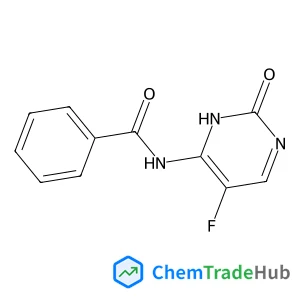
N-(5-Fluoro-2-oxo-2,3-dihydro-4-pyrimidinyl)benzamide
CAS Number:
10357-07-0
Molecular Formula:
C11H8FN3O2
Pushpendra Kumar, Sunil Kumar, Subrata Ghosh, Suman Kalyan Pal
The role of the charge transfer (CT) state in interfacial electron transfer in dye-sensitized semiconductor nanocrystals is still poorly understood. To address this problem, femtosecond transient absorption (TA) spectroscopy is used as a probe to investigate the electron injection across a newly synthesized coumarin dye (8-hydroxy-2-oxo-4-phenyl-2 benzo[h]chromene-3-carbonitrile, coded BC5) and ZnO quantum dots (QDs). Steady state and time-resolved spectroscopic measurements reveal that BC5 dye interacts strongly with ZnO QDs in the ground state forming a CT complex. The BC5–ZnO QD complex absorbs more towards red compared to only the dye and QDs, and emits fluorescence due to radiative recombination of photogenerated charges. The formation of charges following the excitation of the CT complex has been demonstrated by observing the signature of dye radical cations and electrons in the conduction band (CB) of the QDs in the TA spectra. The TA signals of these charges grow sharply as a result of ultrafast direct electron injection into the QD. We have monitored the complete dynamics of photogenerated charges by measuring the TA signals of the charges up to a couple of nanoseconds. The injected electrons that are free or shallowly trapped recombine with a time constant of 625 fs, whereas deeply trapped electrons disappear slowly (526 ps) via radiative recombination. Furthermore, theoretical studies based on ab initio calculations have been carried out to complement the experimental findings.
DOI: 10.1039/JA993080027N
Waste containing N-Methoxy-N-methyl-1,3-thiazole-5-carboxamide (CAS: 898825-89-3...
N-(4-Biphenylyl)dibenzo[b,d]furan-4-amine should be stored in a tightly sealed c...
The market for 3-Acetamido-5-amino-2,4,6-triiodobenzoic acid (CAS: 1713-07-1) is...
Benzyl 2-O-acetyl-3,4,6-tri-O-benzyl-beta-D-galactopyranoside (CAS: 61820-03-9) ...
2-Ethylpiperazine dihydrochloride (CAS: 438050-52-3) is regulated under the Glob...
1,1'-[1,3-Phenylenebis(methylene)]bis(3-methyl-1H-pyrrole-2,5-dione) (CAS: 11946...
Several alternatives can be used in the synthesis of 5-Fluoro-2-(1-pyrrolidinyl)...
Proper personal protective equipment (PPE) must be worn when handling this compo...
When handling 6-Bromoimidazo[1,2-a]pyridin-8-amine, it is important to wear appr...
Alternatives to (2S,4R)-4-(4-Nitrobenzyl)pyrrolidine-2-carboxylic acid hydrochlo...

Physical Chemistry Chemical Physics (PCCP) is an international journal co-owned by 19 physical chemistry and physics societies from around the world. This journal publishes original, cutting-edge research in physical chemistry, chemical physics and biophysical chemistry. To be suitable for publication in PCCP, articles must include significant innovation and/or insight into physical chemistry; this is the most important criterion that reviewers and Editors will judge against when evaluating submissions. The journal has a broad scope and welcomes contributions spanning experiment, theory, computation and data science. Topical coverage includes spectroscopy, dynamics, kinetics, statistical mechanics, thermodynamics, electrochemistry, catalysis, surface science, quantum mechanics, quantum computing and machine learning. Interdisciplinary research areas such as polymers and soft matter, materials, nanoscience, energy, surfaces/interfaces, and biophysical chemistry are welcomed if they demonstrate significant innovation and/or insight into physical chemistry. Joined experimental/theoretical studies are particularly appreciated when complementary and based on up-to-date approaches.

![[5-fluoro-2-(morpholine-4-carbonyl)phenyl]boronic acid structure](https://static.chemtradehub.com/structs/121/1217501-26-2-505c.webp "[5-fluoro-2-(morpholine-4-carbonyl)phenyl]boronic acid structure")