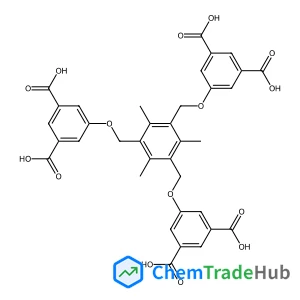
5,5',5''-(((2,4,6-Trimethylbenzene-1,3,5-triyl)tris(methylene))tris(oxy))triisophthalic acid
CAS Number:
1159974-70-5
Molecular Formula:
C36H30O15
Evgeniia S. Vikulova, Ksenya I. Karakovskaya, Igor Yu. Ilyin, Evgenia A. Kovaleva, Dmitry A. Piryazev, Ludmila N. Zelenina, Sergey V. Sysoev, Natalia B. Morozova, Kseniya V. Zherikova
New data on the thermodynamic properties of the melting and sublimation of a series of volatile iridium(I) complexes [Ir(cod)(L)] with cyclooctadiene-1,5 (cod) and β-diketones (L = RC(O)CHC(O)R′) have been obtained with differential scanning calorimetry and vapor pressure measurements. Combining experimental, empirical and theoretical methods, ways to estimate difference in heat capacities between gas and crystal phases have been suggested. An effect on the volatility in introducing the simplest alkyl, fluorinated alkyl and aryl terminal groups (R and R′) into the chelate ligand has been explained in terms of a detailed crystal packing analysis supported by a quantum chemical calculation of crystal lattice energies. To reveal the influence of the coordination center, the thermal behavior of complexes was compared with that for the tris-chelates, [Ir(L)3]. The study broadens our understanding of relationships between the structure and thermal properties of volatile precursors, which is useful for further tuning effective compounds for metal–organic chemical vapor deposition purposes.
Manidipa Paul, Nabanita Pal, P. R. Rajamohanan, Bharat S. Rana, Anil K. Sinha, Asim Bhaumik
DOI: 10.1039/B925619A
Masataka Nagaoka
DOI: 10.1039/C0CP01077D
Nevena Todorova, Andrew Hung, Simon M. Maaser, Michael D. W. Griffin, John Karas, Geoffrey J. Howlett, Irene Yarovsky
DOI: 10.1039/C0CP00299B
Yang Qu, Wei Zhou, Kai Pan, Chungui Tian, Zhiyu Ren, Youzhen Dong, Honggang Fu
DOI: 10.1039/B922658C
Adéla Křepelová, John Newberg, Thomas Huthwelker, Hendrik Bluhm, Markus Ammann
DOI: 10.1039/C0CP00359J
Olivier Cairon
DOI: 10.1039/C000991A
Satoshi Katano, Yoichi Uehara
DOI: 10.1039/C0CP01005G
Waste containing N-Methoxy-N-methyl-1,3-thiazole-5-carboxamide (CAS: 898825-89-3...
N-(4-Biphenylyl)dibenzo[b,d]furan-4-amine should be stored in a tightly sealed c...
The market for 3-Acetamido-5-amino-2,4,6-triiodobenzoic acid (CAS: 1713-07-1) is...
Benzyl 2-O-acetyl-3,4,6-tri-O-benzyl-beta-D-galactopyranoside (CAS: 61820-03-9) ...
2-Ethylpiperazine dihydrochloride (CAS: 438050-52-3) is regulated under the Glob...
1,1'-[1,3-Phenylenebis(methylene)]bis(3-methyl-1H-pyrrole-2,5-dione) (CAS: 11946...
Several alternatives can be used in the synthesis of 5-Fluoro-2-(1-pyrrolidinyl)...
Proper personal protective equipment (PPE) must be worn when handling this compo...
When handling 6-Bromoimidazo[1,2-a]pyridin-8-amine, it is important to wear appr...
Alternatives to (2S,4R)-4-(4-Nitrobenzyl)pyrrolidine-2-carboxylic acid hydrochlo...

Physical Chemistry Chemical Physics (PCCP) is an international journal co-owned by 19 physical chemistry and physics societies from around the world. This journal publishes original, cutting-edge research in physical chemistry, chemical physics and biophysical chemistry. To be suitable for publication in PCCP, articles must include significant innovation and/or insight into physical chemistry; this is the most important criterion that reviewers and Editors will judge against when evaluating submissions. The journal has a broad scope and welcomes contributions spanning experiment, theory, computation and data science. Topical coverage includes spectroscopy, dynamics, kinetics, statistical mechanics, thermodynamics, electrochemistry, catalysis, surface science, quantum mechanics, quantum computing and machine learning. Interdisciplinary research areas such as polymers and soft matter, materials, nanoscience, energy, surfaces/interfaces, and biophysical chemistry are welcomed if they demonstrate significant innovation and/or insight into physical chemistry. Joined experimental/theoretical studies are particularly appreciated when complementary and based on up-to-date approaches.