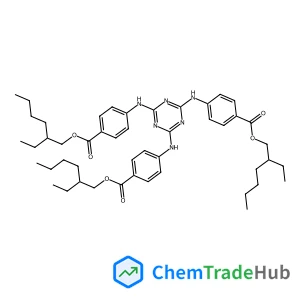
Tris(2-ethylhexyl) 4,4',4''-(1,3,5-triazine-2,4,6-triyltriimino)tribenzoate
CAS Number:
88122-99-0
Molecular Formula:
C48H66N6O6
Jianhua Liao, Xiao Yang, Lu Ouyang, Yinlong Lai, Jiuzhong Huang, Renshi Luo
Cascade radical cyclization is an attractive synthetic method due to its high atom- and step-economy to construct carbo- and heterocycles, which have wide applications in chemical and life science industries. Radical acceptors with unsaturated bonds play a key role in realizing highly rapid, concise, and efficient cascade radical cyclization. This Review is devoted to highlighting the latest achievements in the development of cascade radical cyclization methodologies for the synthesis of carbo- and heterocycles in this rapidly growing research field. Based on the hybridization of starting materials, this Review includes C(sp)–C(sp) bond, C(sp)–C(sp2) bond, C(sp2)–C(sp2) bond, C(sp2)–C(sp3), and carbon–heteroatom bond coupling cyclization. Representative examples mainly published in last three years will be discussed for each highlighted reaction design and mechanism, providing readers with common tools for future research in cascade radical cyclization.
Janelle D. S. Newman, G. J. Blanchard
DOI: 10.1039/B711212B
A. K. Croft, H. M. Howard-Jones
DOI: 10.1039/B704966H
T. Lenzer
DOI: 10.1039/B710111B
D. Sokolovski, S. Cavalli, V. Aquilanti
DOI: 10.1039/B709427B
Michael Bowker, Chris Morgan, Vladimir P. Zhdanov
DOI: 10.1039/B709384E
Elka S. Basheva, Peter A. Kralchevsky, Krassimir D. Danov, Kavssery P. Ananthapadmanabhan, Alex Lips
DOI: 10.1039/B705758J
Géraldine Dantelle, Michel Mortier, Daniel Vivien
DOI: 10.1039/B706735F
Chunhai Ruan, Zhibo Yang, M. T. Rodgers
DOI: 10.1039/B709820K
Ethyl 3-cyclohexylpropanoate is a clear, colorless to light yellow liquid with a...
Waste containing 2-(Hydroxymethyl)-5-(methoxycarbonyl)-6-methyl-4-(2-nitrophenyl...
Waste containing 2,4,6-Tris(pentafluoroethyl)-1,3,5-triazine (CAS: 858-46-8) sho...
When handling Chloroac-nle-oh (CAS: 56787-36-1), it is essential to wear appropr...
Ethyl 6-phenylimidazo[2,1-b][1,3]thiazole-3-carboxylate is primarily used in the...
Alternatives to alpha-(2-Bromophenyl)benzylamine (CAS: 55095-15-3) in synthesis ...
Waste containing 2-Chloro-5-methoxypyridine (CAS: 139585-48-1) should be managed...
1-(4-Methoxyphenyl)-2,5-dimethyl-1H-pyrrole (CAS: 5044-27-9) is used in various ...
There are alternative reagents and compounds that can be used in the synthesis o...
Tungsten(IV) oxide, also known as tungsten dioxide, is a chemical compound with ...

Organic Chemistry Frontiers publishes high-quality research from across organic chemistry. Emphases are placed on studies that make significant contributions to the field of organic chemistry by reporting either new or significantly improved protocols or methodologies. Topics include, but are not limited to the following: Organic synthesis Development of synthetic methodologies Catalysis Natural products Functional organic materials Supramolecular and macromolecular chemistry Physical and computational organic chemistry