












Visible-light-induced metal-free cascade cyclization of N-arylpropiolamides to 3-phosphorylated, trifluoromethylated and thiocyanated azaspiro[4.5]trienones‡
Literature Information
Publication Date
2020-12-21
DOI
10.1039/D0QO01410A
Impact Factor
5.281
Authors
Fan-Lin Zeng, Xiao-Lan Chen, Kai Sun, Hu-Lin Zhu, Xiao-Ya Yuan, Ling-Bo Qu, Yu-Fen Zhao, Bing Yu
View Original
Abstract
Photocatalytic strategies for the preparation of 3-phosphoryl/trifluoromethyl/thiocyanato azaspiro[4.5]trienones via a radical-initiated cascade annulation reaction of N-arylpropiolamides with phosphorus reagents, 1-trifluoromethyl-1,2-benziodoxol-3(1H)-one (Togni's reagent II) or NH4SCN have been developed under blue LED irradiation at room temperature. The novel synthetic methodologies constitute the first application of 2,4,5,6-tetra(9H-carbazol-9-yl)isophthalonitrile (4CzIPN) as a photocatalyst for the synthesis of spiro-γ-lactam derivatives, in which the use of transition metals and a high reaction temperature could be avoided. The reactions are operationally simple, easy to scale up, and metal-free with wide reaction scope and good functional group tolerance.
Related Literature
Selective inhibition of ADAR2-catalyzed editing of the serotonin 2c receptor pre-mRNA by a helix-threading peptide
Nicole T. Schirle, Rena A. Goodman, Malathy Krishnamurthy, Peter A. Beal
2010-08-31
Paper
DOI: 10.1039/C0OB00309C
Template-free synthesis of monodisperse Cu2WO4(OH)2 round and elliptical hollow spheres with a ligand-assisted dissolution process
Wei Cheng, Kaibin Tang, Zhongping Liu, Jie Sheng, Yunxia Qi
2009-10-14
Communication
DOI: 10.1039/B914086G
Lamellar transition-metal molybdate–CTA mesostructured composites (metal = Ni, Co): one-pot synthesis and application in treatment of acid fuchsine
Hong-Bin Yao, Xiao-Bo Li, Shu-Juan Liu, Shu-Hong Yu
2009-10-06
Communication
DOI: 10.1039/B914329G
Organocatalytic kinetic resolution via intramolecular aldol reactions: Enantioselective synthesis of both enantiomers of chiral cyclohexenones
Liujuan Chen, Sanzhong Luo, Jiuyuan Li, Xin Li, Jin-Pei Cheng
2010-04-01
Paper
DOI: 10.1039/B927343C
Synthesis of oligoribonucleotides with phosphonate-modified linkages
Ondřej Páv, Ivana Košiová, Ivan Barvík, Radek Pohl, Miloš Buděšínský, Ivan Rosenberg
2011-06-15
Paper
DOI: 10.1039/C1OB05488K
Long wavelength red fluorescent dyes from 3,5-diiodo-BODIPYs
Lijuan Jiao, Changjiang Yu, Timsy Uppal, Mingming Liu, Yan Li, Yunyou Zhou, Erhong Hao, Xiaoke Hu, M. Graça H. Vicente
2010-04-14
Communication
DOI: 10.1039/C001068E
Asymmetric synthesis of a tricyclic benzofuran motif: a privileged core structure in biologically active molecules
Henrik Sundén
2010-09-08
Communication
DOI: 10.1039/C0OB00331J
Highly selective fluorescent probe for Au3+ based on cyclization of propargylamide
Min Jung Jou, Xiaoqiang Chen, Ha Na Kim, Hae-Jo Kim, Sang-gi Lee
2009-10-22
Communication
DOI: 10.1039/B917832E
Elaboration and properties of hierarchically structured optical thin films of MIL-101(Cr)
Patricia Horcajada, Christian Serre, Cédric Boissière, David Grosso, Clément Sanchez, Gérard Férey
2009-10-29
Communication
DOI: 10.1039/B915011K
Towards a tunable and switchable water adhesion on a TiO2nanotube film with patterned wettability
Feng Zhou, Weimin Liu, Qunji Xue
2009-10-09
Communication
DOI: 10.1039/B914630J
You might also like
Compound Q&A
What industries use (1R,3S)-1,3-Cyclopentanediol (CAS: 16326-97-9)?
(1R,3S)-1,3-Cyclopentanediol finds applications in various industries. In the ph...
16326-97-9(1R,3S)-1,3-Cyclopen...
Compound Q&A
What precautions should be taken when handling N'-[4-(Dimethylamino)phenyl]-N,N-dimethyl-1,4-benzenediamine (CAS: 637-31-0)?
When handling N'-[4-(Dimethylamino)phenyl]-N,N-dimethyl-1,4-benzenediamine, it i...
637-31-0N'-[4-(Dimethylamino...
Compound Q&A
Are there alternatives to 5-(2,4-Difluorophenyl)-2-methoxypyrimidine (CAS: 1352318-16-1) in synthesis?
There are several alternatives to 5-(2,4-Difluorophenyl)-2-methoxypyrimidine in ...
1352318-16-15-(2,4-Difluoropheny...
Compound Q&A
What regulatory guidelines apply to 1-(3-Methoxyphenoxy)propan-2-ol (CAS: 382141-68-6)?
1-(3-Methoxyphenoxy)propan-2-ol (CAS: 382141-68-6) must comply with the Globally...
382141-68-61-(3-Methoxyphenoxy)...
Compound Q&A
Is Tetrodotoxin Citrate (CAS: 18660-81-6) safe?
Tetrodotoxin Citrate is extremely dangerous and should be handled with extreme c...
18660-81-6Tetrodotoxin Citrate
Compound Q&A
What are the main uses of 2-Methyl-2-propanyl [(1R,3S)-3-hydroxycyclopentyl]carbamate (CAS: 225641-84-9)?
2-Methyl-2-propanyl [(1R,3S)-3-hydroxycyclopentyl]carbamate (CAS: 225641-84-9) i...
225641-84-92-Methyl-2-propanyl ...
Compound Q&A
How should waste containing 4-(2-Hydroxyhexafluoroisopropyl)Benzoic Acid (CAS: 16261-80-6) be handled?
Waste containing 4-(2-Hydroxyhexafluoroisopropyl)Benzoic Acid (CAS: 16261-80-6) ...
16261-80-64-(2-Hydroxyhexafluo...
Compound Q&A
How is 2-Methyl-2-proanyl {(2S)-1-[(benzyloxy)amino]-3-hydroxy-3-methyl-1-oxo-2-butanyl}carbamate (CAS: 102507-19-7) typically synthesized?
2-Methyl-2-proanyl {(2S)-1-[(benzyloxy)amino]-3-hydroxy-3-methyl-1-oxo-2-butanyl...
102507-19-72-Methyl-2-propanyl ...
Compound Q&A
What is Benzeneethanamine, α-ethyl-, hydrochloride (1:1) (CAS: 20735-15-3)?
Benzeneethanamine, α-ethyl-, hydrochloride (1:1) is an organic compound with the...
20735-15-3Benzeneethanamine, α...
Compound Q&A
Are there alternatives to 3-{(E)-[4-(Dimethylamino)phenyl]diazenyl}benzoic acid (CAS: 20691-84-3) in synthesis?
In the synthesis of compounds similar to 3-{(E)-[4-(Dimethylamino)phenyl]diazeny...
20691-84-33-{(E)-[4-(Dimethyla...
Source Journal
Organic Chemistry Frontiers

CiteScore:
7.8
Self-citation Rate:
8.7%
Articles per Year:
724
Organic Chemistry Frontiers publishes high-quality research from across organic chemistry. Emphases are placed on studies that make significant contributions to the field of organic chemistry by reporting either new or significantly improved protocols or methodologies. Topics include, but are not limited to the following: Organic synthesis Development of synthetic methodologies Catalysis Natural products Functional organic materials Supramolecular and macromolecular chemistry Physical and computational organic chemistry
Recommended Compounds
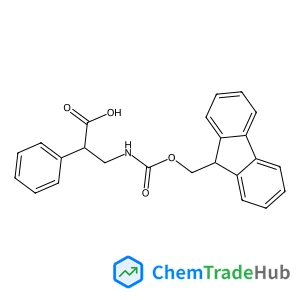
(S)-3-((((9H-Fluoren-9-yl)methoxy)carbonyl)amino)-2-phenylpropanoic acid
CAS Number:
1217663-60-9
Molecular Formula:
C24H21NO4
Recommended Suppliers




Disclaimer
This page provides academic journal information for reference and research purposes only. We are not affiliated with any journal publishers and do not handle publication submissions. For publication-related inquiries, please contact the respective journal publishers directly.
If you notice any inaccuracies in the information displayed, please contact us at support@chemtradehub.com. We will promptly review and address your concerns.