












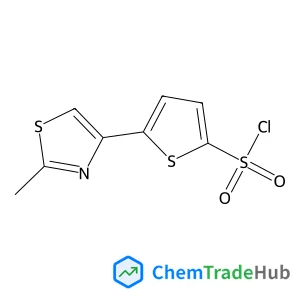
5-(2-Methyl-1,3-thiazol-4-yl)-2-thiophenesulfonyl chloride
CAS Number:
215434-25-6
Molecular Formula:
C8H6ClNO2S3
Matthew L. Becker
A ring-opening copolymerization of propylene oxide with saturated and unsaturated anhydrides using Mg(BHT)2(THF)2 catalyst followed by an isomerization yields poly(propylene fumarate) (PPF) oligomers with well-defined molecular mass, narrow molecular mass distribution, quantitative end-group fidelity, and a reduced viscosity compared to PPF. Mass spectrometry analyses and kinetic studies show that the resulting copolymers have gradient compositional sequencing. The lower viscosity of the statistical copolymer affords 3D printing with a lower diluent fraction (30 wt%) and higher molecular mass copolymer in the resin formulations. We also show that the mechanical properties of the printed structures can be tailored according to the monomer composition and resin formulation.
Katherine A. Abrahams, Gurdyal S. Besra
DOI: 10.1039/D0MD00261E
Tasaduq Hussain Wani, Goutam Chowdhury, Anindita Chakrabarty
DOI: 10.1039/D0MD00383B
Ivana Cacciatore, Hasan Turkez, Annalisa Di Rienzo, Michele Ciulla, Antonio Di Stefano
DOI: 10.1039/D1MD00177A
Utsav Garg, Yasser Azim
DOI: 10.1039/D0MD00400F
Nattawadee Panyain, Aurélien Godinat, Aditya Raymond Thawani, Sofía Lachiondo-Ortega, Katie Mason, Sarah Elkhalifa, Lisa M. Smith, Jeanine A. Harrigan
DOI: 10.1039/D1MD00218J
Riccardo Ronchetti, Andrea Carotti, Antimo Gioiello, Emidio Camaioni
DOI: 10.1039/D1MD00058F
Reidun Aesoy, Sindre Støa, Viola Lekve, Stein Ove Døskeland, Lars Herfindal, Pål Rongved
DOI: 10.1039/D1MD00020A
Anmol Gulati, Charles S. Yeung, Blair Lapointe, Solomon D. Kattar, Hakan Gunaydin, Jack D. Scott, Kaleen K. Childers, Joey L. Methot, Vladimir Simov, Ravi Kurukulasuriya, Barbara Pio, Greg J. Morriello, Ping Liu, Haiqun Tang, Santhosh Neelamkavil, Harold B. Wood, Vanessa L. Rada, Michael J. Ardolino, Xin Cindy Yan, Rachel Palte, Karin Otte, Robert Faltus, Janice Woodhouse, Laxminarayan G. Hegde, Paul Ciaccio, Ellen C. Minnihan, Erin F. DiMauro, Matthew J. Fell, Peter H. Fuller, J. Michael Ellis
DOI: 10.1039/D1MD00097G
DOI: 10.1039/D1MD90001C
Waste containing 6-Chloro-5-(2'-hydroxy-3'-methoxy-4-biphenylyl)-3-(3-methoxyphe...
(3alpha,5alpha)-3-Hydroxypregnane-11,20-dione is primarily used in the pharmaceu...
The market for 4-Amino-6-chloro-2-pyridinecarboxylic acid (CAS: 546141-56-4) is ...
Alternatives to (2-Benzoylethyl)trimethylammonium chloride (CAS: 24472-88-6) in ...
N-[4-Nitro-3-(trifluoromethyl)phenyl]acetamide (CAS: 393-12-4) is generally safe...
Alternative reagents such as other phosphates or similar functional groups can b...
There are alternatives to N,N'-Bis(3-aminopropyl)-1,3-propanediamine (CAS: 4605-...
When handling Aluminium trihexadecanoate, it is important to use appropriate per...
(1,1-Dioxido-3-oxo-1,2-benzothiazol-2(3H)-yl)acetic acid is a chemical compound ...
Several alternatives to 5,5-dimethyloxolan-2-one (CAS: 3123-97-5) can be used in...

Polymer Chemistry welcomes submissions in all areas of polymer science that have a strong focus on macromolecular chemistry. Manuscripts may cover a broad range of fields, yet no direct application focus is required.
-1,2-cyclohexanediamine structure](https://static.chemtradehub.com/structs/928/928769-12-4-a4f0.webp "N,N'-Bis[3-(2-methoxyphenyl)-2-hydroxybenzyl](1R,2R)-1,2-cyclohexanediamine structure")
![2-morpholino-2-[2-(trifluoromethyl)pyrimidin-5-yl]ethanamine structure](https://static.chemtradehub.com/structs/119/1192570-20-9-2810.webp "2-morpholino-2-[2-(trifluoromethyl)pyrimidin-5-yl]ethanamine structure")
![2-Methyl-2-propanyl [2-(2-oxa-6-azaspiro[3.3]hept-6-yl)ethyl]carbamate structure](https://static.chemtradehub.com/structs/141/1415562-38-7-c0a4.webp "2-Methyl-2-propanyl [2-(2-oxa-6-azaspiro[3.3]hept-6-yl)ethyl]carbamate structure")




