



Dibenzothiophene-S,S-dioxide-bispyridinium-fluorene-based polyelectrolytes for cathode buffer layers of polymer solar cells
Literature Information
Publication Date
2020-05-04
DOI
10.1039/D0PY00416B
Impact Factor
5.582
Authors
Guiting Chen, Dan Cheng, Wenyan Zou, Ziyan Cai, Yufeng Xie, Yaqi Chen, Baitian He, Hongqing Hao, Wei Yang, Yong Cao
View Original
Abstract
Herein, a novel electron-deficient conjugated water/alcohol-soluble polyelectrolyte (WSPE) named PFSOPyCl-E, consisting of dibenzothiophene-S,S-dioxide, bispyridinium salts and fluorene with ethylene oxide side chains, was presented. Previously we have synthesized another WSPE (PFSOPyCl) composed of the same backbone as that of PFSOPyCl-E but with octyl side chains. PFSOPyCl and PFSOPyCl-E were applied as cathode buffer materials (CBMs) to inverted polymer solar cells (PSCs) of poly[4,8-bis(2-ethylhexyloxyl)benzo[1,2-b:4,5-b′]dithiophene-2,6-diyl-alt-ethylhexyl-3-fluorothithieno[3,4-b]thiophene-2-carboxylate-4,6-diyl] (PTB7):[6,6]-phenyl-C71 butyric acid methyl ester (PC71BM) systems, and simultaneous enhancements in open-circuit voltage (Voc), short-circuit current density (Jsc) and fill factor (FF) could be achieved when inserting these cathode buffer layers (CBLs). It was found that these CBLs could build directed dipoles at the indium tin oxide (ITO)/active layer interfaces, leading to the reductions in the ITO work function (WF) and improvements in Voc for the modified devices. The Jsc and FFs of PSCs were increased by several mechanisms. Firstly, the energy level alignments between the reduced ITO WFs (4.30–4.32 eV), deep LUMO energy levels (ELUMO) of these CBLs (4.04–4.10 eV) and ELUMO of PC71BM (∼3.90 eV) could generate good ohmic contacts, facilitating electron extractions and transportations. Secondly, these CBLs were able to n-dope PC71BM at the interfaces, inducing efficient electron-transporting pathways in the devices. Moreover, these polar polymeric CBLs could improve the compatibilities between ITO and the active layers, thus decreasing the interfacial resistances. It is worth noting that PFSOPyCl-E showed better cathode-modifying performance than PFSOPyCl, probably since PFSOPyCl-E with ethylene oxide side chains of high polarity and flexibility possessed better wettability with ITO and smoother films than PFSOPyCl. Hence, the devices modified by PFSOPyCl-E displayed lower contact resistances and higher FFs and Jsc than the PFSOPyCl-modified ones. Therefore, this class of electron-deficient conjugated WSPEs are promising CBMs for high-performance PSCs.
Recommended Journals

Medicinal Chemistry Research

Bioorganic & Medicinal Chemistry

Bioorganic & Medicinal Chemistry Letters

Herald of the Russian Academy of Sciences

Critical Reviews in Solid State and Materials Sciences

Acta Metallurgica Sinica-English Letters

Electroanalysis

Main Group Chemistry

Chinese Journal of Chemistry

Atomization and Sprays
Related Literature
Target 2035 – update on the quest for a probe for every protein
Susanne Müller, Suzanne Ackloo, Arij Al Chawaf, Hartmut Beck, Shaunna Beedie, Ulrich A. K. Betz, Gustavo Arruda Bezerra, Paul E. Brennan, David Brown, Peter J. Brown, Alex N. Bullock, Adrian J. Carter, Apirat Chaikuad, Mathilde Chaineau, Alessio Ciulli, Ian Collins, Jan Dreher, Kristina Edfeldt, Aled M. Edwards, Ursula Egner, Stephen M. Fuchs, Matthew D. Hall, Ingo V. Hartung, Alexander Hillisch, Stephen H. Hitchcock, Evert Homan, Natarajan Kannan, James R. Kiefer, Stefan Knapp, Milka Kostic, Stefan Kubicek, Andrew R. Leach, Sven Lindemann, Hisanori Matsui, Jordan L. Meier, Maurice Michel, Maxwell R. Morgan, Anke Mueller-Fahrnow, Dafydd R. Owen, Benjamin G. Perry, Saul H. Rosenberg, Kumar Singh Saikatendu, Cora Scholten, Sujata Sharma, Anton Simeonov, Michael Sundström, Matthew H. Todd, Claudia Tredup, Timothy M. Willson, Georg E. Winter
2021-12-03
Opinion
DOI: 10.1039/D1MD00228G
Retraction: MicroRNA-451 blockade promotes osteoblastic differentiation and skeletal anabolic effects by promoting YWHAZ-mediated RUNX2 protein stabilization
2021-01-26
Retraction
DOI: 10.1039/D1MD90001C
De novo molecular drug design benchmarking
Lauren L. Grant, Clarissa S. Sit
2021-06-03
Review Article
DOI: 10.1039/D1MD00074H
The medicinal chemistry of mitochondrial dysfunction: a critical overview of efforts to modulate mitochondrial health
Maximillian Taro William Lee, William Mahy, Mark David Rackham
2021-06-04
Review Article
DOI: 10.1039/D1MD00113B
The modulatory role of sulfated and non-sulfated small molecule heparan sulfate-glycomimetics in endothelial dysfunction: absolute structural clarification, molecular docking and simulated dynamics, SAR analyses and ADMET studies
Daniel M. Gill, Sabrina A. Shamir, Fiona L. Wilkinson, M. Yvonne Alexander, Marinonio L. Cornelio, Alan M. Jones
2021-04-23
Research Article
DOI: 10.1039/D0MD00366B
A review of the latest research on Mpro targeting SARS-COV inhibitors
Huihui Yang
2021-04-14
Review Article
DOI: 10.1039/D1MD00066G
Natural product-informed exploration of chemical space to enable bioactive molecular discovery
2020-12-16
Review Article
DOI: 10.1039/D0MD00376J
Generation of reactive oxygen species is the primary mode of action and cause of survivin suppression by sepantronium bromide (YM155)
Tasaduq Hussain Wani, Goutam Chowdhury, Anindita Chakrabarty
2021-02-15
Research Article
DOI: 10.1039/D0MD00383B
You might also like
Compound Q&A
How should waste containing 6-Chloro-5-(2'-hydroxy-3'-methoxy-4-biphenylyl)-3-(3-methoxyphenyl)-1H-pyrrolo[3,2-d]pyrimidine-2,4(3H,5H)-dione (CAS: 1346607-05-3) be handled?
Waste containing 6-Chloro-5-(2'-hydroxy-3'-methoxy-4-biphenylyl)-3-(3-methoxyphe...
1346607-05-36-Chloro-5-(2'-hydro...
Compound Q&A
What are the main uses of (3alpha,5alpha)-3-Hydroxypregnane-11,20-dione (CAS: 23930-19-0)?
(3alpha,5alpha)-3-Hydroxypregnane-11,20-dione is primarily used in the pharmaceu...
23930-19-0(3alpha,5alpha)-3-Hy...
Compound Q&A
What is the market or research trend for 4-Amino-6-chloro-2-pyridinecarboxylic acid (CAS: 546141-56-4)?
The market for 4-Amino-6-chloro-2-pyridinecarboxylic acid (CAS: 546141-56-4) is ...
546141-56-44-Amino-6-chloro-2-p...
Compound Q&A
Are there alternatives to (2-Benzoylethyl)trimethylammonium chloride (CAS: 24472-88-6) in synthesis?
Alternatives to (2-Benzoylethyl)trimethylammonium chloride (CAS: 24472-88-6) in ...
24472-88-6(2-Benzoylethyl)trim...
Compound Q&A
Is N-[4-Nitro-3-(trifluoromethyl)phenyl]acetamide (CAS: 393-12-4) safe?
N-[4-Nitro-3-(trifluoromethyl)phenyl]acetamide (CAS: 393-12-4) is generally safe...
393-12-4N-[4-Nitro-3-(triflu...
Compound Q&A
Are there alternatives to [(4R,5R,6S)-5-hydroxy-10-imino-3,7-dioxa-1,9-diazatricyclo[6.4.0.02,6]dodeca-8,11-dien-4-yl]methyl dihydrogen phosphate (CAS: 39679-56-6) in synthesis?
Alternative reagents such as other phosphates or similar functional groups can b...
39679-56-6[(4R,5R,6S)-5-hydrox...
Compound Q&A
Are there alternatives to N,N'-Bis(3-aminopropyl)-1,3-propanediamine (CAS: 4605-14-5) in synthesis?
There are alternatives to N,N'-Bis(3-aminopropyl)-1,3-propanediamine (CAS: 4605-...
4605-14-5N,N'-Bis(3-aminoprop...
Compound Q&A
What precautions should be taken when handling Aluminium trihexadecanoate (CAS: 555-35-1)?
When handling Aluminium trihexadecanoate, it is important to use appropriate per...
555-35-1Aluminium trihexadec...
Compound Q&A
What is (1,1-Dioxido-3-oxo-1,2-benzothiazol-2(3H)-yl)acetic acid (CAS: 52188-11-1)?
(1,1-Dioxido-3-oxo-1,2-benzothiazol-2(3H)-yl)acetic acid is a chemical compound ...
52188-11-1(1,1-Dioxido-3-oxo-1...
Compound Q&A
Are there alternatives to 5,5-dimethyloxolan-2-one (CAS: 3123-97-5) in synthesis?
Several alternatives to 5,5-dimethyloxolan-2-one (CAS: 3123-97-5) can be used in...
3123-97-55,5-dimethyloxolan-2...
Source Journal
Polymer Chemistry

CiteScore:
8.6
Self-citation Rate:
7.3%
Articles per Year:
457
Polymer Chemistry welcomes submissions in all areas of polymer science that have a strong focus on macromolecular chemistry. Manuscripts may cover a broad range of fields, yet no direct application focus is required.
Recommended Compounds
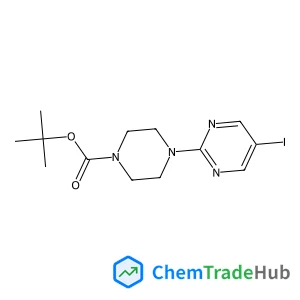
2-Methyl-2-propanyl 4-(5-iodo-2-pyrimidinyl)-1-piperazinecarboxylate
CAS Number:
1027616-32-5
Molecular Formula:
C13H19IN4O2
![1-(2-Chlorophenyl)-6-[(2S)-3,3,3-trifluoro-2-methylpropyl]-1,7-dihydro-4H-pyrazolo[3,4-d]pyrimidin-4-one structure](https://static.chemtradehub.com/structs/794/794568-91-5-0c34.webp "1-(2-Chlorophenyl)-6-[(2S)-3,3,3-trifluoro-2-methylpropyl]-1,7-dihydro-4H-pyrazolo[3,4-d]pyrimidin-4-one structure")
1-(2-Chlorophenyl)-6-[(2S)-3,3,3-trifluoro-2-methylpropyl]-1,7-dihydro-4H-pyrazolo[3,4-d]pyrimidin-4-one
CAS Number:
794568-91-5
Molecular Formula:
C15H12ClF3N4O
Recommended Suppliers







Disclaimer
This page provides academic journal information for reference and research purposes only. We are not affiliated with any journal publishers and do not handle publication submissions. For publication-related inquiries, please contact the respective journal publishers directly.
If you notice any inaccuracies in the information displayed, please contact us at support@chemtradehub.com. We will promptly review and address your concerns.