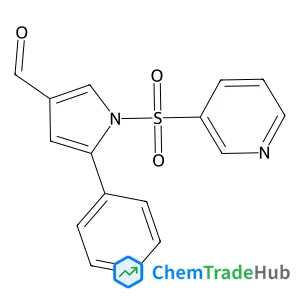
5-Phenyl-1-(pyridin-3-ylsulfonyl)-1H-pyrrole-3-carbaldehyde
CAS Number:
881676-90-0
Molecular Formula:
C16H12N2O3S
Junjie Quan, Enze Xu, Hanwen Zhu, Yajing Chang, Yi Zhu, Pengcheng Li, Zhenjie Sun, Dabin Yu, Yang Jiang
Prussian blue analogues are potential competitive energy storage materials due to their diverse metal combinations and wide three-dimensional ion channels. Here, we prepared a new highly crystalline monoclinic nickel-doped cobalt hexacyanoferrate via a feasible and simple one-step co-precipitation method. In the process of sodium-ion de-intercalation, three stable charge and discharge platforms, which are consistent with the cyclic voltammetry performance, are seen for the first time, showing the function of nickel ions in Prussian blue. Furthermore, the charge transfer and structural evolution caused by the transmission of sodium ions were well revealed via ex situ XRD, ex situ XPS, and in situ EIS studies. Simulation calculations are performed relating to the energy band structure and the highest-occupied bonding orbitals of the system in different charge states, revealing the charge and discharge mechanism of the nickel-doped material and the reason for the emergence of the new platform at low voltages. In addition, NaNi0.17Co0.83Fe(CN)6 also delivers a striking capacity of 146 mA h g−1 and superior cyclability, with 93% capacity retention over 100 cycles; it can be considered as a promising alternative cathode material for use in sodium-ion batteries.
Shanqing Zhang, Huijun Zhao
DOI: 10.1039/B805095C
Katlin Ivon Barrios Eguiluz, Giancarlo Richard Salazar-Banda, Maribel Elizabeth Funes-Huacca, Juliana Vieira Alberice, Emanuel Carrilho, Sergio Antonio Spinola Machado, Luis Alberto Avaca
DOI: 10.1039/B809080G
Randi L. Gant-Branum, Thomas J. Kerr, John A. McLean
DOI: 10.1039/B904643G
Dong Xiang, Michele Konigsberger, Busolo Wabuyele, Karl Hornung, James Cheney
DOI: 10.1039/B821836F
Arunas Ramanavicius, Almira Ramanaviciene
DOI: 10.1039/B801501E
Ilaria Palchetti, Marco Mascini
DOI: 10.1039/B802920M
Isabelle V. Batista, Marcos R. V. Lanza, Iara L. T. Dias, Sônia M. C. N. Tanaka, Auro A. Tanaka, Maria D. P. T. Sotomayor
DOI: 10.1039/B804462G
Xiangyang Shi, Su He Wang, Mary E. Van Antwerp, Xisui Chen, James R. Baker, Jr
DOI: 10.1039/B902199J
When considering alternatives to 1-(4-Chlorophenyl)-N-hydroxymethanimine (CAS: 3...
This compound should be stored in a cool, dry place away from direct sunlight. I...
3-(4-Bromophenyl)-5-(2-fluorophenyl)-1,2,4-oxadiazole is synthesized through a m...
5-Chloro-2-(4-chlorophenyl)-4-methyl-6-[3-(1-piperidinyl)propoxy]pyrimidine (CAS...
2-Chloro-4-(difluoromethoxy)pyridine is used in the pharmaceutical industry for ...
3-Chloro-6-methylpyridazine (CAS: 1121-79-5) is classified under the Globally Ha...
Several alternatives can be used in the synthesis of Methyl 4,5-dimethyl-2-nitro...
Alternatives to (2E,2'E)-3,3'-(1,4-Phenylene)bisacrylaldehyde include other acry...
3-Amino-5-chloropyridin-2-ol hydrochloride is an organic compound with the CAS n...
When handling 6,7-Difluoro-2,3-dihydro-4H-chromen-4-one, it is essential to wear...

Physical Chemistry Chemical Physics (PCCP) is an international journal co-owned by 19 physical chemistry and physics societies from around the world. This journal publishes original, cutting-edge research in physical chemistry, chemical physics and biophysical chemistry. To be suitable for publication in PCCP, articles must include significant innovation and/or insight into physical chemistry; this is the most important criterion that reviewers and Editors will judge against when evaluating submissions. The journal has a broad scope and welcomes contributions spanning experiment, theory, computation and data science. Topical coverage includes spectroscopy, dynamics, kinetics, statistical mechanics, thermodynamics, electrochemistry, catalysis, surface science, quantum mechanics, quantum computing and machine learning. Interdisciplinary research areas such as polymers and soft matter, materials, nanoscience, energy, surfaces/interfaces, and biophysical chemistry are welcomed if they demonstrate significant innovation and/or insight into physical chemistry. Joined experimental/theoretical studies are particularly appreciated when complementary and based on up-to-date approaches.