


The primary photo-dissociation dynamics of lactate in aqueous solution: decarboxylation prevents dehydroxylation
Literature Information
Publication Date
2021-02-16
DOI
10.1039/D0CP05650B
Impact Factor
3.676
Authors
Jan Thøgersen, Veronica Vaida, Mikkel Bregnhøj, Tobias Weidner, Frank Jensen
View Original
Abstract
We study the primary photolysis dynamics of aqueous lactate induced by photo-excitation at λ = 200 nm. Our calculations indicate that both decarboxylation and dehydroxylation are energetically possible, but decarboxylation is favoured dynamically. UV pump – IR probe transient absorption spectroscopy shows that the photolysis is dominated by decarboxylation, whereas dehydroxylation is not observed. Analysis of the transient IR spectrum suggests that photo-dissociation of lactate primarily produces CO2 and CH3CHOH− through the lowest singlet excited state of lactate, which has a lifetime of τ = 11 ps. UV pump – VIS probe transient absorption spectroscopy of electrons from the dissociating lactate anion indicates that the anionic electron from the CO2˙− fragment is transferred to the CH3CHOH˙ counter radical during the decarboxylation process, and CO2˙− is consequently only observed as a minor photo-product. The photo-dissociation quantum yield after the full decay of the excited state is Φ(100ps) = 38 ± 5%.
Recommended Journals

Fibre Chemistry

European Journal of Wood and Wood Products

Russian Chemical Reviews

Journal of Catalysis

Science Progress

Israel Journal of Chemistry

Proceedings of the National Academy of Sciences of the United States of America

Journal of Medicinal Chemistry

Pure and Applied Chemistry

Pharmacological Reviews
Related Literature
Synthesis of core–shell polyurethane–ureananoparticles containing 4,4′-methylenedi-p-phenyl diisocyanate and isophorone diisocyanate by self-assembled neutralization emulsification
In Woo Cheong, Jung Hyun Kim
2004-09-14
Communication
DOI: 10.1039/B409755F
Photochemical polymerization of thiophene derivatives in aqueous solution
Sergey A. Piletsky, Elena V. Piletska, Kal Karim, Frank Davis, Seamus P. J. Higson, Anthony P. F. Turner
2004-08-20
Communication
DOI: 10.1039/B408387C
A regioregular polyalkylthiophene bearing covalently-linked biotin, and its interaction with avidin in solution and in thin films
Fouzi Mouffouk, Simon J. Higgins, Stewart J. Brown, Naser Sedghi, Bill Eccleston, Stuart Reeman
2004-09-06
Communication
DOI: 10.1039/B408935A
First lanthanide dipolar complexes for second-order nonlinear optics
Katell Sénéchal, Loïc Toupet, Isabelle Ledoux, Joseph Zyss, Hubert Le Bozec, Olivier Maury
2004-09-08
Communication
DOI: 10.1039/B407073A
Chiral amplification by polypeptides and its relevance to prebiotic catalysis
David R. Kelly, Alastair Meek, Stanley M. Roberts
2004-08-25
Communication
DOI: 10.1039/B404379K
A new approach to bioconjugates for proteins and peptides (“pegylation”) utilising living radical polymerisation
François Lecolley, Lei Tao, Giuseppe Mantovani, Ian Durkin, Sylvie Lautru, David M. Haddleton
2004-07-28
Communication
DOI: 10.1039/B407712A
Practical asymmetric synthesis of β-hydroxy-β-trifluoromethylated ketonesvia the first example of the in situ generation of trifluoro-acetaldehyde and its successive asymmetric carbon–carbon bond formation reaction with chiral imines
Kazumasa Funabiki, Wataru Hashimoto, Masaki Matsui
2004-08-13
Communication
DOI: 10.1039/B408226E
Isolation and characterisation of the mixed-metal alkyl amide [(TMEDA)Na(μ-Bu)(μ-TMP)Mg(TMP)], an unexpected chelate-trapped intermediate in the formation of inverse crowns
Eva Hevia, Daniel J. Gallagher, Alan R. Kennedy, Robert E. Mulvey, Charles T. O'Hara, Christine Talmard
2004-09-23
Communication
DOI: 10.1039/B410293B
Mono- and bis(tetrathiafulvaleno)hexadehydro[12]annulenes
Kenji Hara, Masashi Hasegawa, Yoshiyuki Kuwatani, Hideo Enozawa, Masahiko Iyoda
2004-08-13
Communication
DOI: 10.1039/B407200F
Efficient boron removal by using mesoporous matrices grafted with saccharides
Gertrudis Rodríguez-López, M. Dolores Marcos, Ramón Martínez-Máñez, Félix Sancenón, Juan Soto, Luis A. Villaescusa, Danile Beltrán, Pedro Amorós
2004-08-19
Communication
DOI: 10.1039/B406611A
You might also like
Compound Q&A
How should waste containing 6-Chloro-5-(2'-hydroxy-3'-methoxy-4-biphenylyl)-3-(3-methoxyphenyl)-1H-pyrrolo[3,2-d]pyrimidine-2,4(3H,5H)-dione (CAS: 1346607-05-3) be handled?
Waste containing 6-Chloro-5-(2'-hydroxy-3'-methoxy-4-biphenylyl)-3-(3-methoxyphe...
1346607-05-36-Chloro-5-(2'-hydro...
Compound Q&A
What are the main uses of (3alpha,5alpha)-3-Hydroxypregnane-11,20-dione (CAS: 23930-19-0)?
(3alpha,5alpha)-3-Hydroxypregnane-11,20-dione is primarily used in the pharmaceu...
23930-19-0(3alpha,5alpha)-3-Hy...
Compound Q&A
What is the market or research trend for 4-Amino-6-chloro-2-pyridinecarboxylic acid (CAS: 546141-56-4)?
The market for 4-Amino-6-chloro-2-pyridinecarboxylic acid (CAS: 546141-56-4) is ...
546141-56-44-Amino-6-chloro-2-p...
Compound Q&A
Are there alternatives to (2-Benzoylethyl)trimethylammonium chloride (CAS: 24472-88-6) in synthesis?
Alternatives to (2-Benzoylethyl)trimethylammonium chloride (CAS: 24472-88-6) in ...
24472-88-6(2-Benzoylethyl)trim...
Compound Q&A
Is N-[4-Nitro-3-(trifluoromethyl)phenyl]acetamide (CAS: 393-12-4) safe?
N-[4-Nitro-3-(trifluoromethyl)phenyl]acetamide (CAS: 393-12-4) is generally safe...
393-12-4N-[4-Nitro-3-(triflu...
Compound Q&A
Are there alternatives to [(4R,5R,6S)-5-hydroxy-10-imino-3,7-dioxa-1,9-diazatricyclo[6.4.0.02,6]dodeca-8,11-dien-4-yl]methyl dihydrogen phosphate (CAS: 39679-56-6) in synthesis?
Alternative reagents such as other phosphates or similar functional groups can b...
39679-56-6[(4R,5R,6S)-5-hydrox...
Compound Q&A
Are there alternatives to N,N'-Bis(3-aminopropyl)-1,3-propanediamine (CAS: 4605-14-5) in synthesis?
There are alternatives to N,N'-Bis(3-aminopropyl)-1,3-propanediamine (CAS: 4605-...
4605-14-5N,N'-Bis(3-aminoprop...
Compound Q&A
What precautions should be taken when handling Aluminium trihexadecanoate (CAS: 555-35-1)?
When handling Aluminium trihexadecanoate, it is important to use appropriate per...
555-35-1Aluminium trihexadec...
Compound Q&A
What is (1,1-Dioxido-3-oxo-1,2-benzothiazol-2(3H)-yl)acetic acid (CAS: 52188-11-1)?
(1,1-Dioxido-3-oxo-1,2-benzothiazol-2(3H)-yl)acetic acid is a chemical compound ...
52188-11-1(1,1-Dioxido-3-oxo-1...
Compound Q&A
Are there alternatives to 5,5-dimethyloxolan-2-one (CAS: 3123-97-5) in synthesis?
Several alternatives to 5,5-dimethyloxolan-2-one (CAS: 3123-97-5) can be used in...
3123-97-55,5-dimethyloxolan-2...
Source Journal
Physical Chemistry Chemical Physics

CiteScore:
5.5
Self-citation Rate:
10.3%
Articles per Year:
3036
Physical Chemistry Chemical Physics (PCCP) is an international journal co-owned by 19 physical chemistry and physics societies from around the world. This journal publishes original, cutting-edge research in physical chemistry, chemical physics and biophysical chemistry. To be suitable for publication in PCCP, articles must include significant innovation and/or insight into physical chemistry; this is the most important criterion that reviewers and Editors will judge against when evaluating submissions. The journal has a broad scope and welcomes contributions spanning experiment, theory, computation and data science. Topical coverage includes spectroscopy, dynamics, kinetics, statistical mechanics, thermodynamics, electrochemistry, catalysis, surface science, quantum mechanics, quantum computing and machine learning. Interdisciplinary research areas such as polymers and soft matter, materials, nanoscience, energy, surfaces/interfaces, and biophysical chemistry are welcomed if they demonstrate significant innovation and/or insight into physical chemistry. Joined experimental/theoretical studies are particularly appreciated when complementary and based on up-to-date approaches.
Recommended Compounds
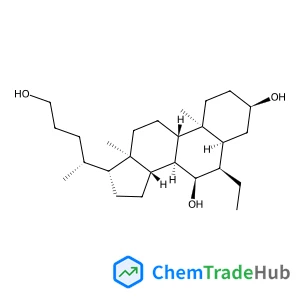
(3alpha,5beta,6alpha,7alpha)-6-Ethylcholane-3,7,24-triol
CAS Number:
1537866-49-1
Molecular Formula:
C26H46O3
Recommended Suppliers




Disclaimer
This page provides academic journal information for reference and research purposes only. We are not affiliated with any journal publishers and do not handle publication submissions. For publication-related inquiries, please contact the respective journal publishers directly.
If you notice any inaccuracies in the information displayed, please contact us at support@chemtradehub.com. We will promptly review and address your concerns.