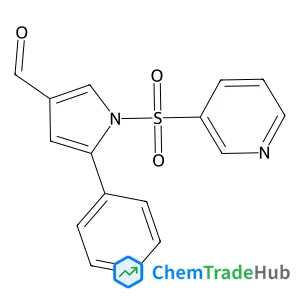
5-Phenyl-1-(pyridin-3-ylsulfonyl)-1H-pyrrole-3-carbaldehyde
CAS Number:
881676-90-0
Molecular Formula:
C16H12N2O3S
Miaoren Xia
The pandemic of COVID-19 has posed an urgent need to learn the dynamics of the virus and the mechanism of its contagion of host cells. By means of molecular dynamics simulations, this work addressed the behavior of 2019-nCoV in two aspects: the binding affinity of its receptor binding domain (RBD) with ACE2, and its potential conformation preferences in its unbound state. The results showed that the RBD of 2019-nCov bound much stronger with ACE2 than that of SARS-CoV due to a better organized hydrogen bond network between the former pair with most of the residues at the contact interface sharing the responsibility to hold the pair tightly. This is in contrast to the case of SARS-CoV, which strongly relied on the residues at the ends of the cleft. In its unbound state, the RBD of 2019-nCoV was found to fold part of its receptor binding motif (RBM) into a helical conformation and flip into a concave to minimize its contact with the external environment. This has the biological implication that the virus may achieve higher translational motion in the condensed phase and have a higher chance of survival by avoiding capture by the immune system before reaching its target receptor.
Anees A. Ansari, Renu Singh, G. Sumana, B. D. Malhotra
DOI: 10.1039/B817562D
F. Bonnier, D. Bertrand, L. Ventéo, M. Pluot, B. Baehrel, M. Manfait, G. D. Sockalingum
DOI: 10.1039/B717164A
Ross Stevenson, Robert J. Stokes, Donna MacMillan, David Armstrong, Karen Faulds, Roger Wadsworth, Suma Kunuthur, Colin J. Suckling, Duncan Graham
DOI: 10.1039/B905562B
Florence Draux, Pierre Jeannesson, Abdelilah Beljebbar, Ali Tfayli, Nicolas Fourre, Michel Manfait, Josep Sulé-Suso, Ganesh D. Sockalingum
DOI: 10.1039/B812610K
Nicoletta Nicolaou, Royston Goodacre
DOI: 10.1039/B804439B
Monique Sigaud, Olivier Vittori, Naim Ouaini
DOI: 10.1039/B811629F
Rosaria Ciriminna, Mario Pagliaro
DOI: 10.1039/B819417C
Atsushi Urakawa, Franz Trachsel, Philipp Rudolf von Rohr, Alfons Baiker
DOI: 10.1039/B808984C
Guixin Li, Hongyan Nan, Xingwang Zheng
DOI: 10.1039/B816226C
When considering alternatives to 1-(4-Chlorophenyl)-N-hydroxymethanimine (CAS: 3...
This compound should be stored in a cool, dry place away from direct sunlight. I...
3-(4-Bromophenyl)-5-(2-fluorophenyl)-1,2,4-oxadiazole is synthesized through a m...
5-Chloro-2-(4-chlorophenyl)-4-methyl-6-[3-(1-piperidinyl)propoxy]pyrimidine (CAS...
2-Chloro-4-(difluoromethoxy)pyridine is used in the pharmaceutical industry for ...
3-Chloro-6-methylpyridazine (CAS: 1121-79-5) is classified under the Globally Ha...
Several alternatives can be used in the synthesis of Methyl 4,5-dimethyl-2-nitro...
Alternatives to (2E,2'E)-3,3'-(1,4-Phenylene)bisacrylaldehyde include other acry...
3-Amino-5-chloropyridin-2-ol hydrochloride is an organic compound with the CAS n...
When handling 6,7-Difluoro-2,3-dihydro-4H-chromen-4-one, it is essential to wear...

Physical Chemistry Chemical Physics (PCCP) is an international journal co-owned by 19 physical chemistry and physics societies from around the world. This journal publishes original, cutting-edge research in physical chemistry, chemical physics and biophysical chemistry. To be suitable for publication in PCCP, articles must include significant innovation and/or insight into physical chemistry; this is the most important criterion that reviewers and Editors will judge against when evaluating submissions. The journal has a broad scope and welcomes contributions spanning experiment, theory, computation and data science. Topical coverage includes spectroscopy, dynamics, kinetics, statistical mechanics, thermodynamics, electrochemistry, catalysis, surface science, quantum mechanics, quantum computing and machine learning. Interdisciplinary research areas such as polymers and soft matter, materials, nanoscience, energy, surfaces/interfaces, and biophysical chemistry are welcomed if they demonstrate significant innovation and/or insight into physical chemistry. Joined experimental/theoretical studies are particularly appreciated when complementary and based on up-to-date approaches.