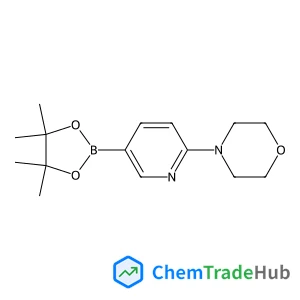
4-(5-(4,4,5,5-tetramethyl-1,3,2-dioxaborolan-2-yl)pyridin-2-yl)morpholine
CAS Number:
485799-04-0
Molecular Formula:
C15H23BN2O3
Renato Pereira Orenha, Glaucio Régis Nagurniak, Matheus Cachoeira Colaço, Giovanni Finoto Caramori, Maurício Jeomar Piotrowski, Krys Elly de Araújo Batista, Alvaro Muñoz-Castro, Breno de Almeida Silva, Benjamim José Esteves, Renato Luis Tame Parreira
The recent development of compounds for recognizing ions highlights the applicability of this area. In this work, the simultaneous recognition of cations (Li+, Na+ and K+) and anions (F−, Cl− and I−) using a macrocycle comprising a simple crown ether and an iodine-triazole unit is investigated. The roles of the (i) cation radius, (ii) anion radius, and (iii) electron withdrawing (–CN) and donor (–OH) groups of the receptor in ionic recognition were evaluated. Energy decomposition analysis (EDA) shows that the ion–receptor interactions are attractive and predominantly electrostatic. Molecular electrostatic potential plots and EDA analysis reveal that a decreasing cation radius favors interactions with the oxygen atoms present in the crown ether. A decreasing anion radius increases the σ-hole interactions with the iodine atoms present in the receptors. In compounds containing –CN and –OH groups, the oxygen atoms in the crown ether show lower ability to interact with the Na+ cation. Nevertheless, in the receptor–OH structure, the Na+⋯OH interactions counterbalance the lower ability of the crown ether oxygens to interact with the Na+ cation. I− recognition is enhanced by the presence of –OH and, more strongly, –CN groups, occurring due to the increased σ-hole area in the receptor–CN structure, as supported by a C–H⋯I− interaction in the receptor–OH compound. The reported results are useful for the design of compounds with improved capabilities for both cation and anion recognition prior to engaging in exploratory synthesis efforts.
Alvaro Cimas
DOI: 10.1039/B924025J
Joanne M. Carr, David J. Wales
DOI: 10.1039/B820649J
Boris Khlebtsov, Vitaly Khanadeev
DOI: 10.1039/B925102B
Heike Fliegl, Karin Fink, Christopher E. Anson
DOI: 10.1039/B819444K
Mateusz L. Donten, Agata Królikowska, Jolanta Bukowska
DOI: 10.1039/B816605F
M. Vervloet, G. Mulas, G. Malloci
DOI: 10.1039/B814037E
A. Chaudhuri, D. C. Jackson, T. J. Lerotholi, Robert G. Jones, T.-L. Lee, B. Detlefs, D. P. Woodruff
DOI: 10.1039/B921281G
Lan-Mei Chen, Si-Yan Liao, Kang-Cheng Zheng, Liang-Nian Ji
DOI: 10.1039/B818023G
Jie Zhang, David P. Burt, Anna L. Whitworth, Daniel Mandler, Patrick R. Unwin
DOI: 10.1039/B819809H
Waste containing 2-Ethyl-4-Methyl-1H-Imidazole-5-Carbaldehyde (CAS: 88634-80-4) ...
Triethoxy(octyl)silane (CAS: 1385031-14-0) is widely used in the pharmaceuticals...
Several alternatives to 3-iodo-7-nitro-1H-indazole (CAS: 864724-64-1) exist in t...
Yes, there are alternatives to Benzene, bis[(trimethoxysilyl)ethyl] (CAS: 266317...
Isothiazole-3-carbonitrile (CAS: 1452-17-1) is generally considered safe when us...
(3-Chlorophenyl)methanol (CAS: 873-63-2) is considered low to moderately toxic. ...
(2S,3S)-2-Hydroxy-3-({[(2-methyl-2-propanyl)oxy]carbonyl}amino)-3-(2-naphthyl)pr...
Proper handling of methyl 2-(bromomethyl)-5-methoxybenzoate requires the use of ...
6,8-Dibromoimidazo[1,2-a]pyridine-2-carboxylic acid (CAS: 904805-36-3) is an aro...
3-Amino-5-bromo-2-pyridinecarbonitrile is considered safe when handled under pro...

Physical Chemistry Chemical Physics (PCCP) is an international journal co-owned by 19 physical chemistry and physics societies from around the world. This journal publishes original, cutting-edge research in physical chemistry, chemical physics and biophysical chemistry. To be suitable for publication in PCCP, articles must include significant innovation and/or insight into physical chemistry; this is the most important criterion that reviewers and Editors will judge against when evaluating submissions. The journal has a broad scope and welcomes contributions spanning experiment, theory, computation and data science. Topical coverage includes spectroscopy, dynamics, kinetics, statistical mechanics, thermodynamics, electrochemistry, catalysis, surface science, quantum mechanics, quantum computing and machine learning. Interdisciplinary research areas such as polymers and soft matter, materials, nanoscience, energy, surfaces/interfaces, and biophysical chemistry are welcomed if they demonstrate significant innovation and/or insight into physical chemistry. Joined experimental/theoretical studies are particularly appreciated when complementary and based on up-to-date approaches.
![N,N'-1,2-Ethanediylbis[2-(vinylsulfonyl)acetamide] structure](https://static.chemtradehub.com/structs/667/66710-66-5-b556.webp "N,N'-1,2-Ethanediylbis[2-(vinylsulfonyl)acetamide] structure")
![N-[(5,6-Dichloro-1H-benzimidazol-2-yl)methyl]-9-(1-methyl-1H-pyrazol-4-yl)-2-(4-morpholinyl)-9H-purin-6-amine structure](https://static.chemtradehub.com/structs/238/2387704-62-1-25f4.webp "N-[(5,6-Dichloro-1H-benzimidazol-2-yl)methyl]-9-(1-methyl-1H-pyrazol-4-yl)-2-(4-morpholinyl)-9H-purin-6-amine structure")