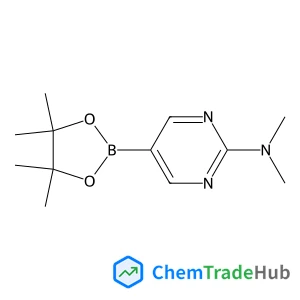
N,N-Dimethyl-5-(4,4,5,5-tetramethyl-1,3,2-dioxaborolan-2-yl)-2-pyrimidinamine
CAS Number:
1032759-30-0
Molecular Formula:
C12H20BN3O2
Debdas Dhabal, Tanmoy Patra
Despite widespread development and use of ionic liquids (ILs) in both academic and industrial research, computational force fields (FFs) for most of those are not available for a precise description of inter-species interactions in aqueous environments. In the scope of this study, by means of molecular simulations, the osmotic coefficient of an aqueous solution of an IL is calculated and used as a basis to reparameterize popular IL-FFs existing in the literature. We first calculate the osmotic coefficients (at 298.15 K and 1 atm pressure) of aqueous solutions of 1-butyl-3-methylimidazolium chloride (BMIMCl), a generic IL, popularly used in biomass processing and the subsequent conversion to value-added intermediates. The performance of two popular atomic, nonpolarizable FFs developed for BMIMCl, one by Lopes, Pádua, and coworkers (FF-LP) and the other by Sambasivarao, Acevedo, and coworkers (FF-SA), when mixed with the SPC/E water model, is tested with respect to their ability to reproduce the experimental osmotic coefficient data. Interestingly, the osmotic coefficient is found to be increasing with a gradual increase in IL molality within the concentration range of our investigation, which is contrary to the experimental trend reported in the literature for the same IL–water mixture. Henceforth, necessary corrections to the nonbonded ion–ion and ion–water interactions are made to match the experimental osmotic coefficient. To further assess the reliability of the new FF, we extensively explore the thermodynamic (density, isothermal compressibility, and thermal expansion coefficient), dynamic (diffusivity and viscosity), and association/dissociation properties (rationalized with the help of radial distribution functions) with both the original and reparameterized FF for a wider range of concentrations up to a molality of 18.50 mol kg−1. The calculated quantities are compared against experimental data wherever available. The modified FF parameters exhibit significant improvements in terms of its ability to match experimental solution properties, such as density, viscosity, association/dissociation, etc. We report that excessive dissociation of BMIMCl in water is responsible for the shortcomings observed in the original FFs and improved prediction of physicochemical properties could be achieved using the modified FFs.
Torsten Mayr, Tobias Abel, Barbara Enko, Sergey Borisov, Christian Konrad, Stefan Köstler, Bernhard Lamprecht, Stefan Sax, Emil J. W. List, Ingo Klimant
DOI: 10.1039/B904536H
Soyab A. Patel, Alan Barnes, Neil Loftus, Rachel Martin, Philip Sloan, Nalin Thakker, Royston Goodacre
DOI: 10.1039/B812533C
Dong Xiang, Michele Konigsberger, Busolo Wabuyele, Karl Hornung, James Cheney
DOI: 10.1039/B821836F
Emma Weir, Antoin Lawlor, Aine Whelan, Fiona Regan
DOI: 10.1039/B715532H
Jr-Chi Liu, Wei-Jen Chen, Chen-Wei Li, Kwok-Kong Tony Mong, Pei-Jane Tsai, Te-Lung Tsai, Yuan C. Lee, Yu-Chie Chen
DOI: 10.1039/B908069D
Ying Lu, Ningning Zhu, Ping Yu, Lanqun Mao
DOI: 10.1039/B807913G
Katlin Ivon Barrios Eguiluz, Giancarlo Richard Salazar-Banda, Maribel Elizabeth Funes-Huacca, Juliana Vieira Alberice, Emanuel Carrilho, Sergio Antonio Spinola Machado, Luis Alberto Avaca
DOI: 10.1039/B809080G
Brandon Bartling, Lu Li, Chung-Chiun Liu
DOI: 10.1039/B900266A
When considering alternatives to 1-(4-Chlorophenyl)-N-hydroxymethanimine (CAS: 3...
This compound should be stored in a cool, dry place away from direct sunlight. I...
3-(4-Bromophenyl)-5-(2-fluorophenyl)-1,2,4-oxadiazole is synthesized through a m...
5-Chloro-2-(4-chlorophenyl)-4-methyl-6-[3-(1-piperidinyl)propoxy]pyrimidine (CAS...
2-Chloro-4-(difluoromethoxy)pyridine is used in the pharmaceutical industry for ...
3-Chloro-6-methylpyridazine (CAS: 1121-79-5) is classified under the Globally Ha...
Several alternatives can be used in the synthesis of Methyl 4,5-dimethyl-2-nitro...
Alternatives to (2E,2'E)-3,3'-(1,4-Phenylene)bisacrylaldehyde include other acry...
3-Amino-5-chloropyridin-2-ol hydrochloride is an organic compound with the CAS n...
When handling 6,7-Difluoro-2,3-dihydro-4H-chromen-4-one, it is essential to wear...

Physical Chemistry Chemical Physics (PCCP) is an international journal co-owned by 19 physical chemistry and physics societies from around the world. This journal publishes original, cutting-edge research in physical chemistry, chemical physics and biophysical chemistry. To be suitable for publication in PCCP, articles must include significant innovation and/or insight into physical chemistry; this is the most important criterion that reviewers and Editors will judge against when evaluating submissions. The journal has a broad scope and welcomes contributions spanning experiment, theory, computation and data science. Topical coverage includes spectroscopy, dynamics, kinetics, statistical mechanics, thermodynamics, electrochemistry, catalysis, surface science, quantum mechanics, quantum computing and machine learning. Interdisciplinary research areas such as polymers and soft matter, materials, nanoscience, energy, surfaces/interfaces, and biophysical chemistry are welcomed if they demonstrate significant innovation and/or insight into physical chemistry. Joined experimental/theoretical studies are particularly appreciated when complementary and based on up-to-date approaches.