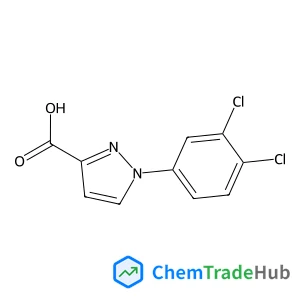
1-(3,4-Dichlorophenyl)-1H-pyrazole-3-carboxylic acid
CAS Number:
1152949-12-6
Molecular Formula:
C10H6Cl2N2O2
Xin Du, Jing Zhang, Hong Yu, Jianyan Lin, Shoutao Zhang, Guochun Yang
Peroxides have attracted considerable attention due to their intriguing electronic properties and diverse applications. However, only a few transition metal peroxides have been known thus far, limiting the variety of peroxide examples. Here, we demonstrate the stabilization of peroxides in the O-rich V–O system through first-principles calculations coupled with a swarm-intelligence structure search. As well as reproducing the known stoichiometries of VO, V2O3, VO2, and V2O5, two hitherto unknown V2O and VO4 stoichiometries are predicted to be thermodynamically stable at megabar pressures. VO4 has the highest oxygen content among the known peroxides to date. More interestingly, its electronic band gap increases with pressure, originating from the pressure-induced decrease of O–O bonding length in the peroxide group. V-rich V2O exhibits superconductivity, becoming the first example in the V–O system. Our work not only unravels the unusual vanadium peroxide, but also provides further insight into the diverse electronic properties of vanadium oxides under high pressure.
Siqi Wang, Mingmin Zhong, Haibo Liu, Meng Ju
DOI: 10.1039/D3CP03678B
Edward R. Smith, Panagiotis E. Theodorakis
DOI: 10.1039/D3CP03579D
Md Al Mamunur Rashid, Sein Min, Sung Keon Namgoong, Keunhong Jeong
DOI: 10.1039/D3CP04310J
Srinivas Pattipaka, Tae Wan Park, Young Min Bae, Yujin Na, Kyeongwoon Chung, Kwi-Il Park, Jungho Ryu, Woon Ik Park, Geon-Tae Hwang
DOI: 10.1039/D3SE01206A
Qian Wang, Yu Zhuang, Abuduwayiti Aierken, Qiaogang Song, Qin Zhang, Youbo Dou, Qiuli Zhang, Shuyi Zhang
DOI: 10.1039/D3CP05309A
Kumar Ayush, Pooja Sahu, Sk. Musharaf Ali, Tarak K. Patra
DOI: 10.1039/D3CP05136F
Alberto García-Fernández, Stefania Riva, Håkan Rensmo
DOI: 10.1039/D3CP05061K
Ainhoa Oliden-Sánchez, Rebeca Sola-Llano, Joaquín Pérez-Pariente, Luis Gómez-Hortigüela, Virginia Martínez-Martínez
DOI: 10.1039/D3CP02625F
Akira Yamaguchi, Tomoki Kujirai, Takeshi Fujita, Hideki Abe, Masahiro Miyauchi
DOI: 10.1039/D3SE01346D
Waste containing N-Methoxy-N-methyl-1,3-thiazole-5-carboxamide (CAS: 898825-89-3...
N-(4-Biphenylyl)dibenzo[b,d]furan-4-amine should be stored in a tightly sealed c...
The market for 3-Acetamido-5-amino-2,4,6-triiodobenzoic acid (CAS: 1713-07-1) is...
Benzyl 2-O-acetyl-3,4,6-tri-O-benzyl-beta-D-galactopyranoside (CAS: 61820-03-9) ...
2-Ethylpiperazine dihydrochloride (CAS: 438050-52-3) is regulated under the Glob...
1,1'-[1,3-Phenylenebis(methylene)]bis(3-methyl-1H-pyrrole-2,5-dione) (CAS: 11946...
Several alternatives can be used in the synthesis of 5-Fluoro-2-(1-pyrrolidinyl)...
Proper personal protective equipment (PPE) must be worn when handling this compo...
When handling 6-Bromoimidazo[1,2-a]pyridin-8-amine, it is important to wear appr...
Alternatives to (2S,4R)-4-(4-Nitrobenzyl)pyrrolidine-2-carboxylic acid hydrochlo...

Physical Chemistry Chemical Physics (PCCP) is an international journal co-owned by 19 physical chemistry and physics societies from around the world. This journal publishes original, cutting-edge research in physical chemistry, chemical physics and biophysical chemistry. To be suitable for publication in PCCP, articles must include significant innovation and/or insight into physical chemistry; this is the most important criterion that reviewers and Editors will judge against when evaluating submissions. The journal has a broad scope and welcomes contributions spanning experiment, theory, computation and data science. Topical coverage includes spectroscopy, dynamics, kinetics, statistical mechanics, thermodynamics, electrochemistry, catalysis, surface science, quantum mechanics, quantum computing and machine learning. Interdisciplinary research areas such as polymers and soft matter, materials, nanoscience, energy, surfaces/interfaces, and biophysical chemistry are welcomed if they demonstrate significant innovation and/or insight into physical chemistry. Joined experimental/theoretical studies are particularly appreciated when complementary and based on up-to-date approaches.
![4-Chloro-2-{[(2-chlorophenoxy)acetyl]amino}benzoic acid structure](https://static.chemtradehub.com/structs/351/351424-20-9-9467.webp "4-Chloro-2-{[(2-chlorophenoxy)acetyl]amino}benzoic acid structure")