


Dielectric relaxation and proton field-cycling NMR relaxometry study of dimethyl sulfoxide/glycerol mixtures down to glass-forming temperatures
Literature Information
Publication Date
2020-04-02
DOI
10.1039/D0CP00501K
Impact Factor
3.676
Authors
Max Flämig, Liana Gabrielyan, Rafael Minikejew, Shiraz Markarian, Ernst A. Rössler
View Original
Abstract
Mixtures of glycerol and dimethyl sulfoxide (DMSO) are studied by dielectric spectroscopy (DS) and by 1H field-cycling (FC) NMR relaxometry in the entire concentration range and down to glass-forming temperatures (170–323 K). Molecular dynamics is accessed for 0 < xDMSO ≤ 0.64, at higher concentration phase separation occurs. The FC technique provides the frequency dependence of the spin–lattice relaxation rate which is transformed to the susceptibility representation and thus allows comparing NMR and DS results. The DS spectra virtually do not change with xDMSO and T, only the relaxation times become shorter. This is in contrast to the non-associated mixture toluene/quinaldine for which strong spectral changes occur. The FC relaxation spectra of glycerol in solution with DMSO or (deuterated) DMSO-d6 display a bimodal structure with a high-frequency part reflecting rotational and a low-frequency part reflecting translational dynamics. Regarding the rotational contribution in the glycerol/DMSO-d6 mixtures, no spectral change with xDMSO and T is observed. Yet, the non-deuterated mixture reveals a broader relaxation spectrum. Time constants τrot(T) probed by the two techniques complement each, a range 10−11 s < τ < 10 s is covered. The glass transition temperature Tg(xDMSO) is determined, yielding Tg = 149.5 ± 1 K of pure DMSO by extrapolation. Analysing the low-frequency FC NMR spectra allows to determine the diffusion coefficient Dtrans. Its logarithm shows a linear xDMSO-dependence as does lg τrot. The ratio Dtrans/Drot is independent of xDMSO and its low value indicates large separation of translation and rotation. The corresponding unphysically small hydrodynamic radius indicates strong failure of Stokes–Einstein–Debye relation. Such anomaly is taken as characteristics of a 3d hydrogen-bonded network. We conclude, although DMSO is an aprotic liquid the molecule is continuously incorporated in the hydrogen network of glycerol. Both molecules display common dynamics, i.e., no decoupling of the component dynamics is found in contrast to quinaldine/toluene with a similar Tg difference of its components.
Recommended Journals

Atomization and Sprays

Polycyclic Aromatic Compounds

Bioorganic & Medicinal Chemistry Letters

Bioorganic & Medicinal Chemistry

Critical Reviews in Solid State and Materials Sciences

Journal of Chemical Sciences

Biocatalysis and Biotransformation

Chinese Journal of Chemistry

Heteroatom Chemistry

Acta Metallurgica Sinica-English Letters
Related Literature
Retracted Article: Comparing gas transport in three polymers via molecular dynamics simulation
Luke R. Anderson, Andrew M. Ediger
2018-08-13
Paper
DOI: 10.1039/C8CP02829J
Energy vs. density on paths toward more exact density functionals
2018-02-23
Paper
DOI: 10.1039/C7CP07730K
Clathrate ice sL: a new crystalline phase of ice with ultralow density predicted by first-principles phase diagram computations
Lars Ojamäe
2018-02-28
Paper
DOI: 10.1039/C8CP00699G
Inducing microstructural changes in Nafion by incorporating graphitic carbon nitride to enhance the vanadium-blocking effect
Chunxiao Wu, Shanfu Lu, Jin Zhang, Yan Xiang
2018-02-09
Paper
DOI: 10.1039/C7CP07744K
On the contribution of f electrons to the quadratic hyperpolarizability: the case of lanthanide terpyridyl complexes
Fatima Ibersiene, Camille Latouche, Claudine Katan, Abdou Boucekkine
2018-02-27
Communication
DOI: 10.1039/C8CP00853A
Investigation of copper precursors in the synthesis of higher alcohols from syngas over CuZnAl catalysts without promoters
Yong-Jun Liu, Lei Jia, Wei Huang
2018-06-26
Paper
DOI: 10.1039/C8CP02296H
On the distinct binding modes of expansin and carbohydrate-binding module proteins on crystalline and nanofibrous cellulose: implications for cellulose degradation by designer cellulosomes
Adam Orłowski, Lior Artzi, Pierre-Andre Cazade, Melissabye Gunnoo, Edward A. Bayer, Damien Thompson
2018-03-06
Paper
DOI: 10.1039/C7CP07764E
Effect of halogen dopants on the properties of Li2O2: is chloride special?
Henry A. Cortes
2018-05-08
Paper
DOI: 10.1039/C8CP01211C
Optical spectroscopy of isolated flavins: photodissociation of protonated lumichrome
Alexander Sheldrick, David Müller, Alan Günther, Pablo Nieto, Otto Dopfer
2018-02-21
Communication
DOI: 10.1039/C8CP00590G
Macroscale precipitation kinetics: towards complex precipitate structure design
Nirmali Prabha Das, Brigitta Müller, Ágota Tóth, Dezső Horváth, Gábor Schuszter
2018-05-17
Paper
DOI: 10.1039/C8CP01798K
You might also like
Compound Q&A
How should waste containing N-Methoxy-N-methyl-1,3-thiazole-5-carboxamide (CAS: 898825-89-3) be handled?
Waste containing N-Methoxy-N-methyl-1,3-thiazole-5-carboxamide (CAS: 898825-89-3...
898825-89-3N-Methoxy-N-methyl-1...
Compound Q&A
How should N-(4-Biphenylyl)dibenzo[b,d]furan-4-amine (CAS: 1318338-47-4) be stored?
N-(4-Biphenylyl)dibenzo[b,d]furan-4-amine should be stored in a tightly sealed c...
1318338-47-4N-(4-Biphenylyl)dibe...
Compound Q&A
What is the market or research trend for 3-Acetamido-5-amino-2,4,6-triiodobenzoic acid (CAS: 1713-07-1)?
The market for 3-Acetamido-5-amino-2,4,6-triiodobenzoic acid (CAS: 1713-07-1) is...
1713-07-13-Acetamido-5-amino-...
Compound Q&A
How should Benzyl 2-O-acetyl-3,4,6-tri-O-benzyl-beta-D-galactopyranoside (CAS: 61820-03-9) be stored?
Benzyl 2-O-acetyl-3,4,6-tri-O-benzyl-beta-D-galactopyranoside (CAS: 61820-03-9) ...
61820-03-9Benzyl 2-O-acetyl-3,...
Compound Q&A
What regulatory guidelines apply to 2-Ethylpiperazine dihydrochloride (CAS: 438050-52-3)?
2-Ethylpiperazine dihydrochloride (CAS: 438050-52-3) is regulated under the Glob...
438050-52-32-Ethylpiperazine di...
Compound Q&A
What regulatory guidelines apply to 1,1'-[1,3-Phenylenebis(methylene)]bis(3-methyl-1H-pyrrole-2,5-dione) (CAS: 119462-56-5)?
1,1'-[1,3-Phenylenebis(methylene)]bis(3-methyl-1H-pyrrole-2,5-dione) (CAS: 11946...
119462-56-51,1'-[1,3-Phenyleneb...
Compound Q&A
Are there alternatives to 5-Fluoro-2-(1-pyrrolidinyl)pyridine (CAS: 1287217-79-1) in synthesis?
Several alternatives can be used in the synthesis of 5-Fluoro-2-(1-pyrrolidinyl)...
1287217-79-15-Fluoro-2-(1-pyrrol...
Compound Q&A
What precautions should be taken when handling 1-((2R,3R,4R,5R)-5-((bis(4-methoxyphenyl)(phenyl)methoxy)methyl)-4-hydroxy-3-methoxytetrahydrofuran-2-yl)-5-methylpyrimidine-2,4(1H,3H)-dione (CAS: 153631-19-7)?
Proper personal protective equipment (PPE) must be worn when handling this compo...
153631-19-71-((2R,3R,4R,5R)-5-(...
Compound Q&A
What precautions should be taken when handling 6-Bromoimidazo[1,2-a]pyridin-8-amine (CAS: 676371-00-9)?
When handling 6-Bromoimidazo[1,2-a]pyridin-8-amine, it is important to wear appr...
676371-00-96-Bromoimidazo[1,2-a...
Compound Q&A
Are there alternatives to (2S,4R)-4-(4-Nitrobenzyl)pyrrolidine-2-carboxylic acid hydrochloride (CAS: 1049740-22-8) in synthesis?
Alternatives to (2S,4R)-4-(4-Nitrobenzyl)pyrrolidine-2-carboxylic acid hydrochlo...
1049740-22-8(2S,4R)-4-(4-Nitrobe...
Source Journal
Physical Chemistry Chemical Physics

CiteScore:
5.5
Self-citation Rate:
10.3%
Articles per Year:
3036
Physical Chemistry Chemical Physics (PCCP) is an international journal co-owned by 19 physical chemistry and physics societies from around the world. This journal publishes original, cutting-edge research in physical chemistry, chemical physics and biophysical chemistry. To be suitable for publication in PCCP, articles must include significant innovation and/or insight into physical chemistry; this is the most important criterion that reviewers and Editors will judge against when evaluating submissions. The journal has a broad scope and welcomes contributions spanning experiment, theory, computation and data science. Topical coverage includes spectroscopy, dynamics, kinetics, statistical mechanics, thermodynamics, electrochemistry, catalysis, surface science, quantum mechanics, quantum computing and machine learning. Interdisciplinary research areas such as polymers and soft matter, materials, nanoscience, energy, surfaces/interfaces, and biophysical chemistry are welcomed if they demonstrate significant innovation and/or insight into physical chemistry. Joined experimental/theoretical studies are particularly appreciated when complementary and based on up-to-date approaches.
Recommended Compounds


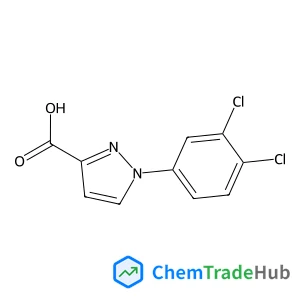
1-(3,4-Dichlorophenyl)-1H-pyrazole-3-carboxylic acid
CAS Number:
1152949-12-6
Molecular Formula:
C10H6Cl2N2O2
Recommended Suppliers





Disclaimer
This page provides academic journal information for reference and research purposes only. We are not affiliated with any journal publishers and do not handle publication submissions. For publication-related inquiries, please contact the respective journal publishers directly.
If you notice any inaccuracies in the information displayed, please contact us at support@chemtradehub.com. We will promptly review and address your concerns.