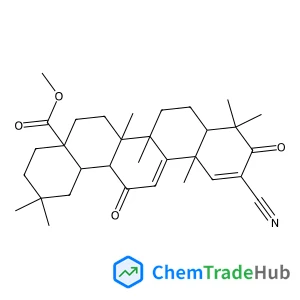
Methyl 2-cyano-3,12-dioxooleana-1,9(11)-dien-28-oate
CAS Number:
218600-53-4
Molecular Formula:
C32H43NO4
Caroline W. Karanja, Kofi S. Yeboah, Wilson W. S. Ong
Cyclic dinucleoties, such as cGAMP, c-di-GMP and c-di-AMP, are fascinating second messengers with diverse roles in both prokaryotes and eukaryotes. Consequently there is a need for simple and inexpensive methods for profiling these compounds in biological media, monitoring their synthesis or degradation by enzymes and for identifying inhibitors of proteins that metabolize or bind to these dinucleotides. Since 2011, when we reported the first simple method to detect c-di-GMP (S. Nakayama, I. Kelsey, J. Wang, K. Roelofs, B. Stefane, Y. Luo, V. T. Lee and H. O. Sintim, J. Am. Chem. Soc., 2011, 133, 4856) or in 2014 when we revealed another surprisingly simple assay to detect c-di-AMP (J. Zhou, D. A. Sayre, Y. Zheng, H. Szmacinski and H. O. Sintim, Anal. Chem., 2014, 86, 2412), there have been efforts to develop assays to detect cyclic dinucleotides by others. However a unified and simple assay, which can be used for all cyclic dinucleotides is lacking. Here, we investigate STING binding by various fluorescein-labeled c-di-GMP, c-di-AMP and cGAMP, using fluorescent polarization (FP). Fluorescein-labeled c-di-GMP (F-c-di-GMP) was found to be the best binder of STING. This probe could be displaced by unlabeled cGAMP, c-di-AMP or c-di-GMP and hence it is a universal probe, which can be used to monitor all three dinucleotides. HPLC analysis was used to validate the new F-c-di-GMP-based FP assay.
Da-Hai Li, Hua Zheng, Zi-Yi Wang, Rong-Jun Zhang, Hao Zhang, Yu-Xiang Zheng, Song-You Wang, David Wei Zhang, Liang-Yao Chen
DOI: 10.1039/C7CP00660H
Christopher Penschke, Joachim Paier
DOI: 10.1039/C7CP01785E
Jing Wan, Likui Yang, Ning Wei, Jiao Shi, Qing-Hua Qin
DOI: 10.1039/C7CP01274H
Manuel J. Schuler, Thomas S. Hofer, Christian W. Huck
DOI: 10.1039/C7CP01662J
Cristina Ortega-Moo, Rocio Durán, Bárbara Herrera, Soledad Gutiérrez-Oliva, Rubicelia Vargas
DOI: 10.1039/C7CP01304C
Hyun Joon Chang, Myeongsang Lee, Jae In Kim, Sungsoo Na
DOI: 10.1039/C7CP01418J
S. Vangaveti, R. J. D'Esposito, J. L. Lippens, S. V. Ranganathan
DOI: 10.1039/C7CP00717E
Ryo Furuta, Naoyuki Kurake, Kenji Ishikawa, Keigo Takeda, Hiroshi Hashizume, Hiroki Kondo, Takayuki Ohta, Masafumi Ito, Makoto Sekine, Masaru Hori
DOI: 10.1039/C7CP00489C
Malgorzata Bayda, Gonzalo Angulo, Jerzy Karolczak, Jacek Koput, Jacek Dobkowski, Bronislaw Marciniak
DOI: 10.1039/C7CP00590C
DOI: 10.1039/C7CP01750B
Waste containing N-Methoxy-N-methyl-1,3-thiazole-5-carboxamide (CAS: 898825-89-3...
N-(4-Biphenylyl)dibenzo[b,d]furan-4-amine should be stored in a tightly sealed c...
The market for 3-Acetamido-5-amino-2,4,6-triiodobenzoic acid (CAS: 1713-07-1) is...
Benzyl 2-O-acetyl-3,4,6-tri-O-benzyl-beta-D-galactopyranoside (CAS: 61820-03-9) ...
2-Ethylpiperazine dihydrochloride (CAS: 438050-52-3) is regulated under the Glob...
1,1'-[1,3-Phenylenebis(methylene)]bis(3-methyl-1H-pyrrole-2,5-dione) (CAS: 11946...
Several alternatives can be used in the synthesis of 5-Fluoro-2-(1-pyrrolidinyl)...
Proper personal protective equipment (PPE) must be worn when handling this compo...
When handling 6-Bromoimidazo[1,2-a]pyridin-8-amine, it is important to wear appr...
Alternatives to (2S,4R)-4-(4-Nitrobenzyl)pyrrolidine-2-carboxylic acid hydrochlo...
![4-{2-[4-(2-Methyl-2-propanyl)phenyl]ethoxy}quinazoline structure](https://static.chemtradehub.com/structs/120/120928-09-8-d3db.webp "4-{2-[4-(2-Methyl-2-propanyl)phenyl]ethoxy}quinazoline structure")